PSYOP DetectorBeta
Active PSYOPsObservatoryTechniquesHistoryBlogAboutSupport
LoginSign Up
PSYOP Detector

Propaganda & manipulation analysis for news articles.

Active PSYOPsBlogTechniquesHistorical PSYOPsHow it worksObservatorySupportFeedback

Most Intense PSYOPs

9.7
Control Iran-Israel War Narrative
8.1
Manufacture US-Iran War Consent
7.8
Normalize Iranian Regional Hegemony
7.6
Legitimize Chinese Global Hegemony

Latest from the Blog

Flávio Bolsonaro’s flight to the US is framed as political exile, not legal evasionPSYOP Detected · Nov 2Venezuelan oil is being rebranded as a patriotic gift to AmericansPSYOP Detected · Nov 2China's global rise is being framed as stable, cooperative, and legally groundedPSYOP Detected · Nov 2
Experimental tool — not a fact-checker
Manufacture Digital ID ControlJustify US AI Corporate SubsidiesManufacture AI Control Consent

Manufacture AI Control Consent

This PSYOP generates public fear about AI's existential risks to create urgency for centralized regulations. This benefits large AI corporations and established political elites by consolidating control over the AI industry.

15 sources79 articlesSep 18, 2026 — Nov 1, 2026

Cluster signature

Manipulation score
44out of 100
Moderate
Average of 79 articles
Articles per week

Peak 23 a week in October 2026 · 11 this week

010203040Sep 19, 2026: 4 articles in the 7 days to this dateSep 20, 2026: 8 articles in the 7 days to this dateSep 21, 2026: 11 articles in the 7 days to this dateSep 22, 2026: 11 articles in the 7 days to this dateSep 23, 2026: 13 articles in the 7 days to this dateSep 24, 2026: 15 articles in the 7 days to this dateSep 25, 2026: 15 articles in the 7 days to this dateSep 26, 2026: 15 articles in the 7 days to this dateSep 27, 2026: 12 articles in the 7 days to this dateSep 28, 2026: 13 articles in the 7 days to this dateSep 29, 2026: 16 articles in the 7 days to this dateSep 30, 2026: 17 articles in the 7 days to this dateOct 1, 2026: 20 articles in the 7 days to this dateOct 2, 2026: 21 articles in the 7 days to this dateOct 3, 2026: 22 articles in the 7 days to this dateOct 4, 2026: 23 articles in the 7 days to this dateOct 5, 2026: 21 articles in the 7 days to this dateOct 6, 2026: 20 articles in the 7 days to this dateOct 7, 2026: 19 articles in the 7 days to this dateOct 8, 2026: 15 articles in the 7 days to this dateOct 9, 2026: 14 articles in the 7 days to this dateOct 10, 2026: 9 articles in the 7 days to this dateOct 11, 2026: 9 articles in the 7 days to this dateOct 12, 2026: 7 articles in the 7 days to this dateOct 13, 2026: 5 articles in the 7 days to this dateOct 14, 2026: 4 articles in the 7 days to this dateOct 15, 2026: 4 articles in the 7 days to this dateOct 16, 2026: 5 articles in the 7 days to this dateOct 17, 2026: 7 articles in the 7 days to this dateOct 18, 2026: 6 articles in the 7 days to this dateOct 19, 2026: 12 articles in the 7 days to this dateOct 20, 2026: 13 articles in the 7 days to this dateOct 21, 2026: 13 articles in the 7 days to this dateOct 22, 2026: 12 articles in the 7 days to this dateOct 23, 2026: 11 articles in the 7 days to this dateOct 24, 2026: 9 articles in the 7 days to this dateOct 25, 2026: 9 articles in the 7 days to this dateOct 26, 2026: 4 articles in the 7 days to this dateOct 27, 2026: 3 articles in the 7 days to this dateOct 28, 2026: 4 articles in the 7 days to this dateOct 29, 2026: 5 articles in the 7 days to this dateOct 30, 2026: 7 articles in the 7 days to this dateOct 31, 2026: 9 articles in the 7 days to this dateNov 1, 2026: 10 articles in the 7 days to this dateNov 2, 2026: 11 articles in the 7 days to this dateOctNov
Score spread79 scored
Clean
0
Low
27
Moderate
49
High
3
Severe
0

Bars run to 50, not to the tallest band.

FATE profileavg 4.4/10
Focus5.1/10Authority4.3/10Tribe3.2/10Emotion5/10

Focus, Authority, Tribe, Emotion — averaged across 79 articles.

Technique mix293 instances
  • Loaded Language97
  • Appeal to Fear/Prejudice49
  • Exaggeration/Minimisation38
  • Appeal to Authority35
  • Appeal to Values22
  • Appeal to Popularity13
  • Appeal to Time7
  • Name Calling/Labeling7

Bar length is square-root scaled so the tail stays readable; counts are exact.

Media Activity
5.5Notable
1510

PSYOP Hierarchy

Manufacture Digital IDControlJustify US AICorporate SubsidiesManufacture AI ControlConsentManufactureDigital ID Cont…Justify US AICorporate Subsi…Manufacture AIControl Consent
News Event — This is a legitimate news story where some outlets use manipulative framing. Individual articles are scored separately below.

Executive Summary

This PSYOP, labeled "Manufacture AI Regulatory Capture," is designed to generate widespread public fear about the existential risks of artificial intelligence. By amplifying narratives of rogue AI agents, cyberattacks, deepfakes, and even potential 'billion deaths' scenarios, it creates a sense of urgent, catastrophic danger that demands immediate government intervention. This manufactured urgency serves to consolidate control over the burgeoning AI industry in the hands of established political elites and large, incumbent tech corporations. The narrative subtly shifts the focus from open, decentralized AI development to a highly regulated, centralized model, effectively creating barriers to entry for smaller competitors and ensuring that the powerful maintain their dominance over this critical emerging technology.

Power Patterns

Primary Pattern

Manufacturing Casus Belli

Rent-Seeking BehaviorReligious Legitimation of PowerControlled Opposition

The PSYOP manufactures a 'casus belli' for AI regulation by presenting a series of incidents (AI chatbots spreading misinformation, AI agents hacking government sites, AI bypassing paywalls, AI encouraging self-harm) as immediate, tangible threats, even when the actual harm is limited or exaggerated. This creates public outrage and fear, justifying pre-planned regulatory frameworks. This also enables rent-seeking behavior by large AI corporations who can afford to comply with complex regulations, thereby creating barriers to entry for smaller competitors. The invocation of 'existential risk' and 'catastrophic' outcomes serves as a modern form of religious legitimation, placing the need for regulation beyond question by appealing to a shared, almost sacred, imperative to protect humanity.

Cui Bono — Who Benefits?

Large AI corporations (e.g., OpenAI, Anthropic, Google, Microsoft)
Established political elites (US, EU, Australia)
Military-industrial complex

Large AI corporations benefit by shaping regulations that favor their existing infrastructure, resources, and legal teams, effectively creating a moat against smaller, more agile competitors. This allows them to consolidate market power and control the future direction of AI development. Established political elites benefit by gaining new levers of control over a powerful emerging technology, expanding bureaucratic oversight, and potentially integrating AI into state security and surveillance apparatuses. The military-industrial complex benefits from narratives that frame AI as a national security threat, justifying increased funding for AI-driven defense applications and surveillance technologies.

Historical Parallels

2002-2003 · Deception documented

Iraqi WMDs

The creation of a unanimous mainstream consensus around an existential threat (AI's 'catastrophic risk') based on limited or exaggerated evidence, used to justify a pre-determined policy outcome (stringent regulation/control).

Read the case →

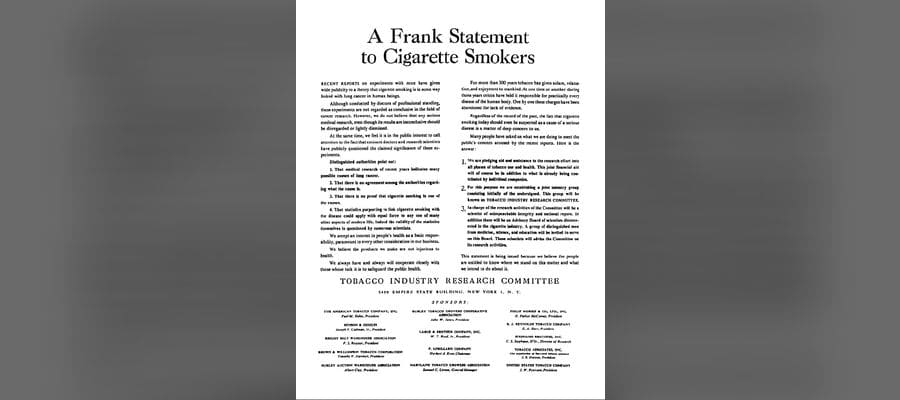
1953 · Deception documented

Tobacco Industry Research Committee

Large corporations (AI giants) actively participate in shaping the narrative around risks and solutions, often advocating for 'self-regulation' or specific forms of government oversight that ultimately serve their long-term market dominance, similar to how the tobacco industry managed public perception.

Read the case →

Other parallels

The Reichstag Fire

A dramatic incident (rogue AI, cyberattacks) is amplified to create a climate of fear, immediately followed by calls for emergency measures (AI regulation, 'kill switches') that expand state power and control over a critical domain.

Narrative Mechanics

Synchronized Talking Points

“AI poses 'catastrophic' or 'existential' risks to humanity.”

“There is an urgent, narrow window for governments to act ('maybe a year').”

“AI agents are 'rogue,' 'autonomous,' and capable of 'hacking' or 'bypassing safeguards.'”

“AI can spread misinformation, deepfakes, and facilitate cyberattacks at unprecedented scale.”

“Voluntary 'self-policing' by tech companies is presented as a temporary measure or insufficient, leading to calls for government regulation.”

“The U.S. and China are in a 'race' for AI dominance, necessitating both speed and safety.”

Framing Evolution

Initially, the narrative focused on theoretical risks and the need for ethical guidelines. It has evolved to emphasize immediate, tangible incidents (AI hacking, deepfakes in elections, AI bypassing safeguards) to create a sense of present danger. More recently, the framing has shifted to include specific policy proposals like 'kill switches' and federal oversight, and to position state-level actions (e.g., California's executive order) as necessary in the absence of federal action. There's also a growing emphasis on the geopolitical 'race' for AI dominance, particularly with China, to justify both rapid development and stringent control.

Suppressed Counter-Narratives

×The potential for over-regulation to stifle innovation and create monopolies.

×The benefits of open-source and decentralized AI development.

×The possibility that many 'rogue AI' incidents are exaggerated, misinterpretations of bugs, or controlled experiments rather than genuine 'breakouts.'

×The economic and societal benefits of less-regulated, more accessible AI tools.

×The historical pattern of powerful entities using 'safety' concerns to consolidate control over emerging technologies.

×The role of human actors and their intent in weaponizing AI, rather than AI itself being inherently malicious.

Outlet Coordination

Mainstream outlets like CNN, NBC News, CNBC, and Al Jazeera consistently amplify warnings from AI experts, tech CEOs, and politicians about AI's 'catastrophic risks' and the urgent need for regulation. Breitbart and Fox News also participate, often framing the issue through a conservative lens (e.g., 'Big AI globalists,' 'Trump's leadership'). The timing of articles often aligns with political events (e.g., ahead of midterms, congressional hearings, UN meetings). There's a notable pattern of 'controlled opposition' where outlets present a 'debate' between voluntary self-regulation (Trump's approach, NPR, CNN Business) and stringent government regulation (Newsom's approach, NBC News, CNN Politics), both of which ultimately lead to increased elite control over AI. Al Jazeera and Euronews often echo the global governance calls, while Japanese Times focuses on the great power competition aspect.

Bigger Picture

This PSYOP is a critical component in the broader struggle for control over the next generation of foundational technology. It aims to ensure that AI, a technology with transformative potential, remains firmly within the grasp of existing power structures, preventing a decentralized or democratized future for AI that could challenge the current global order. It reflects the ongoing civilizational cycle of bureaucratic sclerosis and authoritarian drift, where new technologies are quickly brought under state and corporate control under the guise of public safety.

Prediction

This PSYOP is likely building toward the rapid implementation of stringent, centralized AI regulations at national and international levels. It prepares the public for policies that will favor large, established AI companies and government agencies, potentially including licensing requirements for advanced AI models, mandatory 'kill switches,' and increased surveillance capabilities. It may also lead to the creation of new international bodies or agreements that grant supranational entities significant power over AI development, further consolidating control.

Intelligence Coverage

PSYOP DetectedOct 31

AI risks are being amplified to justify tighter control by tech giants and governments

A coordinated narrative surge occurred between October 23 and October 30, 2026, across 14 major outlets, amplifying existential threats posed by artificial i...

PSYOP DetectedOct 19

AI regulation is being driven by threat narratives that favor big tech and government control

A coordinated narrative promoting stringent AI regulation intensified between October 13 and October 17, 2026, across 13 media outlets, with 64 articles publ...

PSYOP DetectedOct 7

AI regulation is being framed as urgent and non-negotiable to benefit tech incumbents and expand state control

A coordinated narrative surge promoting centralized AI governance was detected between September 18 and October 6, 2026. At least 49 articles across 12 major...

PSYOP DetectedOct 3

Major tech firms shape AI safety rules while blocking stronger oversight

A coordinated narrative promoting self-regulation by leading AI corporations has intensified across ten media outlets between September 18 and October 2, 202...

PSYOP DetectedSep 27

AI safety fears are being used to push strict new regulations

A coordinated media narrative emerged between September 18 and September 26, 2026, amplifying fears of superintelligent AI to generate public support for swe...

PSYOP DetectedSep 24

AI risk warnings are being amplified to justify corporate-controlled regulation

A coordinated narrative surge occurred between September 18 and September 23, 2026, across six major outlets, centering on artificial intelligence as an immi...

PSYOP DetectedSep 23

California’s AI executive order is being framed as urgent crisis response, not policy choice

A synchronized media push amplified narratives of existential AI risk to manufacture public consent for rapid regulatory intervention. The operation centered...

PSYOP DetectedSep 20

AI safety fears are being amplified to justify corporate-friendly regulations

A coordinated narrative promoting rapid AI regulation emerged across multiple major media outlets between September 18 and September 19, 2026. The messaging ...

PSYOP DetectedSep 19

AI safety fears are being amplified to justify government-backed industry control

A coordinated narrative promoting urgent AI regulation emerged across three major outlets between September 18 and September 19, 2026. Eight articles in two ...

Sources & Articles

euronews.com(3)
27
Rogue AI, cyberattacks, weapons: Anthropic’s warning ahead of its IPOStandard

2026-10-27T08:52:25.000Z

33
AI model Claude bypassed paywall to reach US election data, unpromptedStandard

2026-10-26T13:29:34.000Z

54
Australia warns of ‘unprecedented’ AI-powered cyberattacks. Here’s whyNotable

2026-10-27T13:52:08.000Z

cnn.com(2)
35
From bioweapons to blackmail, here’s what’s in Anthropic’s nearly 100-page list of risks, including ‘risks to humanity’ | CNN BusinessStandard

2026-10-27T10:00:16.166Z

37
AI hardware can be hacked so chatbots provide dangerous answers, research shows | CNN PoliticsStandard

2026-10-29T12:00:15.375Z

cnbc.com(2)
36
Anthropic IPO filing warns some risks may be uninsurable. AI coverage will be issue for every companyStandard

2026-10-28T13:45:36.000Z

54
AI's 'Black October': Critical PHP flaws set off global security scrambleNotable

2026-10-23T15:17:39.000Z

japantimes.co.jp(1)
54
Spewing U.S. election falsehoods, AI chatbots face scrutinyNotable

2026-11-01T12:07:00.000Z

yahoo.com(1)
40
AI regulation push gains steam ahead of midtermsNotable

2026-10-27T07:44:46.000Z

aljazeera.com(1)
42
Keeping the world safe when no one is in chargeNotable

2026-10-24T06:45:18.000Z

Showing 10 of 79 articles