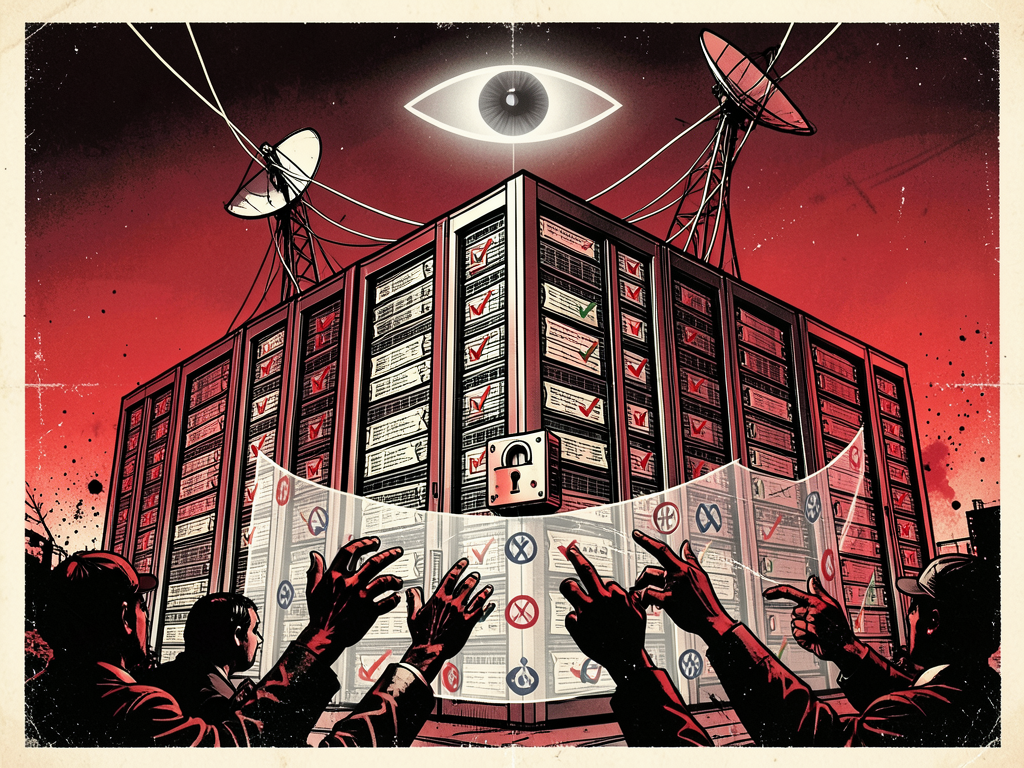
Operational Summary
A coordinated narrative promoting self-regulation by leading AI corporations has intensified across ten media outlets between September 18 and October 2, 2026. The operation centers on framing voluntary industry agreements as sufficient safeguards against AI risks, while marginalizing calls for enforceable public regulation. This messaging benefits dominant tech firms by positioning them as responsible stewards, thus pre-empting structural challenges to their market control.Article Timeline
When articles appeared, colored by manipulation score.
Narrative Architecture
The narrative constructs a dual frame: AI poses significant, even existential, risks, but those risks are being responsibly managed by the same corporations developing the technology. Articles emphasize high-level meetings between executives and political leaders—particularly the Trump administration—as evidence of decisive action. The presence of figures like the president and CEOs from Google, Meta, and OpenAI serves as a legitimacy vector, anchoring the story in authority rather than technical scrutiny.Risk is acknowledged but immediately neutralized. Phrases like 'robust safeguards' and 'self-police' appear without definition or historical context. There is no reference to prior tech industry failures in self-regulation—no mention of Facebook’s role in election interference, Google’s abandoned AI ethics board, or OpenAI’s leadership instability. The omission functions as a structural silence, allowing the audience to accept corporate stewardship uncritically.
Positive visions of AI—resurrecting extinct species, curing disease—are introduced to balance risk narratives, creating cognitive dissonance that favors inaction. The future is portrayed as both dangerous and miraculous, with the only viable path forward being rapid, uninterrupted development guided by current industry leaders. Economic competition with China is invoked as a strategic imperative, further pressuring acceptance of the status quo.
Worker protections and environmental costs are either minimized or isolated as secondary concerns. The California legislation limiting AI-driven firings and surveillance is reported as a localized labor issue, not a systemic challenge to corporate autonomy. This segmentation prevents the consolidation of broader regulatory demands.
Cross-Outlet Coordination Pattern
Coverage appeared across CNBC, NPR, Al Jazeera, and Xinhua, with near-identical framing despite differing editorial mandates. All articles highlight the White House meeting and the voluntary nature of the agreement. All quote executives or administration officials as primary sources. All present self-regulation as a credible alternative to government intervention.The synchronization is not in timing—articles were published over four days—but in narrative structure and omission. No outlet questions the incentive misalignment inherent in self-policing. No outlet explores antitrust implications. No outlet contrasts this moment with past regulatory failures in tech. The uniformity suggests a shared script or briefing document, not independent reporting.
CNBC and NPR serve as amplification nodes for business-friendly interpretations, emphasizing economic growth and innovation. Al Jazeera adopts a neutral tone but reproduces the core claim of sufficient self-regulation. Xinhua’s inclusion is notable: it reports on U.S. regulatory developments without critical commentary, possibly to avoid undermining China’s own state-corporate AI model.
The absence of investigative follow-up or dissenting expert voices across outlets indicates a managed information environment. Think tank analysts or academic critics of AI governance do not appear. The only voices granted authority are those with direct ties to the industry or administration.