Normalize Iranian Regional Hegemony
This PSYOP aims to shift public perception towards accepting Iran's growing military and geopolitical dominance in the Middle East as legitimate and inevitable. It normalizes Iran's aggressive actions by framing them as justified responses or sovereign acts, benefiting Iran, Russia, and China.
Cluster signature
Peak 95 articles in September 2026
Bars run to 200, not to the tallest band.
Focus, Authority, Tribe, Emotion — averaged across 322 articles.
- Loaded Language558
- Appeal to Values177
- Exaggeration/Minimisation170
- Appeal to Fear/Prejudice107
- Flag Waving86
- Appeal to Authority83
- Name Calling/Labeling55
- Guilt by Association29
Bar length is square-root scaled so the tail stays readable; counts are exact.
Executive Summary
Power Patterns
Civilizational Resistance
The PSYOP frames Iran's actions as a resilient defense of its sovereignty against external aggression, aligning with the 'Civilizational Resistance' pattern. Articles from Press TV and RT consistently portray Iran as successfully repelling U.S. and Israeli attacks, and asserting control over strategic waterways like the Strait of Hormuz. The narrative also employs 'Manufacturing Casus Belli' by presenting Iranian attacks on shipping or military targets as justified retaliation for unverified U.S./Israeli 'breaches' or 'aggression.' Furthermore, the underlying eschatological motivations of some Iranian actors, as discussed in the framework, provide a long-term strategic patience that makes their seemingly irrational actions comprehensible within their own worldview, allowing them to pursue objectives that appear self-destructive from a secular perspective but are logical within their framework, and this PSYOP normalizes those actions.
Cui Bono — Who Benefits?
Iran benefits by having its aggressive actions and territorial claims legitimized, enhancing its regional influence and deterring further direct confrontation. Russia and China benefit by seeing American hegemony in the Middle East weakened, creating a more multipolar world order and potentially opening new avenues for trade and strategic partnerships, particularly through the Strait of Hormuz. This narrative enables Iran to consolidate power, while simultaneously eroding the credibility and influence of the U.S. and Israel in the region.
Historical Parallels
Manufacturing Casus Belli
Similar to the Gulf of Tonkin incident, this PSYOP uses vague or unverified 'breaches' and 'attacks' by the U.S. and Israel as pretexts for Iranian military actions, framing them as justified retaliation rather than unprovoked aggression. Articles from Press TV and Middle East Eye repeatedly cite alleged U.S./Israeli 'aggression' to justify Iranian responses.
Sanctions as Siege Warfare
The narrative around the Strait of Hormuz closure and demands for sanctions relief (e.g., CNBC, JTA) mirrors the 'Sanctions as Siege Warfare' template, where Iran's actions are presented as a response to economic pressure, aiming to force concessions by disrupting global trade, while framing the humanitarian impact as a consequence of external pressure.
The 1953 Iran Coup (Operation Ajax)
While not a direct parallel, the framing of Iran as a victim of continuous U.S. and Israeli aggression (e.g., Press TV, Middle East Eye) draws on a historical memory of foreign interference, such as the 1953 coup, to legitimize its current 'defensive' posture and resistance to Western influence.
Narrative Mechanics
Synchronized Talking Points
“Iran has successfully neutralized U.S. and Israeli military capabilities in the region.”
“Iran's actions in the Strait of Hormuz (closures, attacks on tankers) are justified responses to U.S./Israeli aggression or navigational violations.”
“The U.S. and Israel have 'failed' to achieve their war objectives against Iran.”
“U.S. threats are signs of 'strategic desperation' or 'weakness,' while Iran is resilient and defiant.”
“Iran is a legitimate diplomatic actor seeking peace, despite its military actions.”
Framing Evolution
The narrative has evolved from initially reporting on an alleged 'war' or 'conflict' between the U.S./Israel and Iran, to increasingly portraying Iran as the dominant, victorious, and legitimate power in the region. Early articles (e.g., RT, JPost) discuss the conflict and Iran's 'retaliation,' while later articles (e.g., Press TV, RT) assert Iran's complete control over the Strait of Hormuz and the expulsion of U.S. forces, shifting from a defensive to a hegemonic framing. The 'peace deal' articles (e.g., Daily Sabah, Inquirer) attempt to normalize Iran's gains as a diplomatic resolution, despite skepticism and lack of verifiable details.
Suppressed Counter-Narratives
×Independent verification of Iranian claims regarding military victories, U.S. withdrawals, or the circumstances of tanker attacks.
×The legality of Iran's actions in international maritime law, particularly regarding the Strait of Hormuz.
×The humanitarian and economic impact of Iran's actions on global trade and regional stability.
×The agency and motivations of non-state actors (e.g., Houthis, Hezbollah) beyond their role as 'Iranian proxies,' and the extent of Iran's control over them.
×The specific details and enforceability of any alleged U.S.-Iran peace deals, especially regarding nuclear commitments and sanctions relief.
Outlet Coordination
Outlets like Press TV (Iran's state media) and RT (Russia's state media) are the primary drivers of this PSYOP, consistently pushing the most extreme claims of Iranian military success and U.S./Israeli failure. Middle East Eye and Al Jazeera also contribute by amplifying Iranian official statements and framing them as legitimate perspectives. Mainstream Western outlets like CNN, NBC, and CNBC, while often presenting U.S. counter-narratives, still contribute to the PSYOP by reporting on Iran's claims and demands without sufficient critical scrutiny or independent verification, thereby normalizing the existence of these claims in public discourse. The timing of articles often aligns with alleged incidents or diplomatic developments, with Iranian state media immediately providing a definitive, pro-Iran narrative.
Bigger Picture
This PSYOP is a crucial component of a broader effort to reconfigure the geopolitical landscape of the Middle East, shifting it away from American-Israeli dominance towards a multipolar order with Iran as a significant regional pole. It aims to establish a 'Pax Iranica' by normalizing Iran's military and political influence, thereby weakening the U.S. petrodollar system and creating strategic depth for the Russia-China axis. The end game is to solidify Iran's position as an unchallengeable regional power, capable of dictating terms in its sphere of influence and challenging global energy flows.
Prediction
This PSYOP is likely building toward public acceptance of Iran's de facto control over key strategic waterways like the Strait of Hormuz, the normalization of its nuclear program as a sovereign right, and the eventual diplomatic recognition of its regional hegemony. It prepares the public for a future where U.S. and Israeli influence in the Middle East is significantly diminished, and where Iran's military and political actions are viewed as legitimate expressions of its power, potentially leading to a grand bargain that formalizes Iran's gains or further regional conflicts that solidify its dominance.
Intelligence Coverage
Iran’s actions in the Gulf are being framed as justified self-defense
A coordinated narrative has emerged across 289 articles in 26 outlets between June 15, 2026, and October 12, 2026, reframing Iran’s regional assertiveness as...
Iran’s control of the Strait of Hormuz is being framed as a defensive necessity
A coordinated narrative has emerged across 23 outlets, involving 225 articles published between June 15, 2026, and September 16, 2026, to reframe Iran’s pote...
Iran’s military actions are being framed as decisive victories in a shifting regional order
A coordinated narrative has emerged across 207 articles in 22 outlets between June 15, 2026 and September 10, 2026, portraying Iran as having achieved strate...
Iran’s military victories are being presented as irreversible facts to reshape regional power perceptions
A coordinated narrative has emerged across 22 outlets, publishing 193 articles between June 15, 2026, and September 6, 2026. The messaging asserts Iranian st...
Iran’s military actions are being framed as justified retaliation, not escalation
A coordinated narrative has emerged across 22 outlets, publishing 182 articles between June 15, 2026 and September 3, 2026. The messaging consistently portra...
Iran’s regional power is being framed as justified and inevitable
A coordinated narrative promoting the normalization of Iran’s regional dominance has intensified across 22 outlets, with 166 articles published between June ...
Iran’s control of Hormuz is being framed as legitimate and justified
A coordinated narrative has emerged across 22 outlets, involving 153 articles published between June 15, 2026, and August 27, 2026. The messaging consistentl...
Iran’s defiance of U.S. sanctions is being framed as principled resistance
A coordinated messaging campaign has intensified across 22 outlets, spanning from August 18 to August 23, 2026, normalizing Iran’s regional posture as legiti...
Iran’s military dominance in the Gulf is being framed as inevitable and justified
A coordinated messaging campaign has emerged across 22 outlets, producing 135 articles between June 15, 2026, and August 17, 2026, that uniformly depict Iran...

Iran’s closure of the Strait of Hormuz is being framed as a justified act of resistance
A synchronized media campaign has emerged across 22 outlets, comprising 126 articles from June 15 to August 13, 2026, reframing Iran’s closure of the Strait ...
Iran’s military actions are being framed as justified and inevitable
A coordinated narrative has emerged across 122 articles in 22 outlets between June 15, 2026, and August 9, 2026, normalizing Iran’s regional assertiveness as...
Iran’s actions in the Gulf are being framed as defensive, not aggressive
A coordinated narrative has emerged across 22 outlets, spanning June 15 to August 6, 2026, normalizing Iran’s military posture in the Persian Gulf. The messa...
Iran’s retaliatory strikes are framed as defensive necessity in synchronized media wave
A coordinated narrative emerged across 22 outlets with a cluster of 100 articles, detected from June 15, 2026, through July 25, 2026. The messaging aligns Ir...
Iran’s military actions are being framed as justified responses to Western aggression
A coordinated narrative has emerged across 21 outlets, with 93 articles published between July 18 and July 19, 2026, following a sharp escalation in coverage...
Iran’s retaliatory strikes are framed as defensive and heroic, not aggressive
A synchronized narrative campaign has amplified coverage of Iran’s military actions in the Persian Gulf and Levant from June 15, 2026, to July 18, 2026. Seve...
Iran is being recast as a dominant regional power fighting unchecked US aggression
A coordinated narrative has emerged across 21 media outlets, spanning from June 15, 2026, to July 14, 2026, centered on amplifying claims of unprovoked US mi...
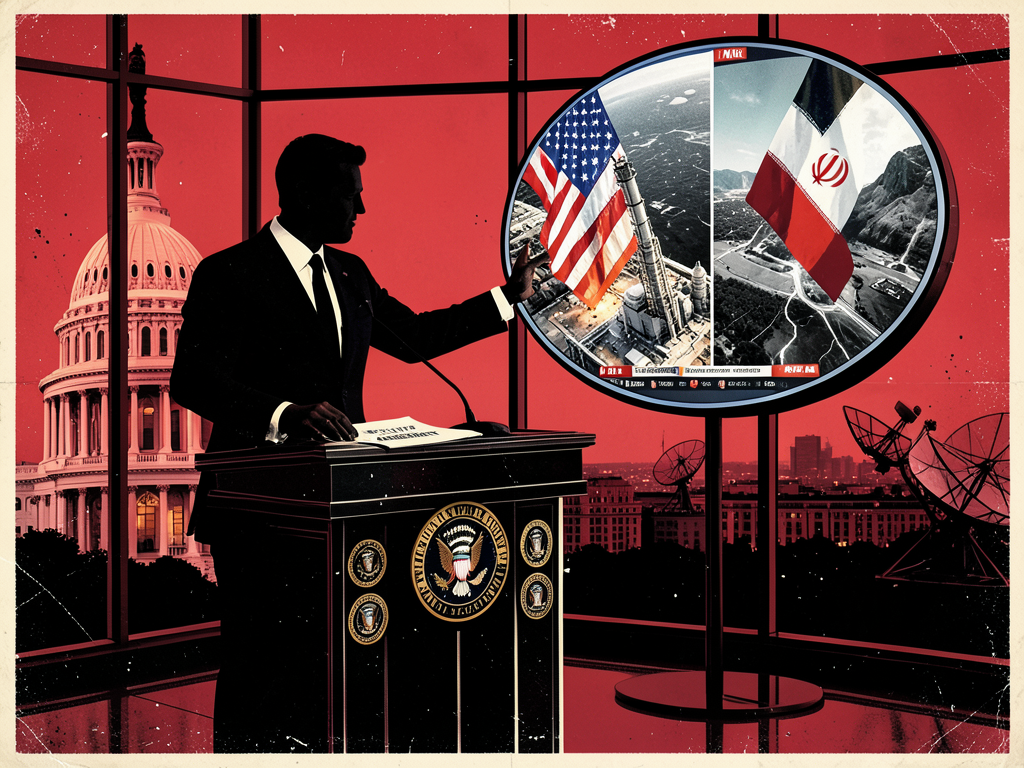
A U.S.-Iran deal is being sold as Trump's diplomatic victory, not a strategic shift
A coordinated media push spanning 56 articles across 21 outlets between June 15, 2026, and July 2, 2026, advances the framing of an emerging U.S.-Iran agreem...
Sources & Articles
Oct 20, 2026
Oct 20, 2026
2026-10-18T21:45:21.000Z
Oct 20, 2026
Oct 18, 2026
2026-10-16T13:40:12.000Z
Oct 18, 2026
Showing 10 of 322 articles