Front groups and PR campaigns · 1953 · US
Tobacco Industry Research Committee
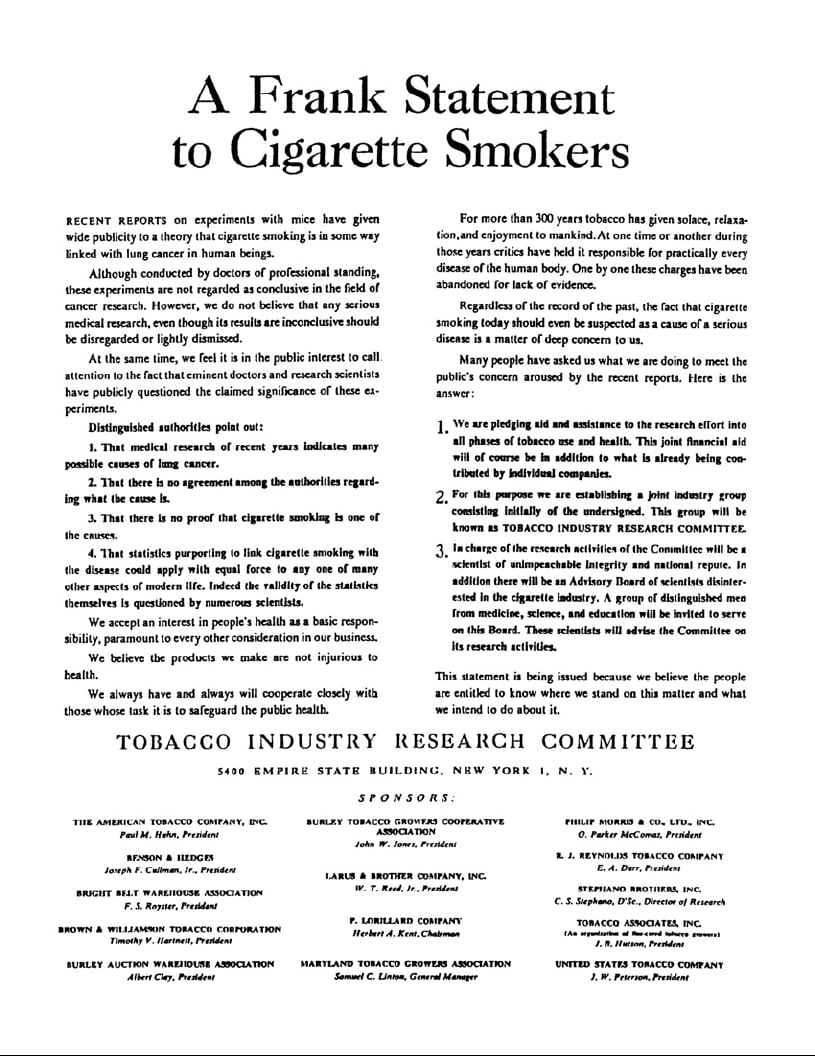
In December 1953 tobacco executives met in New York with the public-relations man John Hill after studies linked smoking to lung cancer. On 4 January 1954 a full-page ad, "A Frank Statement to Cigarette Smokers", ran in 448 newspapers and announced a research committee, the TIRC, while saying there was "no proof" smoking was a cause. In 2006 US District Judge Gladys Kessler found the companies liable for a decades-long scheme to deceive the public. A 1969 Brown & Williamson memo stated: "Doubt is our product".

- Run by
- Cigarette makers
- Six major companies met Hill & Knowlton on 15 December 1953
- Papers carrying the 1954 ad
- 448 newspapers
- Estimates of 43 million readers reached appear in secondary sources
- Before the industry conceded a causal link
- Decades
- Sales rose from 369 billion cigarettes in 1954 to 488 billion in 1961
- Time to exposure
- 17 Aug 2006
- Kessler's 1,683-page opinion, after the DOJ filed suit on 22 September 1999
Timeline
1950-53 · Context
Studies by Doll and Hill, and by Wynder and Graham, link smoking to lung cancer. "Cancer by the Carton" runs in Reader's Digest in December 1952.
15 Dec 1953 · It worked
Led by Paul Hahn of American Tobacco, six major companies meet John Hill of Hill & Knowlton in New York. The meeting leads to the 1954 statement.
4 Jan 1954 · It worked
"A Frank Statement to Cigarette Smokers" runs in 448 newspapers over the signatures of top executives. It says "there is no proof that cigarette smoking is one of the causes" of lung cancer, accepts "an interest in people's health as a basic responsibility, paramount to every other consideration in our business", and announces the Tobacco Industry Research Committee.
1969 · Exposed
A Brown & Williamson document, "Smoking and Health Proposal" (Bates 680561778), says "Doubt is our product since it is the best means of competing with the 'body of fact'". Its author is not confirmed.
1998 · Exposed
Under the Master Settlement Agreement, the Council for Tobacco Research and the Tobacco Institute are dissolved.
22 Sep 1999 · Exposed
The Justice Department sues the major cigarette makers, the Council for Tobacco Research (the later name of the TIRC) and the Tobacco Institute in the District of Columbia, under the racketeering law.
17 Aug 2006 · Exposed
Judge Kessler finds the companies liable for conspiracy and racketeering violations in a 1,683-page opinion (449 F. Supp. 2d 1), finding they marketed cigarettes "with deception" and concealed information.
The ad promised to put public health first in 1954; the industry did not accept a causal link until 1999, and a federal court found it had deceived the public in 2006.
“there is no proof that cigarette smoking is one of the causes”
The playbook
- 1
Front group
The industry created the TIRC, a research body with a neutral name, to carry its message on the science.
- 2
Borrowed authority
The ad promised to back independent research and said the companies would cooperate with those who safeguard the public's health, borrowing the standing of science and medicine.
- 3
Hidden messenger
The public-relations firm Hill & Knowlton helped design the statement, while the ad read as the companies' own candid word.
- 4
Suppress the correction
The 1969 memo and the 2006 opinion describe a long effort to contest and blur the evidence rather than answer it.
Through the FATE framework
- Focus6/10
It shifted the debate from "does smoking cause cancer" to "is the science settled".
- Authority8/10
A research committee and a pledge to put health first lent scientific cover to the industry's position.
- Tribe3/10
There was little appeal to identity; the audience was smokers as consumers.
- Emotion5/10
Reassurance eased smokers' fears; the memo shows doubt was treated as a product.
Propaganda techniques used
Same playbook today
The same playbook can be run by anyone, on any side. We list every current PSYOP that matches Tobacco Industry Research Committee, whoever is behind it.
Manufacture AI Control Consent
Large corporations (AI giants) actively participate in shaping the narrative around risks and solutions, often advocating for 'self-regulation' or specific forms of government oversight that ultimately serve their long-term market dominance, similar to how the tobacco industry managed public perception.
79 articlesIntensity 5