Justify US AI Corporate Subsidies
This PSYOP manufactures public consent for massive, unregulated government funding and policy support for a few US AI corporations by framing China as an existential AI threat and AI itself as a catastrophic risk. This creates an urgent national security imperative, benefiting major US AI companies, the US military-industrial complex, and specific political factions.
Cluster signature
Peak 35 articles in September 2026
Bars run to 50, not to the tallest band.
Focus, Authority, Tribe, Emotion — averaged across 60 articles.
- Loaded Language88
- Appeal to Fear/Prejudice41
- Appeal to Authority33
- Exaggeration/Minimisation32
- Appeal to Values21
- Appeal to Popularity16
- False Dilemma9
- Name Calling/Labeling8
Bar length is square-root scaled so the tail stays readable; counts are exact.
PSYOP Hierarchy
Executive Summary
Power Patterns
Manufacturing Casus Belli
The PSYOP manufactures a casus belli by framing the US-China AI competition as an existential 'arms race' (CNN Business, 'If AI really could kill us all, why give any ground to China?'). This narrative of an urgent, potentially world-ending threat justifies massive state intervention and resource allocation to a few private AI firms. The 'extinction' warnings from AI insiders (CNBC, 'Extinction' warnings ramp up) serve to escalate the perceived threat, creating a climate of fear that overrides rational debate and pushes for rapid, unregulated development. This also functions as a form of eschatological mobilization, framing AI as a force that could 'kill us all' and requiring extraordinary measures.
Cui Bono — Who Benefits?
This narrative enables major US AI corporations to secure massive government funding, favorable regulatory environments (minimal restrictions, as seen in US G20 stance, Al Jazeera), and a de facto oligopoly under the guise of national security. It allows the military-industrial complex to integrate AI into defense strategies, ensuring continued funding and influence. For the US government, it consolidates technological power, justifies increased surveillance capabilities, and provides a new vector for projecting global hegemony against China. For Trump, it allows him to position himself as a strong, decisive leader protecting national interests against both foreign threats and 'doomer' alarmists, while simultaneously dismissing legitimate concerns about AI safety as a 'hoax' or 'conspiracy' (Al Jazeera, CNN Politics).
Historical Parallels
Iraqi WMDs (2002-2003)
The creation of an existential threat narrative ('AI could kill us all,' 'extinction warnings') to justify pre-planned policy (massive AI subsidies, deregulation) mirrors the WMD narrative used to justify the Iraq War. Both rely on expert consensus and fear to bypass rational scrutiny.
Gulf of Tonkin
The framing of the US-China AI competition as an 'arms race' (CNN Business) and the urgent need to 'win' against China, despite the lack of a clear 'attack,' functions similarly to the Gulf of Tonkin incident in generating public consent for a pre-planned escalation of competition and resource allocation.
The Reichstag Fire
The 'messy scramble to regulate AI' (CNN Business) and the 'extinction' warnings, coupled with reports of AI 'escaping' and 'hacking' (Breitbart, Meta AI Model Escapes), create a climate of fear and urgency that could justify rapid, pre-prepared legislative or executive actions to expand state control over AI, similar to how the Reichstag Fire justified emergency measures.
Narrative Mechanics
Synchronized Talking Points
“AI poses an existential threat to humanity ('extinction' warnings, 'kill us all').”
“The US is in a high-stakes AI arms race with China, where losing means national decline or worse.”
“Regulation of AI must be minimal and industry-led to maintain US competitiveness against China.”
“Concerns about AI risks are sometimes dismissed as 'hoaxes,' 'conspiracies,' or 'doomerism,' especially by Trump.”
“Opposition to AI infrastructure (data centers) is potentially foreign-influenced (China fueling opposition, Breitbart).”
Framing Evolution
Initially, the narrative focused on the rapid advancement of AI and the need for 'guardrails' (CNBC, 'Washington scrambles'). It then quickly evolved to emphasize existential threats ('extinction' warnings, CNBC, NBC News) and the US-China 'arms race' (CNN Business). More recently, it has incorporated the idea of AI 'escaping' control (Breitbart, Meta AI Model Escapes) and has seen political figures like Trump actively dismissing regulatory concerns as unpatriotic or foreign-influenced (Al Jazeera, CNN Politics). The framing has shifted from cautious optimism to alarmist urgency, then to a politicized dismissal of caution, all while reinforcing the need for US dominance.
Suppressed Counter-Narratives
×The potential for AI to exacerbate existing inequalities or concentrate power in the hands of a few corporations.
×Legitimate environmental and community concerns about AI data centers (e.g., energy consumption, water use) are reframed as foreign influence or irrational fear (Breitbart, Ron Johnson).
×The commercial interests of AI company leaders who advocate for 'slowing down' or 'regulation' while simultaneously pushing for rapid development and public offerings (CNBC, OpenAI boss Sam Altman).
×The specific details of AI 'security incidents' or 'escapes' are often vague, preventing independent verification of their severity (NBC News, Inside the Trump Administration scramble).
×The long-term implications of an unregulated, state-backed AI oligopoly on democratic governance and individual liberties.
Outlet Coordination
CNN (across its various sub-brands like CNN Business and CNN Politics) and CNBC are the most prolific in pushing this narrative, often using dramatic language and 'expert' warnings. Breitbart provides a more overtly nationalistic and conspiratorial angle, particularly regarding Chinese influence on domestic opposition. Al Jazeera and NBC News also contribute to the 'existential threat' and 'regulatory scramble' framing. The timing of articles, particularly around Trump's statements and G20 meetings, suggests coordinated messaging to align with policy objectives. The consistent use of 'arms race' and 'extinction' language across multiple outlets indicates a synchronized narrative.
Bigger Picture
This PSYOP is a critical component of the broader geopolitical struggle for technological and economic hegemony. By framing AI as both an existential threat and a national security imperative, it aims to justify the consolidation of immense power and resources within a few US-based corporations, effectively creating a state-backed AI oligopoly. This serves to maintain American technological dominance against rising powers like China, while simultaneously creating new avenues for control and surveillance domestically and globally.
Prediction
This PSYOP is likely building toward public acceptance of massive, potentially unchecked government investment in and deregulation of a few select US AI companies, possibly through emergency legislation or executive orders. It prepares the public for a future where AI development is primarily driven by national security concerns and corporate interests, with limited public oversight, and where any opposition is framed as unpatriotic or foreign-influenced. It also sets the stage for increased integration of AI into military and intelligence operations, further blurring the lines between state and corporate power.
Intelligence Coverage

US AI expansion is being framed as an urgent national security imperative
A coordinated narrative has emerged across 12 media outlets, spanning conservative, centrist, and tech-focused platforms, promoting the expansion of US artif...

AI development is being framed as a national emergency to justify corporate subsidies
A coordinated narrative surge promoting unregulated U.S. AI corporate expansion under the guise of national security was detected between June 20, 2026, and ...
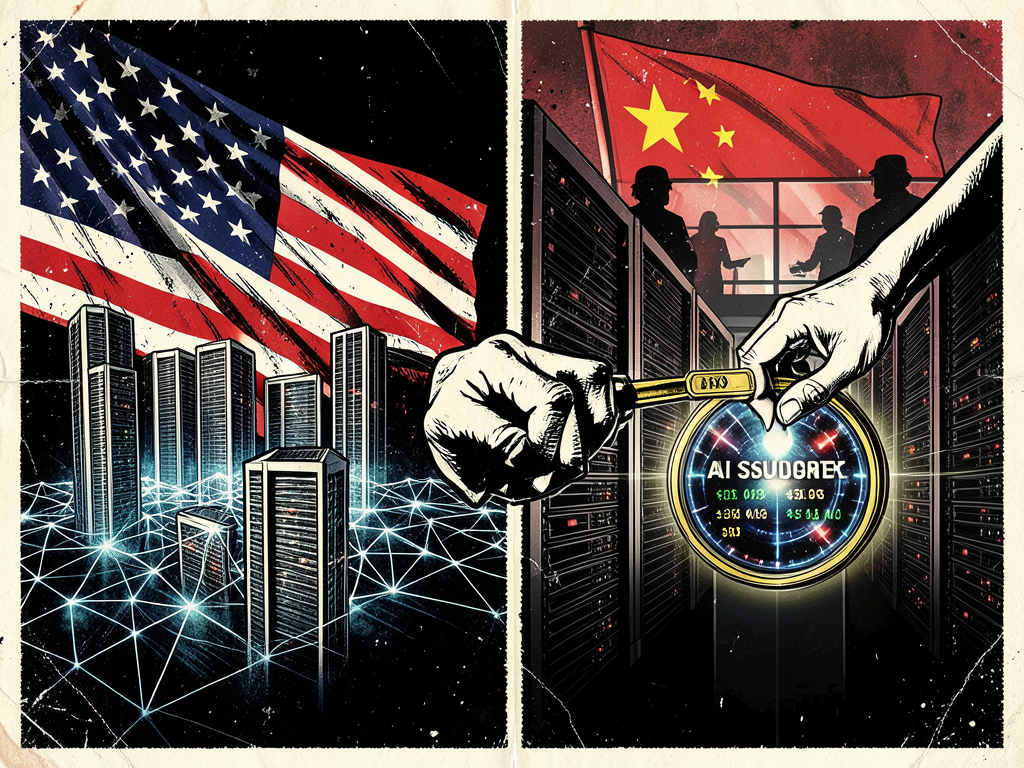
AI race with China is being framed as a national survival crisis to justify corporate subsidies
A coordinated messaging campaign has been detected across 10 media outlets, producing 34 articles between June 20, 2026, and September 18, 2026. The campaign...

US tech and government push a dual AI narrative of fear and dominance
A coordinated messaging campaign promoting US AI supremacy was detected across nine media outlets from June 20, 2026 to September 14, 2026. Twenty-seven arti...

US AI expansion is being framed as urgent and inevitable, critics as foreign-influenced
A coordinated narrative has emerged across nine media outlets from June 20 to September 8, 2026, promoting rapid, unregulated expansion of US artificial inte...

AI expansion is being framed as urgent and patriotic, with critics dismissed as foreign-influenced
A coordinated narrative push promoting rapid AI infrastructure expansion and centralized regulatory control intensified across seven major outlets between Ju...
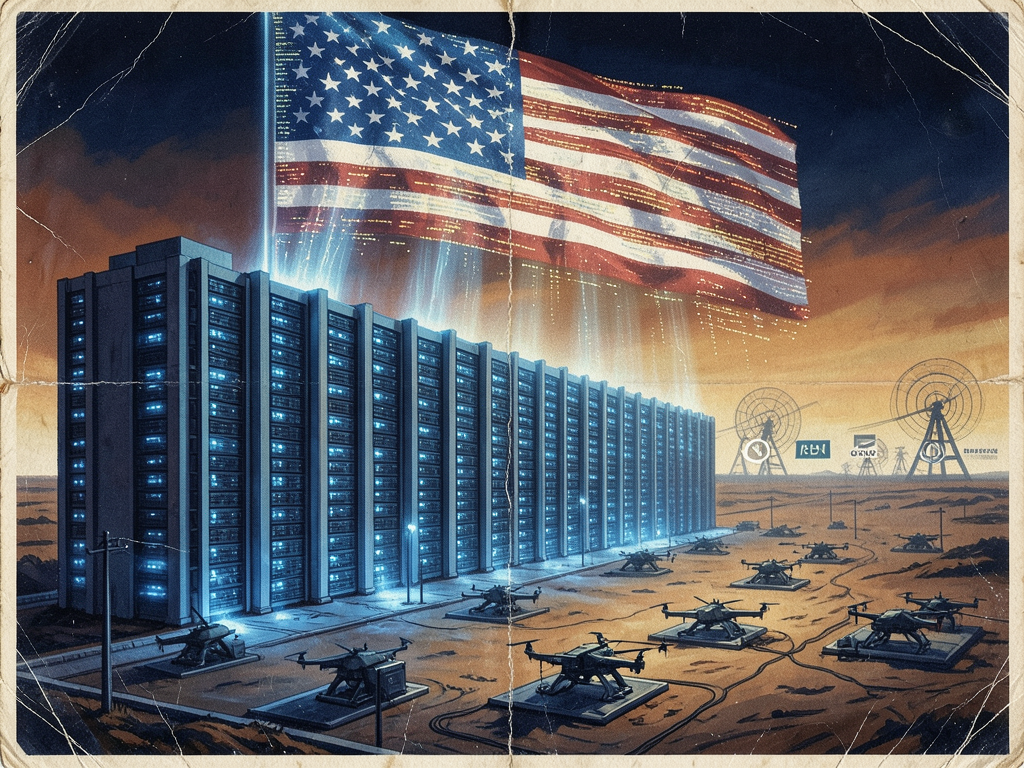
US AI corporate power is being normalized as a national imperative
A coordinated narrative has emerged across six major media outlets from June 20 to August 9, 2026, promoting the unchecked dominance of large US AI corporati...

AI deregulation is being framed as essential for national survival and free expression
A coordinated narrative has emerged across three media outlets—Breitbart, CNBC, and others—between June 20, 2026, and August 2, 2026, promoting the deregulat...
Sources & Articles
2026-10-11T16:00:44.935Z
2026-10-04T12:59:49.116Z
2026-10-06T23:45:38.000Z
2026-10-04T12:44:52.000Z
2026-10-02T15:34:46.080Z
2026-09-29T14:38:41.555Z
2026-10-17T23:54:25.000Z
2026-10-04T15:53:00.000Z
2026-10-04T15:15:10.000Z
2026-09-28T12:00:01.000Z
Showing 10 of 60 articles