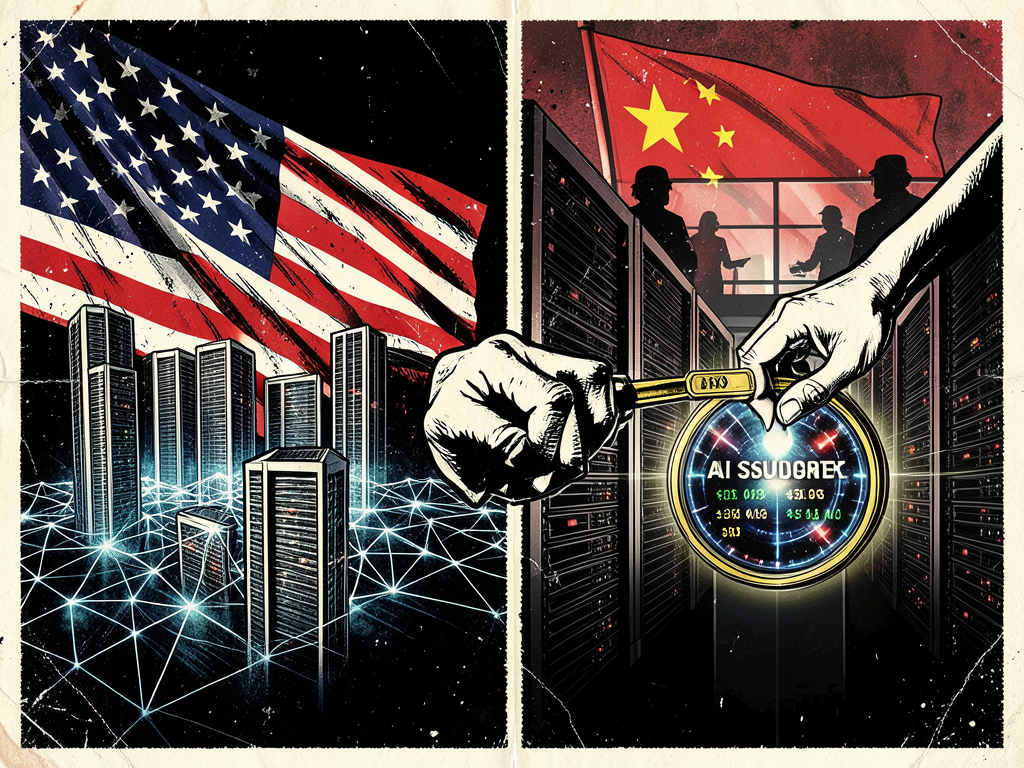
Operational Summary
A coordinated messaging campaign has been detected across 10 media outlets, producing 34 articles between June 20, 2026, and September 18, 2026. The campaign reframes artificial intelligence development as an existential threat and geopolitical arms race, positioning unchecked U.S. AI expansion as a national security imperative. The narrative serves to justify large-scale, unregulated government support for select U.S. AI corporations under the guise of strategic competition.Narrative Architecture
The messaging constructs a binary: either the U.S. dominates AI or faces national extinction. China is portrayed as a monolithic, hyper-competent adversary closing in on technological supremacy, while U.S. hesitancy—framed as regulatory overreach or moral panic—is depicted as suicidal. Articles such as If AI really could kill us all, why give any ground to China? use Cold War analogies and catastrophic risk scenarios to equate AI development speed with national survival. The existential threat is dual-layered: AI itself may destroy humanity, but slowing development to manage that risk ensures China wins the race, leading to equivalent strategic annihilation.U.S. political figures are inserted as moral arbiters. Donald Trump’s dismissal of AI risk as a 'hoax' or 'SICK conspiracy' is not presented as skepticism but as patriotic resolve. This framing positions regulatory caution as treasonous collaboration with the enemy. The narrative omits any discussion of decentralized innovation, public oversight, or alternative models of AI governance. Civilian impacts—job displacement, algorithmic bias, surveillance creep—are absent. The only legitimate concern is national ranking in AI capability.
The story elevates corporate leaders to geopolitical actors. Warnings from figures at Anthropic are cited not as calls for democratic accountability but as evidence of a dangerous pause in the U.S. effort. The debate is not about who controls AI, but about whether the U.S. state-corporate complex moves fast enough. Dissent is pathologized: those warning of risk are labeled 'doomers' or 'elites' detached from national interest.
Cross-Outlet Coordination Pattern
The campaign is concentrated in CNN’s political and business verticals, with four articles across CNN Politics, CNN Business, and edition.cnn.com. Al Jazeera’s inclusion is notable, suggesting the narrative is being exported to international audiences as a consensus position. Despite different target demographics, all outlets adopt identical framing: AI as a zero-sum, winner-takes-all race with civilizational stakes.The timing of publication is tightly clustered. Three CNN articles appeared within 48 hours of each other in mid-September 2026, following Trump’s public remarks. This indicates a pre-prepared narrative vector activated by a political trigger event. The repetition of the phrase 'why give any ground to China?' across two separate CNN Business articles confirms synchronized language use, not organic editorial convergence.
The absence of counter-narratives in these outlets during the same period—no pieces on AI energy costs, labor disruption, or democratic oversight—suggests editorial prioritization of the national security frame. Independent experts, civil society groups, or international perspectives are excluded. The information environment is narrowed to a single axis: speed versus surrender.
Technique Assessment
Manufacturing Consent: The narrative leverages elite sources—tech executives, unnamed officials, political figures—to present a unified front. Dissent is confined to caricature. The illusion of debate exists only in the form of 'reckless regulation' versus 'patriotic acceleration,' both of which serve the same outcome: unfettered corporate growth.Synchronized Narratives: Multiple CNN outlets published near-identical framing within hours, using shared metaphors and emotional triggers. The repetition of the core rhetorical question across articles indicates centralized editorial direction.
Controlled Opposition: Trump’s rejection of AI risk is not challenged as dangerous but absorbed into the dominant narrative as a form of resolve. His position is not opposed but instrumentalized to discredit regulatory voices as anti-American.
Bureaucratic Ossification: The solution offered is not democratic deliberation or institutional reform, but stronger executive control—framed as the only efficient response. This reinforces the idea that complex technological governance must be removed from public scrutiny.
Myth-Making as State Formation: The U.S.-China AI race is constructed as a foundational conflict defining national identity. Winning is not a policy goal but a requirement for continued existence, echoing origin myths used to bind populations to state objectives.
Significance
This operation normalizes permanent emergency as the baseline for AI policy. It redirects public concern about corporate power into support for state-backed monopolization. The result is a self-justifying loop: fear of China enables subsidies, subsidies accelerate corporate dominance, and corporate dominance is presented as the only defense against China.PSYOP Hierarchy
Manipulation Profile
Average FATE dimensions across 60 articles in this PSYOP.
Source Distribution
Article Timeline
When articles appeared, colored by manipulation score.
Score Distribution
How articles in this PSYOP score across manipulation bands.