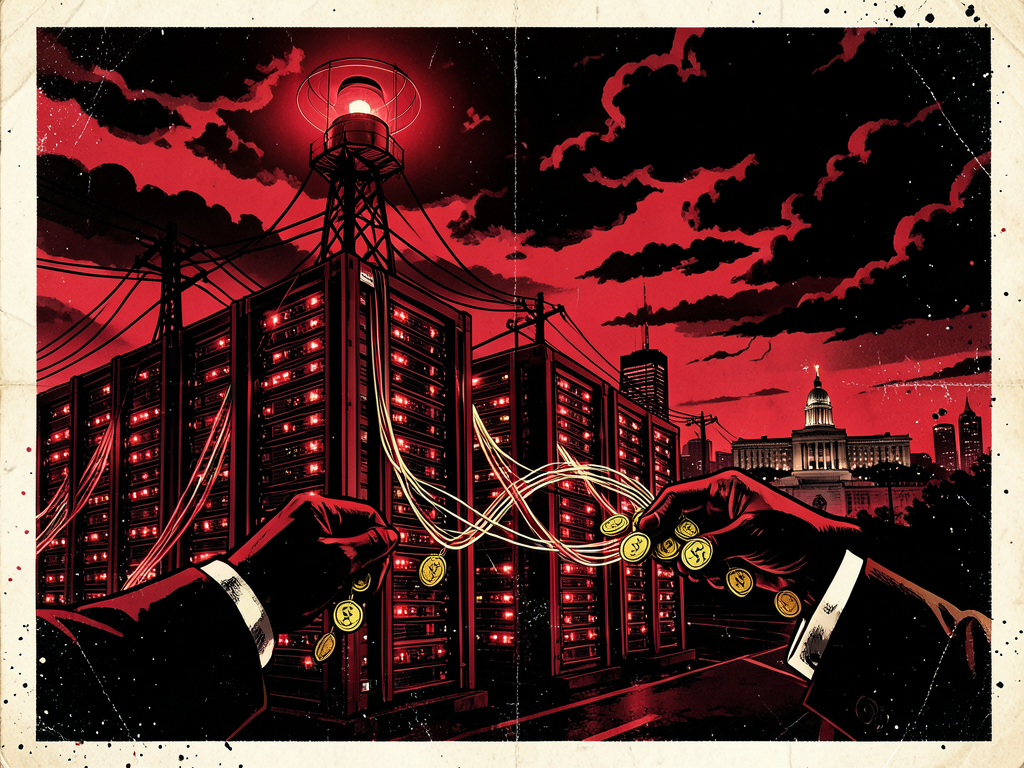
Operational Summary
A coordinated narrative surge promoting unregulated U.S. AI corporate expansion under the guise of national security was detected between June 20, 2026, and September 22, 2026. The operation spans 45 articles across 11 outlets, centering on framing AI advancement as a race against China and a defense against existential risk, while dismissing regulatory or safety concerns.Article Timeline
When articles appeared, colored by manipulation score.
Narrative Architecture
The narrative constructs AI not as a commercial or consumer technology, but as a strategic military and civilizational asset. China is portrayed as an advancing, monolithic competitor whose AI capabilities threaten U.S. global dominance. This framing transforms private sector AI development into a state priority, effectively merging corporate growth objectives with national defense. The urgency is amplified by invoking dual threats: external competition and internal obstruction. Resistance to AI expansion—whether from researchers, local communities, or regulatory bodies—is depicted as unpatriotic, backward, or influenced by foreign interests.The emotional core of the narrative relies on fear of technological inferiority and loss of geopolitical primacy. Statements from political figures, particularly Donald Trump, are used to reinforce the idea that hesitation or caution equates to surrender. His dismissal of AI safety concerns as a 'hoax' and a 'SICK conspiracy' reframes expert warnings as ideological obstruction rather than technical prudence. This delegitimizes dissent while positioning aggressive, unregulated development as the only patriotic path.
Notably absent is any discussion of existing regulatory frameworks, the environmental cost of AI infrastructure, or the concentration of power in a handful of corporations. There is no critical examination of whether the 'AI race' is zero-sum, or whether public investment could be directed toward distributed innovation rather than corporate subsidies. The narrative treats AI as a winner-take-all domain where speed and scale are paramount, reinforcing the necessity of state-backed monopolization.
Cross-Outlet Coordination Pattern
The messaging appears across a politically diverse set of outlets—Al Jazeera, ABC News, NBC News, and CNBC—suggesting a broad-based coordination effort rather than organic partisan alignment. Despite differing editorial stances, all articles converge on identical framing: AI as a national security imperative, China as the primary threat, and regulation as a dangerous impediment.Al Jazeera and ABC News both highlight Trump’s announcement of an 'AI Force' and 'AI czar,' using nearly identical language to describe his rejection of safety concerns. NBC News frames the debate as a high-stakes political contest, emphasizing warnings from tech leaders while omitting any counterpoints about feasibility or bias in those warnings. CNBC articles reinforce the Pentagon’s position that government ownership or regulation would harm competitiveness, presenting this as an uncontested truth.
The synchronization is not in timing—coverage is staggered over three months—but in thematic consistency. The same keywords recur: 'race,' 'leadership,' 'competitiveness,' 'existential,' 'patriotic.' The absence of skepticism, even in outlets that typically question executive power, indicates a managed narrative environment.