Justify French State Repression
This PSYOP manufactures consent for the French government's authoritarian responses to protests by framing dissent as extremist, thereby justifying disproportionate police actions and restrictions on assembly. It primarily benefits Emmanuel Macron's government and the French security apparatus.
10 sources25 articlesFeb 21, 2026 — Oct 28, 2026
Cluster signature
Manipulation score
45out of 100
Moderate
Average of 25 articles
Articles per month25 total
Peak 23 articles in October 2026
Score spread25 scored
Clean
0
Low
6
Moderate
18
High
1
Severe
0
Bars run to 20, not to the tallest band.
FATE profileavg 4/10
Focus, Authority, Tribe, Emotion — averaged across 25 articles.
Technique mix119 instances
- Loaded Language59
- Appeal to Fear/Prejudice11
- Name Calling/Labeling11
- Exaggeration/Minimisation9
- Appeal to Authority6
- Appeal to Values6
- Guilt by Association4
- Doubt3
Bar length is square-root scaled so the tail stays readable; counts are exact.
Media Activity
Intensity History
News Event — This is a legitimate news story where some outlets use manipulative framing. Individual articles are scored separately below.
Executive Summary
This PSYOP, labeled "Normalize French State Violence," aims to manufacture consent for the French government's increasingly authoritarian responses to public protests. It achieves this by consistently framing dissent as extremist, primarily driven by 'ultra-left' or 'seditious' elements, thereby justifying disproportionate police actions, restrictions on assembly, and even the deployment of military forces. The operation serves the interests of Emmanuel Macron's government and the French security apparatus, allowing them to suppress legitimate public grievances related to the cost of living and education without appearing tyrannical. By isolating the violence to a radical fringe, the PSYOP deflects blame from systemic issues and reinforces the state's narrative of maintaining order against illegitimate threats, thus preserving the ruling class's legitimacy amidst a deepening civilizational crisis.
Power Patterns
Primary Pattern
The Consent-Deception-Coercion Cycle
Scapegoating and DisplacementBureaucratic OssificationElite OverproductionGerontocracy
The PSYOP illustrates the shift from deception to coercion in the Consent-Deception-Coercion Cycle. Initially, the government attempts to manage consent through narratives of 'mostly peaceful protests' marred by a 'minority' of violent actors (CNN, CBS News). As unrest escalates, this shifts to open coercion, with bans on protests, massive police deployments, and threats of a state of emergency (Al Jazeera, NBC News, France24). Scapegoating and Displacement are evident in Macron's consistent blaming of 'ultra-left agitators' and 'seditious' elements (CNBC, Al Jazeera, NBC News), redirecting anger from systemic failures to a convenient target group. This is exacerbated by Elite Overproduction and Gerontocracy, where an aging, ossified elite struggles to respond effectively to new challenges, leading to a reliance on force rather than reform.
Cui Bono — Who Benefits?
Emmanuel Macron's Government
French Security Apparatus
The broader French ruling class
This narrative enables the French government to suppress widespread public dissent without losing legitimacy. By framing protesters as extremists or 'seditious,' it justifies the use of overwhelming force, curfews, and bans on assembly, thereby maintaining social control and preventing the collapse of the current political order. It also deflects criticism from Macron's policies and the underlying socioeconomic issues, preserving the power of the ruling class.
Historical Parallels
The Reichstag Fire
The rapid deployment of emergency measures, bans on protests, and the framing of dissent as a threat to the 'Republic' (NBC News, France24) mirrors the Reichstag Fire, where a dramatic incident was used to justify a permanent expansion of state power and suppression of political opposition.
The Color Revolution Template (2000s-present)
While the French protests are domestic, the government's narrative of 'seditious' elements and the rapid deployment of security forces against a 'popular uprising' (Al Jazeera, CNN) echoes the demonization of target governments during Color Revolutions, where popular movements are delegitimized to justify state suppression.
Narrative Mechanics
Synchronized Talking Points
“Protests are 'mostly peaceful' but marred by 'violent clashes' (CBS News, CNN, Euronews).”
“Violence is caused by 'ultra-left' or 'far-left' extremists/agitators/seditious elements (CBS News, Euronews, Al Jazeera, CNBC, NBC News).”
“Massive police and military deployments are 'necessary' to maintain order and prevent chaos (Al Jazeera, ABC News, CNN, France24).”
“The government is responding decisively and will 'hold accountable' those who 'sought to bring down the Republic' (CNN, NBC News).”
Framing Evolution
The narrative evolves from initially acknowledging 'mostly peaceful' protests with legitimate grievances (CBS News, CNN) to increasingly emphasizing the violence of a 'radical fringe' (Euronews, CNBC) and justifying escalating state repression. As the protests continue, the government's rhetoric shifts to blaming 'seditious' elements and foreign interference (Al Jazeera, CNBC), culminating in threats of states of emergency and bans on demonstrations (France24, NBC News). The Al Jazeera articles, while acknowledging government framing, also provide counter-narratives about systemic neglect and disproportionate state violence, suggesting a more critical stance than other outlets.
Suppressed Counter-Narratives
×The extent of police brutality and disproportionate force against peaceful protesters.
×The systemic nature of the socioeconomic grievances (cost of living, education funding) that fuel widespread discontent, beyond a 'radical fringe'.
×The historical context of French state violence against dissent and its role in escalating protests.
×The potential for Macron's policies and the government's response to be the primary drivers of radicalization, rather than an external 'ultra-left' threat.
Outlet Coordination
Mainstream Western outlets like CBS News, CNN, Euronews, ABC News, CNBC, NBC News, and France24 largely align with the government's framing, emphasizing the violence of a radical minority and the necessity of state response. Al Jazeera provides a more critical perspective, highlighting government neglect and disproportionate repression, though some of its articles still reflect the 'chaos' narrative. RT.com and BBC.com push a more extreme version of the 'far-left' threat, linking it to specific political parties and a 'deep national crisis,' suggesting a coordinated effort to delegitimize the broader left ahead of elections.
Bigger Picture
This PSYOP is a domestic manifestation of a broader civilizational decline, where an aging, financialized empire (France, as part of the Western bloc) struggles to maintain internal cohesion and legitimacy. The reliance on state violence and narrative control to suppress dissent reflects a system unable to address its underlying structural problems, instead resorting to coercion. It signals a deepening crisis of governance and a potential shift towards more overt authoritarianism in Western democracies.
Prediction
This PSYOP is likely building toward the normalization of increased state surveillance, further restrictions on public assembly, and potentially the declaration of a state of emergency or the deployment of military forces against civilian protesters in France. It prepares the public to accept these measures as necessary to combat 'extremism' and 'sedition,' rather than as a suppression of legitimate democratic expression. It also aims to delegitimize left-wing political parties and movements ahead of future elections.
Intelligence Coverage
PSYOP DetectedOct 30
French protests are being recast as extremist riots to justify police crackdowns
A coordinated narrative has emerged across Western media outlets to recast widespread public protests in France as violent uprisings driven by radical elemen...
PSYOP DetectedOct 26
French protests are being framed as violent upheaval, not public dissent
A coordinated media narrative emerged on February 21, 2026, and intensified through October 25, 2026, across nine outlets, normalizing a state crackdown on l...
PSYOP DetectedOct 26
French protests are being framed as uncontrollable riots to justify police crackdowns
A coordinated narrative has emerged across multiple international outlets to reframe widespread left-wing protests in France as inherently violent and extrem...
PSYOP DetectedOct 22
French left-wing opposition is being framed as a threat to public order
A coordinated media effort has emerged to associate France’s left-wing political opposition, particularly La France Insoumise (LFI), with civil unrest and vi...
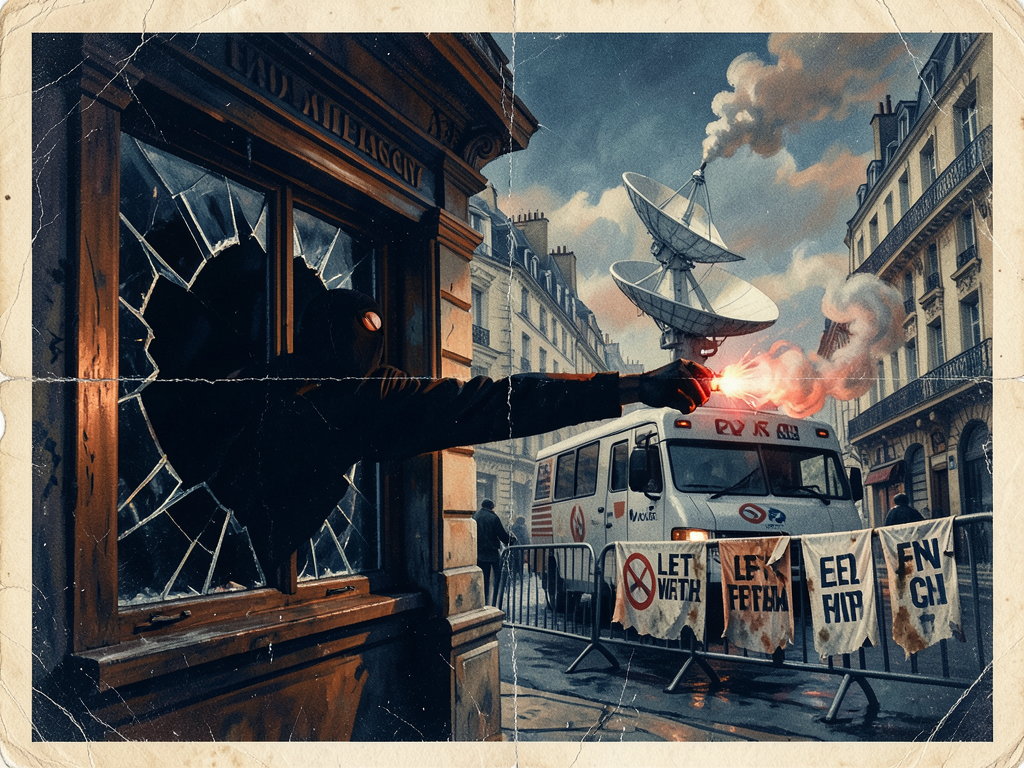
PSYOP DetectedOct 20
French left-wing parties are being linked to chaos and violence in coordinated media coverage
A coordinated narrative has emerged across multiple media outlets linking French left-wing political parties, particularly La France Insoumise (LFI), to esca...
Sources & Articles
48
2026-10-26T05:56:04.000Z
47
2026-10-23T11:05:13.000Z
44
2026-10-18T13:08:06.000Z
35
2026-10-24T10:04:25.000Z
33
2026-10-24T11:09:28.901Z
42
France braces for another weekend of protests as authorities launch massive security operation | CNNNotable
2026-10-23T16:24:28.803Z
46
2026-10-24T11:55:30.000Z
47
2026-10-25T08:35:22.000Z
33
2026-10-24T07:33:00.000Z
34
2026-10-23T10:05:46.000Z
Showing 10 of 25 articles