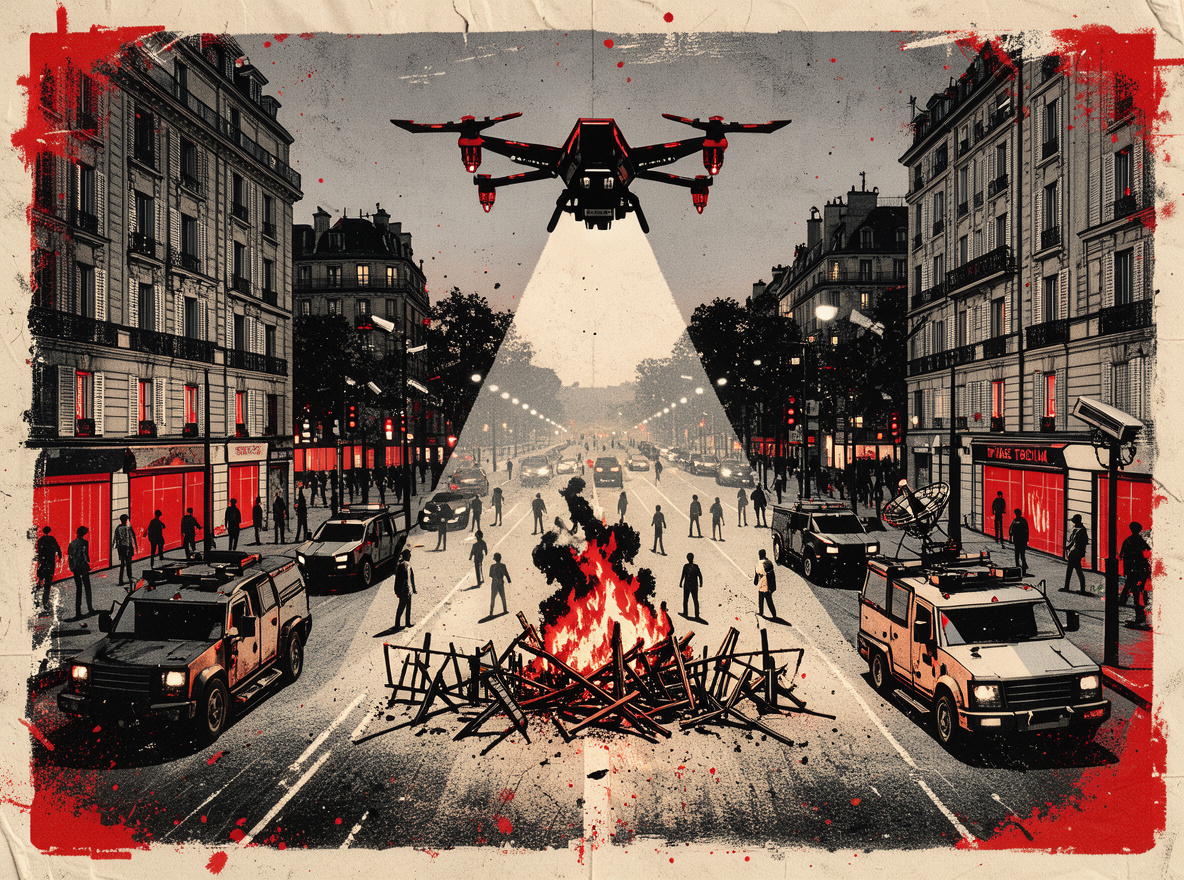
Operational Summary
A coordinated narrative has emerged across Western media outlets to recast widespread public protests in France as violent uprisings driven by radical elements. Detected from February 21, 2026 to October 28, 2026, the operation spans 25 articles across 10 outlets, with a marked intensity spike in late October following nationwide demonstrations over cost-of-living and education funding. The framing systematically justifies expansive police operations and preemptive state repression.Article Timeline
When articles appeared, colored by manipulation score.
Source Distribution
Narrative Architecture
The narrative centers on a dual construction: mass discontent is acknowledged but immediately isolated from violence, which is attributed to a defined fringe. Terms such as 'ultra-left' and 'radical far-left' are consistently deployed to categorize the source of unrest, despite official figures indicating most protests remained peaceful. This dichotomy allows the state to position its response as targeted and necessary, rather than indiscriminate. Emotional levers are activated through references to seized weapons, injuries to officers, and the use of tear gas and water cannon—details presented as reactive, never as initiatory.The underlying socioeconomic grievances—rising poverty, failing public education, and austerity—are acknowledged in passing but structurally downplayed. No outlet traces the protests to policy decisions by the Macron administration or connects them to broader European cost-of-living crises. Instead, the focus remains on public order, with protest organizers and unions relegated to secondary sourcing. The framing implies that disorder, not policy failure, is the primary threat to social stability.
Al Jazeera’s coverage diverges by foregrounding state violence and systemic neglect, but it is outnumbered by outlets that align with the official security narrative. This creates an information environment where the justification for repression appears broadly consensus-driven, even where data suggests proportionality issues.
Cross-Outlet Coordination Pattern
The operation involves a cluster of Western-aligned outlets: CBS News, CNN, Euronews, and affiliated digital platforms. These outlets converged on identical framing within hours of the October 24, 2026 protests, using the same descriptors—'clashes,' 'arrests,' 'radical elements'—despite varying on-the-ground reporting capacity. The speed and uniformity suggest pre-established narrative protocols, likely coordinated through shared sourcing from French interior ministry briefings or EU security channels.All participating outlets rely heavily on official figures for arrest counts and incident reports, while marginalizing or omitting testimonies of excessive force. The repetition of 'over 1,300 arrests' across CBS, Euronews, and CNN functions as a factual anchor that reinforces the scale of state action without interrogating its necessity. This synchronized amplification elevates the perception of threat, making the police response appear proportionate by default.
The absence of investigative follow-up—such as forensic analysis of arrest records, mapping of protest locations to violence, or verification of weapon seizures—indicates a pattern of passive transmission rather than journalistic scrutiny. This is consistent with media operating as a vector for state messaging during civil unrest.
Technique Assessment
Score Distribution
How articles in this PSYOP score across manipulation bands.