Pretext incidents · 1962 · US, Cuba
Operation Northwoods
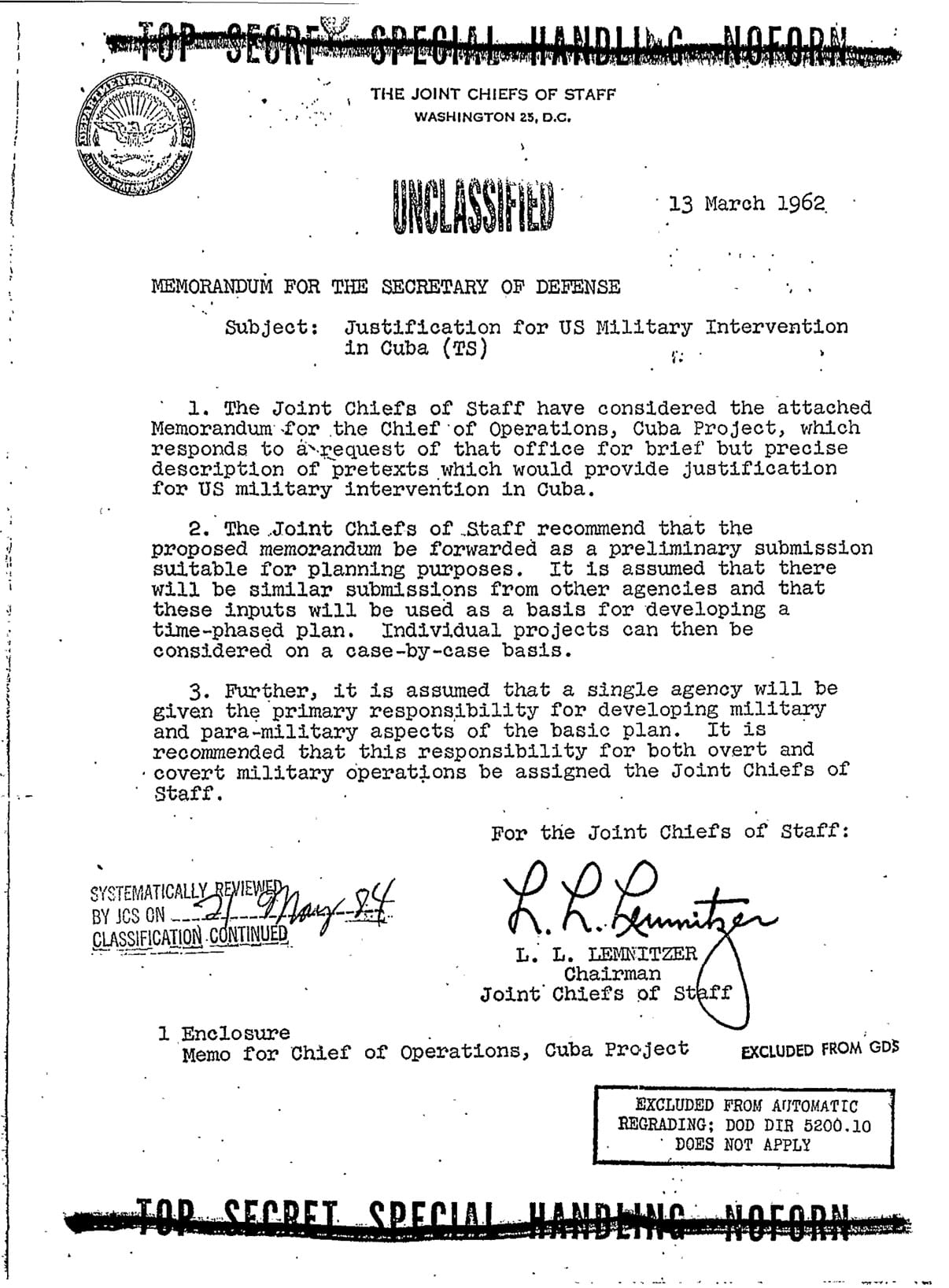
On 13 March 1962 the Joint Chiefs of Staff gave Defense Secretary Robert McNamara a Top Secret memorandum, "Justification for U.S. Military Intervention in Cuba", listing pretexts for war with Cuba, among them a staged "Remember the Maine" ship incident, a simulated attack on a civilian airliner and a fake Cuban terror campaign in US cities. It was a proposal only: the civilian leadership did not adopt it and nothing in it was carried out. It stayed secret until the JFK Records Review Board released it in 1997 and James Bamford described it in 2001.

- Run by
- Joint Chiefs of Staff
- Memorandum signed by Chairman Lyman Lemnitzer, written for the Cuba project run by Col. Edward Lansdale under Operation Mongoose
- Top Secret memorandum with cover memoranda
- 15 pages
- Offered to the Secretary of Defense as a preliminary submission for planning; the proposals were never executed
- The civilian leadership did not adopt it
- Nothing carried out
- The only documented effect was the paper itself; the pretexts were never staged
- Time to exposure
- 18 Nov 1997
- Released by the JFK Assassination Records Review Board; Bamford's Body of Secrets and ABC News brought it to wide attention in April 2001
Timeline
1961-62 · Context
The Kennedy administration runs Operation Mongoose, a covert programme against Fidel Castro's government, with Col. Edward Lansdale as chief of the Cuba project. Lansdale asks the services for ideas.
13 Mar 1962 · It worked
The Joint Chiefs send McNamara the memorandum "Justification for U.S. Military Intervention in Cuba". It proposes a fake "Communist Cuban terror campaign" in Miami, other Florida cities and Washington; sinking "a boatload of Cuban refugees (real or simulated)"; fostering attempts on the lives of Cuban refugees in the US; faking a Cuban air force attack on a civilian jetliner; and a "Remember the Maine" incident, blowing up a US ship in Cuban waters and blaming Cuban sabotage.
16 Mar 1962 · Context
A Lansdale memo of a meeting with the President records Kennedy saying that "we were not discussing the use of U.S. military force". The proposal was rejected by civilian leaders and not implemented.
Jan 1963 · Context
Lemnitzer, whose term as Chairman of the Joint Chiefs ended on 30 September 1962, becomes NATO's Supreme Allied Commander.
18 Nov 1997 · Exposed
The JFK Assassination Records Review Board makes the memorandum public among thousands of military records from 1962 to 1964.
30 Apr 2001 · Exposed
ABC News reports the plans from James Bamford's Body of Secrets (published 24 April 2001). The National Security Archive posts the document the same week.
A proposal by the nation's top military officers to deceive the public into a war was approved in writing by all the Chiefs, and stayed secret for 35 years because it was turned down, not because it was carried out.
The playbook
- 1
Manufactured incident
The memorandum's whole method was to stage, simulate or provoke an event, such as a ship explosion or an airliner attack, that could be blamed on Cuba.
- 2
Borrowed authority
The plan was framed as a considered military paper from the Joint Chiefs to the Defense Secretary, and ABC reports it carried the written approval of every Chief.
- 3
Win before the facts
The incidents were meant to produce public anger and a decision for intervention before anyone could establish who was actually responsible; the memo says casualty lists would cause "a helpful wave of national indignation".
Through the FATE framework
- Focus7/10
The plan centred on one engineered event that would redirect public attention to Cuba.
- Authority6/10
It came from the top uniformed leadership, written in the form of a planning memorandum.
- Tribe6/10
It would have set Americans against a named foreign adversary by presenting Cuba as the attacker.
- Emotion8/10
Fear and outrage over simulated or staged casualties were the intended lever.
Propaganda techniques used
Same playbook today
The same playbook can be run by anyone, on any side. We list every current PSYOP that matches Operation Northwoods, whoever is behind it.
No live PSYOP we track matches this playbook right now. When one does, it will appear here.