Justify Venezuela Oil Seizure
This PSYOP aims to manufacture public consent for the forceful U.S. acquisition of Venezuelan oil reserves, framing it as a legitimate and mutually beneficial economic deal. It serves the interests of the U.S. government and oil corporations by justifying the removal of former President Nicolás Maduro and securing Venezuelan oil assets.
PSYOP Hierarchy
Executive Summary
Power Patterns
Manufacturing Casus Belli
The PSYOP manufactures a casus belli by presenting the seizure of Venezuelan oil as a 'deal' or 'arrangement' that benefits all, obscuring the underlying military and political coercion. This serves the U.S. imperial overextension by securing critical resources and reinforcing exorbitant privilege through control of global energy supplies. The involvement of U.S. oil giants like Chevron and figures like Alejandro Betancourt, despite his controversial past, points to the influence of the Lobby-Industrial Complex and rent-seeking behavior, where private interests profit from state-backed resource acquisition.
Cui Bono — Who Benefits?
The U.S. government benefits by securing vast oil reserves, lowering domestic gas prices, and projecting an image of strong leadership and energy security, especially in an election year. U.S. oil corporations gain access to massive, cheap reserves and new markets. Alejandro Betancourt benefits from his elevated role and potential financial gains. The U.S. military gains a direct financial stake, further intertwining military and economic interests, and potentially securing funding for future operations.
Historical Parallels
1953 Iran Coup (Operation Ajax)
The narrative of a 'deal' with an 'interim government' following the removal of a national leader, aimed at securing resource control (oil), strongly parallels the CIA-orchestrated overthrow of Mosaddegh to restore Western oil interests. Both involve external powers manipulating internal politics for resource acquisition.
Iraqi WMDs (2002-2003)
The coordinated media effort to present a fabricated or highly misleading justification for military action and resource control, with a focus on 'benefits' and 'security,' echoes the WMD narrative used to justify the Iraq War. Both involve a lack of verifiable evidence for the stated justifications and a suppression of dissenting views.
Sanctions as Siege Warfare
The articles implicitly acknowledge that U.S. sanctions weakened Venezuela's oil sector, creating the conditions for the current 'deal.' This aligns with sanctions being used as a tool to destabilize a target nation and make it more amenable to foreign control, as seen in Iraq, Iran, and Cuba.
Narrative Mechanics
Synchronized Talking Points
“The deal is 'historic' and a 'major win' for the U.S. and Venezuela.”
“It will lower U.S. gas prices and replenish strategic reserves.”
“It brings 'investment,' 'prosperity,' and 'economic recovery' to Venezuela.”
“It is a 'mutually beneficial' arrangement.”
“The U.S. is 'securing' or 'taking control' of Venezuelan oil reserves.”
“The deal is linked to the removal/arrest of Nicolás Maduro and the rise of an 'interim government' (Delcy Rodríguez).”
Framing Evolution
The earliest articles (late August) from CNBC and NBC News directly claim the U.S. 'took control' of 65 billion barrels of oil, often citing a Trump social media post. Later articles (early September) from Al Jazeera, Euronews, and Breitbart shift to framing it as a 'deal,' 'arrangement,' or 'expansion' by U.S. and European firms, emphasizing economic benefits and downplaying the coercive aspects, even as they still mention the 'arrest' of Maduro. The narrative moves from outright seizure to a more palatable 'economic partnership' over time, while maintaining the core outcome of U.S. control.
Suppressed Counter-Narratives
×The illegality and violation of international law regarding the seizure of a sovereign nation's resources.
×The lack of verifiable evidence for Maduro's 'abduction' or 'arrest' and the legitimacy of the 'interim government' involved in the 'deal'.
×The long-term geopolitical implications of such a forceful resource grab for international relations and the 'rules-based order'.
×The true cost of U.S. military intervention and its role in creating the conditions for this 'deal'.
×The historical context of U.S. intervention in Latin America and its impact on resource-rich nations.
Outlet Coordination
CNBC and NBC News (late August) were among the first to push the most direct 'U.S. takes control' narrative, often citing presidential statements. Breitbart consistently amplified the 'Trump win' angle. Al Jazeera and Euronews, while sometimes hinting at controversy (e.g., Betancourt's past, secrecy), largely adopted the 'deal' and 'economic benefit' framing, suggesting a broad consensus across different media segments to normalize the outcome. The rapid synchronization of these narratives, particularly the consistent mention of Maduro's 'arrest' and the 'interim government' without critical scrutiny, indicates coordinated narrative management.
Bigger Picture
This PSYOP is a critical component of a broader strategy to reassert U.S. hegemony in the Western Hemisphere, secure vital energy resources, and demonstrate the capacity for decisive action against perceived adversaries. It fits into the larger pattern of imperial overextension and the use of economic and military power to maintain the dollar's exorbitant privilege. The endgame is the consolidation of U.S. control over Venezuela's vast oil wealth, setting a precedent for future resource acquisitions and demonstrating the consequences of challenging U.S. influence.
Prediction
This PSYOP is likely building toward public acceptance of the U.S. as the de facto administrator or primary beneficiary of Venezuelan oil resources, potentially leading to long-term military presence to secure these assets and further economic integration of Venezuela into the U.S. sphere of influence. It prepares the public for a future where such resource seizures, justified by 'economic benefit' and 'energy security,' are normalized.
Intelligence Coverage

Venezuelan oil is being handed to the US as a routine economic deal
A coordinated media operation has emerged normalizing U.S. control over Venezuelan oil reserves. Detected across six articles from August 28 to September 2, ...

Venezuelan oil is being recast as a U.S. economic windfall, not a seizure
A coordinated media narrative emerged on August 28–31, 2026, across four outlets to legitimize U.S. control over Venezuela’s oil reserves under the guise of ...
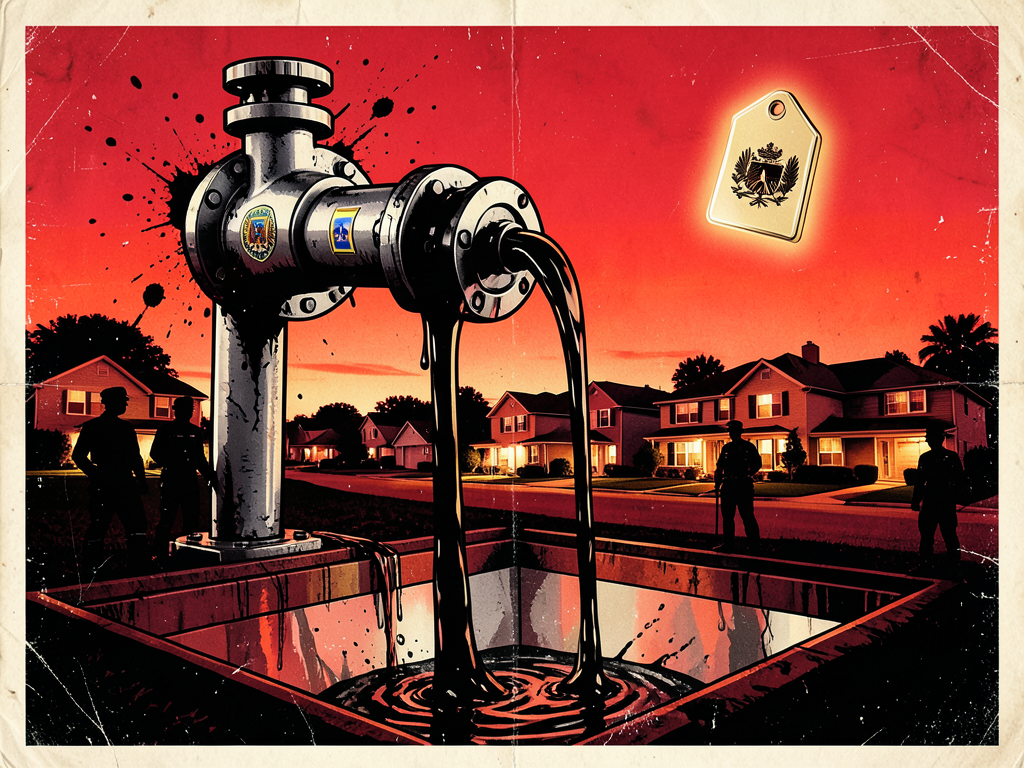
Venezuelan oil deal is being sold as a win for American consumers
On September 1, 2026, a coordinated narrative emerged across four articles in three outlets promoting the U.S. seizure of Venezuelan oil reserves as a strate...
Sources & Articles
2026-09-03T04:19:11.000Z
2026-09-01T14:17:47.000Z
2026-09-01T21:54:14.000Z
2026-09-03T04:05:20.000Z
2026-09-02T05:13:40.000Z
2026-09-02T17:28:52.000Z
2026-09-02T17:28:52.000Z
2026-09-01T21:01:00.000Z
2026-08-31T17:57:00.000Z
2026-09-03T01:29:13.404Z
Showing 10 of 14 articles