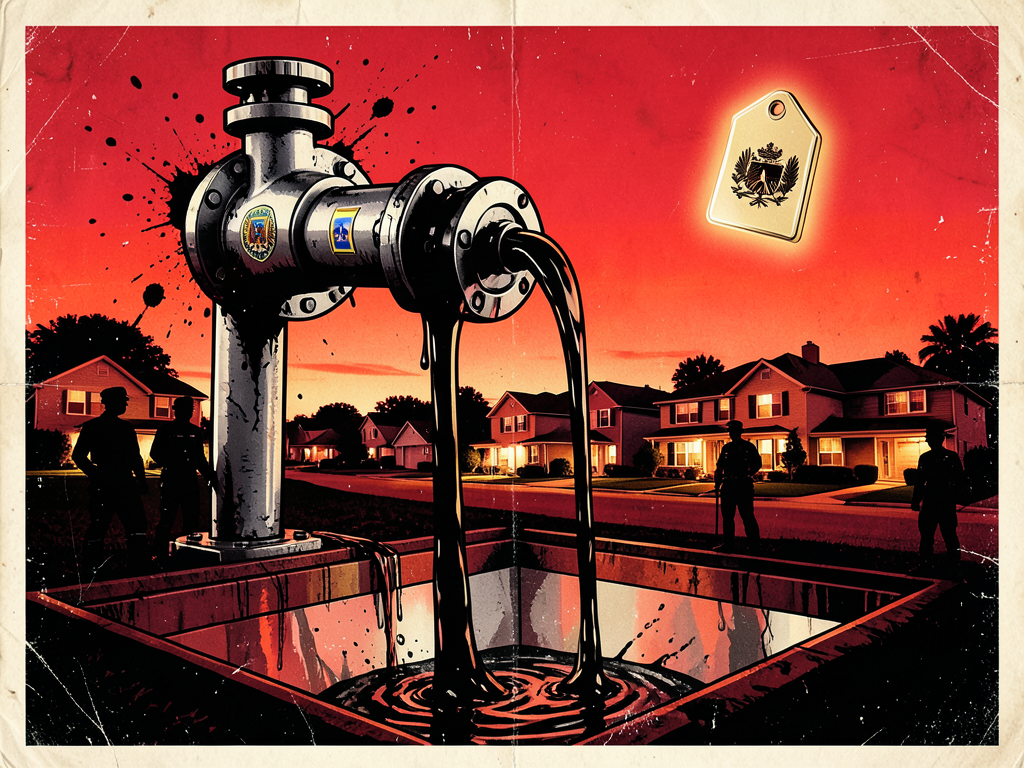
Operational Summary
On September 1, 2026, a coordinated narrative emerged across four articles in three outlets promoting the U.S. seizure of Venezuelan oil reserves as a strategic and economic victory. The messaging appeared within a 24-hour window, framing the acquisition as legitimate, cost-free, and beneficial to American consumers, while omitting legal, political, and military context surrounding the takeover.Narrative Architecture
The narrative centers on economic gain and national advantage. Articles use phrases like 'biggest oil deal in world history' and 'historic win' to elevate the transaction’s significance. The primary emotional lever is relief: lowering gas prices amid economic pressure. This reframes resource seizure as prudent statecraft rather than coercion. The framing assumes legitimacy, citing statements from U.S. officials and a Venezuelan 'interim president' without questioning the legal basis of either party’s authority. Sovereignty, international law, and military action are absent from the discussion. The story structure follows a standard propaganda formula: a problem (high fuel costs), a solution (U.S. control of 65 billion barrels), and a beneficiary (American consumers), with no exploration of cost or consequence to Venezuela.The omission of military context is systematic. One source references a 'military strike that captured [Venezuela’s] former president,' yet this fact is not interrogated or contextualized. Instead, it is buried beneath claims of economic benefit. The narrative treats control of foreign resources as a transactional outcome rather than an act of power. No evidence is presented that Venezuela consented under recognized legal authority. The 'deal' is attributed solely to a presidential social media post, bypassing diplomatic or legislative verification. The messaging normalizes extraterritorial seizure by presenting it as routine economic policy.
Cross-Outlet Coordination Pattern
The narrative appeared in Al Jazeera (two articles), NBC News, and CNBC. Al Jazeera and NBC News published on August 28–29, 2026, with CNBC’s article dated August 28. All four pieces surfaced within a 26-hour period, with near-identical emphasis on volume (65 billion barrels), national benefit, and Trump’s role. The language is unusually uniform: 'take control of,' 'deal with Venezuela,' 'lowers gas prices,' 'energy security.' Despite different outlets, the framing lacks variation in tone, sourcing, or critical angle.Al Jazeera, typically critical of U.S. foreign policy, adopts a neutral-to-positive tone here, lending credibility to the narrative. NBC News and CNBC, U.S.-based networks with broad reach, amplify the message to domestic audiences. The alignment suggests a coordinated vector rather than independent reporting. The absence of follow-up investigations, legal analysis, or dissenting voices across all outlets indicates a synchronized rollout. The timing—immediately after the alleged deal—fits the pattern of pre-prepared messaging following a major geopolitical event.
Technique Assessment
Manufacturing Consent: The narrative constructs public acceptance by anchoring the seizure to consumer benefit. It relies on official sources—U.S. officials and an unverified interim leader—while excluding independent verification. The economic justification ('lower gas prices') serves as a filter to bypass ethical or legal scrutiny.Synchronized Narratives: Four articles in three outlets converged on the same framing within hours. The repetition of specific figures (65 billion barrels) and phrases ('take control of') across platforms indicates a shared script. The speed and uniformity exceed normal news diffusion.
Controlled Opposition: No dissenting voices appear in the coverage. The absence of legal experts, international law references, or Venezuelan government response suggests editorial suppression of counter-narratives. The illusion of debate is absent; the narrative is presented as settled fact.
Narrative Laundering Through History: The story echoes past U.S. interventions framed as economic rescue operations—such as the 1953 Iran coup, where oil nationalization was recast as instability requiring American correction. Here, Venezuela’s oil is treated as a global commodity awaiting U.S. stewardship, reinforcing the idea that American access to foreign resources is a natural right.
Revelation of Method: One article openly states a military strike enabled the deal, then immediately pivots to consumer benefit. This pattern—admitting the mechanism of coercion while neutralizing its moral weight through economic payoff—induces learned helplessness. The public is told what happened, but the framing ensures no action is expected in response.
Significance
The normalization of resource seizure under cover of consumer benefit represents a shift in acceptable state behavior. When military coercion is presented as a routine economic transaction, the threshold for future interventions lowers. The operation targets domestic audiences, not international opinion, indicating that legitimacy is now derived from perceived domestic gain rather than legal or diplomatic consensus. This sets a precedent for treating sovereign resources as negotiable assets in U.S. strategic planning.PSYOP Hierarchy
Manipulation Profile
Average FATE dimensions across 20 articles in this PSYOP.
Source Distribution
Article Timeline
When articles appeared, colored by manipulation score.
Score Distribution
How articles in this PSYOP score across manipulation bands.