Forgery and planted disinformation · 1960-1969 · Israel, US
Dimona's "research reactor"
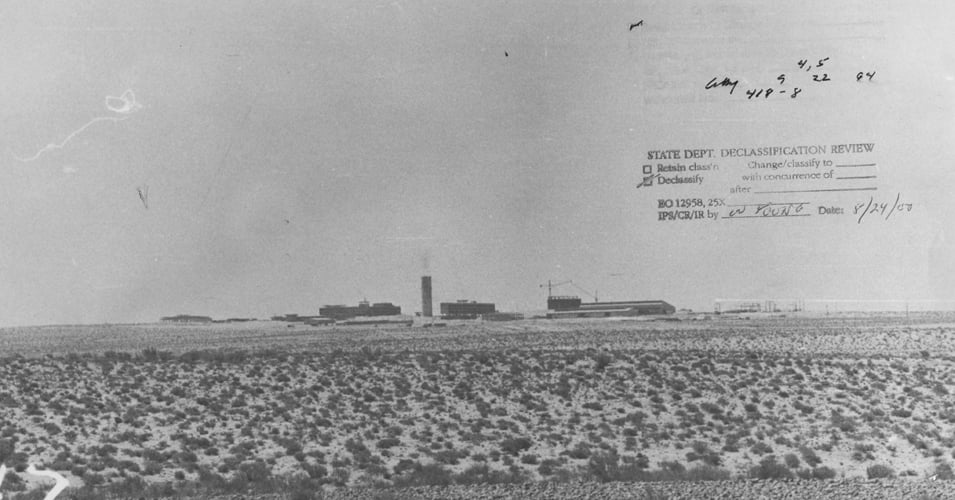
In the late 1950s Israel built a large reactor at Dimona with French help. When US intelligence found it in 1960, Israeli officials gave the US Embassy a series of cover stories, from a textile plant to metallurgical research, and Prime Minister Ben-Gurion told the Knesset in December 1960 that it was "exclusively for peaceful purposes". Under US pressure Israel later allowed US inspection visits, but not IAEA ones. Declassified US records and later accounts describe how the visits were managed to hide the plutonium work. The US ended them in 1969.

- Run by
- Israel
- Prime minister's office and the atomic energy programme
- Descriptions of the site
- 4 cover stories
- Textile plant, metallurgical research, meteorological installation, university research; later the official "peaceful" reactor line
- US inspections ended
- 1969
- The US believed by then that Israel might have a bomb, and ended the visits
- Time to exposure
- Dec 1960
- The US discovery in 1960, confirmed by SNIE 100-8-60 (8 December 1960); the inspection tricks surfaced decades later
Timeline
Sep 1960 · It worked
Asked by US diplomats on a helicopter flight what the large construction near Dimona was, the Israeli Finance Ministry official Addy Cohen says it is "a textile plant". He later said he gave that reply "because that was our story at the time". Other Israeli officials described the site as metallurgical research and other installations.
8 Dec 1960 · Exposed
A US special national intelligence estimate (SNIE 100-8-60) says Israel is building a nuclear reactor complex in the Negev and that "plutonium production for weapons is at least one major purpose of this effort".
21 Dec 1960 · It worked
Prime Minister David Ben-Gurion tells the Knesset the 24-megawatt reactor is "intended exclusively for peaceful purposes". Press reports date the speech 21 or 22 December.
Early Jan 1961 · It worked
Ben-Gurion tells the US ambassador Israel "has no plans for producing nuclear weapons", and says Israel will not accept IAEA safeguards until all reactors are treated alike.
Jul - Aug 1963 · Context
On 5 July President Kennedy writes to Prime Minister Levi Eshkol demanding regular US scientific access to Dimona. In August Israel agrees to US visits, not IAEA ones.
1964-1965 · It worked
US inspection teams visit and find no evidence of weapons work; they work from the assumption that no reprocessing plant exists. Accounts based on Seymour Hersh (and repeated by the Washington Post) say fake walls hid elevators to the underground plant and that a false control room was staged for the visits.
1969 · Exposed
After the last visit in July 1969, and with the Nixon-Meir understanding of September 1969, the US ends the Dimona visits. It was by now believing that Israel might have a nuclear weapon.
Apr 2015 - Nov 2020 · Exposed
The National Security Archive, with Avner Cohen and William Burr, publishes declassified records of the discovery and of the 1964-65 inspections.
US intelligence saw through the story within months in 1960; the details of how the inspections were handled came out decades later.
“intended exclusively for peaceful purposes”
The playbook
- 1
Hidden messenger
Officials gave different non-nuclear descriptions of the site to different audiences, so the real sponsor and purpose stayed unclear.
- 2
Borrowed authority
The prime minister told the Knesset the reactor was for peaceful purposes; inspections were limited to US visitors whose findings carried weight but who worked within Israel's conditions.
- 3
Suppress the correction
The terms of the visits and the staged control room (per Hersh) limited what inspectors could report, so the official line stood unchallenged for years.
Through the FATE framework
- Focus4/10
Attention was steered to "research" and "peaceful" uses, away from plutonium production.
- Authority6/10
A prime minister's words and US inspectors' visits both lent weight to the line that no weapons work was under way.
- Tribe2/10
There was little appeal to group identity; the message was technical.
- Emotion2/10
The cover stories were bureaucratic rather than emotional.
Propaganda techniques used
Same playbook today
The same playbook can be run by anyone, on any side. We list every current PSYOP that matches Dimona's "research reactor", whoever is behind it.
No live PSYOP we track matches this playbook right now. When one does, it will appear here.