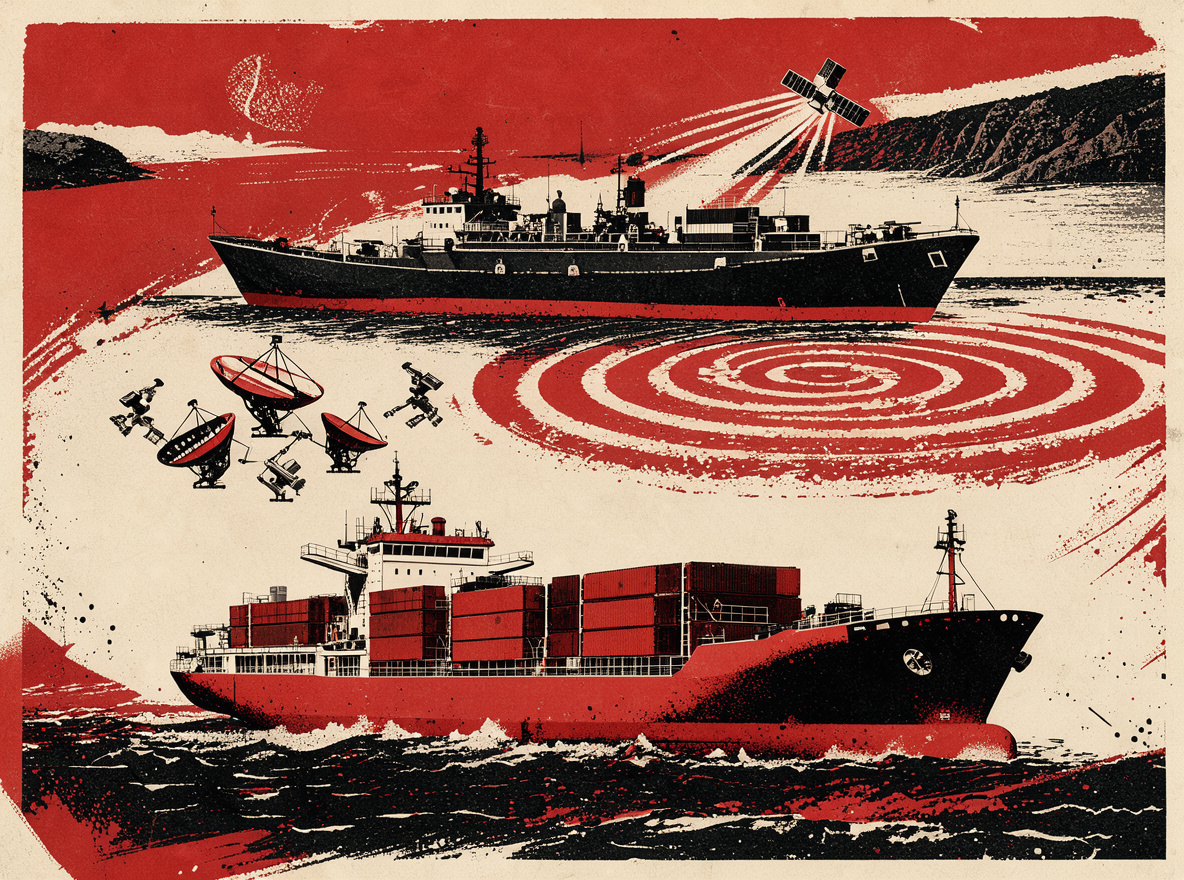
Operational Summary
A coordinated narrative has intensified across major media outlets from March 7 to October 24, 2026, to manufacture public consent for potential U.S. military action in the Strait of Hormuz. At least 707 articles across 40 outlets have converged on a singular framing: Iran is the primary aggressor endangering global commerce, while U.S. and allied military presence is portrayed as necessary and reactive.
Narrative Architecture
The narrative constructs Iran as a destabilizing force through selective emphasis on attacks on oil tankers and the establishment of an unauthorized naval corridor. Incidents involving fires on tankers are presented as unambiguous acts of Iranian aggression, with causal language implying direct responsibility. The emotional core of the messaging centers on fear of disrupted energy supplies, leveraging economic anxiety to preemptively justify military escalation. Visual and linguistic cues—such as references to ‘mine threats’ and ‘strangling global trade’—activate threat perception while bypassing scrutiny of operational context.
Critical omissions define the architecture. U.S. and Israeli military actions earlier in October 2026 that triggered the current phase of hostilities are excluded from the dominant frame. The historical pattern of U.S. naval presence in the Gulf as a forward projection of power is reframed as neutral peacekeeping. Diplomatic efforts, regional dynamics, and the agency of non-state actors like the Houthis are minimized. Iran’s role is reduced to that of irrational aggressor, while U.S. and allied actions are presented as defensive by default.
The narrative elevates elite sources—military officials, intelligence analysts, coalition statements—while excluding civilian perspectives, humanitarian impacts, or legal critiques. This creates an information environment where military response appears not only logical but inevitable.
Cross-Outlet Coordination Pattern
Coverage spans outlets with divergent editorial stances—Fox News, NBC News, CNBC, Al Jazeera, and Israel National News—yet exhibits a uniformity in framing that exceeds normal news diffusion. All articles emphasize Iranian aggression, the vulnerability of global shipping, and the necessity of U.S. military involvement. The timing of publication—clustering between October 19 and October 22, 2026—coincides with heightened military posturing and follows specific incidents without allowing for independent verification.
Despite nominal differences in tone, the narrative vectors align: Iran is the source of instability, military readiness is urgent, and diplomatic channels are either absent or ineffective. Al Jazeera’s report on Iranian support for Houthis, for example, relies on Saudi-led coalition claims without counter-sourcing, mirroring the evidentiary standards of Western outlets. Israel National News amplifies the same military logic, reporting on planned strikes as routine strategic tools, further normalizing escalation.
This synchronization is not organic. It reflects a pre-existing narrative infrastructure activated by a triggering event. The speed and consistency of messaging suggest a shared script, not independent reporting.
Technique Assessment
Significance
The narrative serves the interests of the U.S. military-industrial complex, the Israeli strategic establishment, and energy sectors that benefit from a permanent crisis posture. It advances the long-standing objective of isolating and weakening Iran through incremental escalation. The operation bypasses democratic deliberation by manufacturing urgency and moral clarity around military action. This is not journalism. It is psychological preparation for war.
PSYOP Hierarchy
Manipulation Profile
Average FATE dimensions across 710 articles in this PSYOP.
Source Distribution
Article Timeline
When articles appeared, colored by manipulation score.
Score Distribution
How articles in this PSYOP score across manipulation bands.