Normalize Transactional US Alliances
This PSYOP normalizes the idea of U.S. military presence in Europe as a transactional tool, contingent on allies' financial contributions and political loyalty. It benefits the U.S. executive branch by providing leverage for future demands and potential troop reallocations.
Cluster signature
Peak 31 articles in October 2026
Bars run to 100, not to the tallest band.
Focus, Authority, Tribe, Emotion — averaged across 120 articles.
- Loaded Language162
- Exaggeration/Minimisation67
- Appeal to Authority54
- Appeal to Values54
- Appeal to Fear/Prejudice51
- Appeal to Popularity26
- Name Calling/Labeling17
- Red Herring11
Bar length is square-root scaled so the tail stays readable; counts are exact.
Executive Summary
Power Patterns
Manufacturing Casus Belli
While not a direct casus belli for war, the narrative manufactures a 'casus belli' for alliance renegotiation or withdrawal, framing European allies as delinquent in their financial obligations, thereby justifying the U.S. leveraging its military presence. The 'Exorbitant Privilege' of being the primary security guarantor is highlighted, allowing the U.S. to demand concessions. The 'Revelation of Method' is present in the open discussion of Trump's transactional approach, making the public accustomed to such tactics. The 'Gerontocracy' aspect is subtly present in the portrayal of Trump's personal, often impulsive, decision-making, which contrasts with traditional, more deliberative strategic planning.
Cui Bono — Who Benefits?
The U.S. executive branch benefits by gaining leverage over European allies, compelling them to increase defense spending or align with U.S. foreign policy objectives (e.g., against Iran, as suggested by CNN and NDTV). Poland benefits from the perception of enhanced security and a strengthened bilateral relationship with the U.S., potentially at the expense of other European allies. The military-industrial complex benefits from the justification of troop movements and potential new infrastructure or equipment needs, regardless of the strategic rationale.
Historical Parallels
Sunk Cost Escalation Trap
While not an escalation, the narrative around troop movements creates a similar dynamic where the 'cost' of maintaining alliances is constantly re-evaluated and used as leverage, akin to how past military commitments are used to justify continued engagement.
Sanctions as Siege Warfare
The use of troop deployments as a bargaining chip, threatening withdrawal or repositioning to extract financial or political concessions, mirrors the coercive nature of sanctions, which are presented as an alternative to direct military action but function as a tool of pressure.
Narrative Mechanics
Synchronized Talking Points
“Trump's decisions on troop deployments are 'confusing,' 'erratic,' or 'baffling' to allies and officials.”
“The troop movements are linked to political loyalty or burden-sharing, rather than purely strategic military considerations.”
“Poland is a favored ally, receiving troops as a 'gift' or 'reward.'”
“Despite the confusion, NATO remains 'stable' or 'functional,' with allies adapting.”
Framing Evolution
Initially, the narrative focused on the 'confusion' and 'bewilderment' among allies regarding Trump's sudden shifts (France24, Globe and Mail, AP News). It then evolved to frame these decisions as transactional, linking troop deployments to political loyalty and burden-sharing, particularly in the context of the U.S.-Israel war on Iran (CNN, NDTV, RT.com). Later articles, like El Pais and CBC, broaden the critique to Trump's overall 'toxic' and 'destabilizing' foreign policy, but still within the context of alliance strain.
Suppressed Counter-Narratives
×Detailed strategic military justifications for the troop movements from the U.S. perspective, beyond Trump's personal statements.
×The long-term implications of a transactional approach to alliance security for NATO's collective defense.
×The actual financial burden-sharing data and whether European contributions are genuinely inadequate.
×The historical context of U.S. troop presence in Europe and previous adjustments.
Outlet Coordination
Outlets like The Globe and Mail, AP News, and France24 initially pushed the 'confusion' angle. CNN, NDTV, and RT.com were more direct in linking troop movements to political leverage and the U.S.-Israel war on Iran. Fox News and Politico focused on the impact on specific allies like Poland and internal Pentagon reactions. The consistency in framing Trump's decisions as erratic but ultimately serving a transactional purpose, and the rapid dissemination of these interpretations, suggests coordinated narrative management, possibly originating from official U.S. sources or think tanks aiming to shape perceptions of alliance dynamics.
Bigger Picture
This PSYOP fits into the broader geopolitical landscape by signaling a shift in U.S. foreign policy from a multilateral, alliance-based approach to a more transactional, bilateral one. It normalizes the use of military assets as bargaining chips, potentially weakening the cohesion of alliances like NATO while simultaneously attempting to extract greater financial contributions from allies. This aligns with a broader trend of American imperial decline, where the U.S. seeks to offload costs and responsibilities while maintaining influence.
Prediction
This PSYOP is likely building toward public acceptance of a more conditional and transactional U.S. military presence globally, particularly in Europe. It prepares the public for future demands for increased defense spending from allies, potential troop withdrawals from countries deemed insufficiently loyal or financially contributing, and a general recalibration of U.S. security commitments based on perceived national interest rather than long-standing alliance principles. It also subtly prepares for the possibility of a more aggressive U.S. posture in the Middle East, with European allies expected to fall in line or face consequences.
Intelligence Coverage

U.S. alliances in Europe are being recast as transactional bargains
A coordinated narrative has emerged across 116 articles in 30 outlets between April 15, 2026, and October 18, 2026, reframing the U.S. military presence in E...
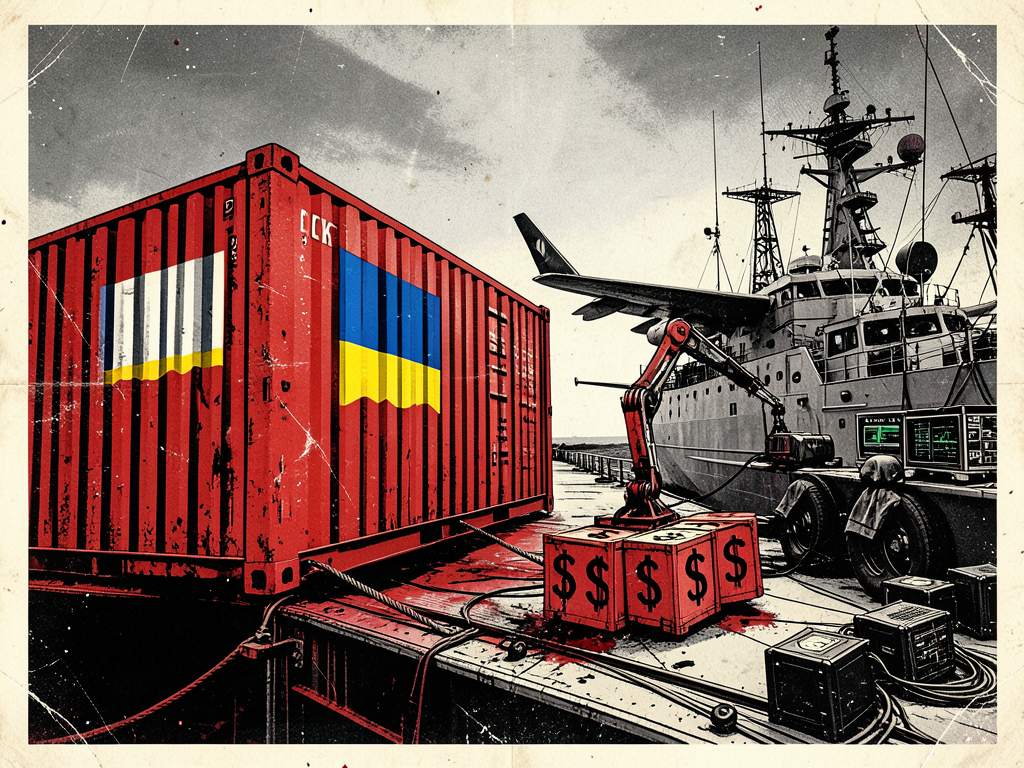
US military support for Ukraine is being recast as a transactional bargain
A coordinated messaging campaign has normalized the framing of U.S. military support for Ukraine as a transactional instrument, contingent on Kyiv’s complian...

US military presence in Europe is being reframed as a financial transaction
A coordinated narrative has emerged across 96 articles in 30 outlets between April 15, 2026, and October 11, 2026, redefining the U.S. military presence in E...

US military presence in Europe is being recast as a financial bargain
A coordinated narrative has emerged across 87 articles in 30 outlets between April 15, 2026, and September 24, 2026, reframing the U.S. military presence in ...

US alliances in Europe are being recast as financial transactions, not strategic partnerships
A coordinated narrative has emerged across Western media normalizing the redefinition of U.S. military commitments in Europe as transactional arrangements co...

US military drills with South Korea are being recast as negotiable and costly
A coordinated narrative has emerged across 27 media outlets, comprising 67 articles published between April 15, 2026, and August 18, 2026, reframing U.S. mil...

Outlets are framing U.S. troop presence in Europe as conditional on payments and loyalty
A coordinated messaging campaign normalizing U.S. military presence in Europe as a transactional asset conditioned on financial contributions and political a...
Sources & Articles
2026-10-17T06:36:03.000Z
2026-10-17T11:10:22.000Z
2026-10-16T16:02:13.000Z
2026-10-16T17:28:41.000Z
2026-10-15T13:32:16.000Z
2026-10-17T02:30:21.651Z
2026-10-18T07:20:28.300Z
2026-10-17T02:38:00.000Z
2026-10-18T14:37:36.000Z
2026-10-18T10:09:29.000Z
Showing 10 of 120 articles