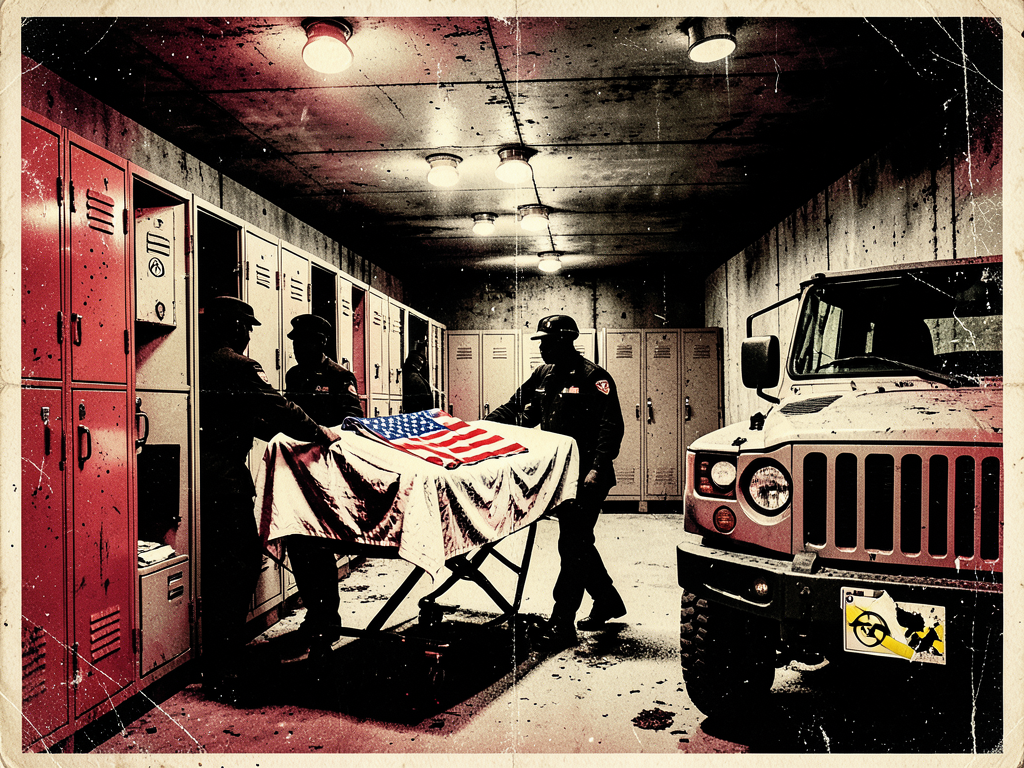
Normalize US Military Casualties
This PSYOP minimizes the impact of U.S. military losses and incidents to maintain public support for ongoing military operations and justify the U.S. military's continued presence abroad, benefiting the US Military-Industrial Complex and Political Establishment.
PSYOP Hierarchy
Executive Summary
Power Patterns
Manufacturing Casus Belli
While not directly manufacturing a casus belli, this PSYOP prepares the ground for future military actions by sanitizing the costs and risks of current operations. By framing crashes as accidents and losses as heroic sacrifices, it prevents public scrutiny that might question the necessity or effectiveness of military deployments, which are often driven by the Lobby-Industrial Complex. This fits into the deception phase of the Consent-Deception-Coercion Cycle, where the public is reassured that the system is working despite evidence of systemic issues and imperial overextension.
Cui Bono — Who Benefits?
The US Military-Industrial Complex benefits from sustained public support and funding for military operations and equipment, which this PSYOP helps secure by minimizing perceived failures. The US Political Establishment maintains legitimacy for its foreign policy decisions, particularly in the Middle East, by presenting military incidents as isolated accidents rather than systemic problems. The Israel Lobby benefits indirectly by ensuring continued US military presence and engagement in the Middle East, which aligns with Israeli strategic objectives, as seen in the simultaneous reporting on Israeli military losses and the emphasis on US-Iran tensions.
Historical Parallels
The Lusitania / Pearl Harbor
While not an attack by an enemy, the emphasis on the 'accidental' nature of the crashes and the heroism of the victims serves a similar function to downplay strategic vulnerabilities and maintain public support for continued military engagement, much like how the narratives around the Lusitania and Pearl Harbor focused on the attack itself to galvanize public opinion for war, rather than on the provocations or ignored warnings.
Iraqi WMDs (2002-2003)
The uniform narrative across multiple outlets, emphasizing official statements and downplaying alternative explanations for the crashes, mirrors the synchronized media effort to promote the WMD narrative. In both cases, critical inquiry into the underlying causes or broader context is suppressed in favor of a simplified, emotionally resonant message.
Narrative Mechanics
Synchronized Talking Points
“Pilots/crew survived and are 'fine' (ynetnews.com, timesofisrael.com, cbc.ca, middleeasteye.net)”
“Cause of crash is 'unclear' or 'under investigation' (ynetnews.com, timesofisrael.com, cbc.ca)”
“Emphasis on 'accident' or 'not hostile action' (ynetnews.com on Iraq crash, theguardian.com on Morocco incident)”
“Focus on the heroism and sacrifice of fallen soldiers (foxnews.com articles on Operation Epic Fury, ynetnews.com on Sapir)”
“Reassurance that the situation is 'under control' and protocols worked (smh.com.au, rt.com, nbcnews.com on air show collision)”
Framing Evolution
The framing consistently shifts from initial reports of a crash with unknown causes to emphasizing pilot survival and official investigations, then to highlighting the heroism of any casualties. In cases of actual fatalities, the narrative quickly pivots to personal stories of sacrifice and patriotism, effectively depoliticizing the incident and reinforcing military legitimacy. The shift is from 'incident happened' to 'incident was managed/is being investigated' to 'our people are heroes'.
Suppressed Counter-Narratives
×Detailed analysis of the strategic necessity or effectiveness of the military operations where incidents occur (e.g., the 'blockade' mentioned by ynetnews.com regarding Hormuz).
×Critique of the U.S. military's operational safety standards or training procedures.
×Discussion of the broader geopolitical implications of U.S. military presence in volatile regions.
×Alternative explanations for crashes beyond 'accident' or 'mechanical failure' when official sources deny hostile action.
×The human cost of military interventions on local populations, focusing exclusively on U.S. and Israeli losses.
Outlet Coordination
Outlets like ynetnews.com, timesofisrael.com, cbc.ca, and middleeasteye.net quickly adopted the 'pilots fine, cause unclear' framing for the Hormuz helicopter crash. Fox News consistently emphasizes the patriotism and dedication of fallen soldiers. The rapid, uniform messaging across diverse outlets, particularly regarding the immediate reassurance of pilot safety and the 'accidental' nature of incidents, suggests coordinated narrative management. Israeli outlets (ynetnews.com, timesofisrael.com, israelhayom.com) also intersperse their reporting on Israeli military losses with U.S. incidents, subtly linking the two and reinforcing a shared narrative of military sacrifice against common threats.
Bigger Picture
This PSYOP is part of a larger effort to maintain the illusion of American military invincibility and moral righteousness, essential for sustaining its global hegemonic project. By sanitizing military failures, it ensures the continued flow of resources to the military-industrial complex and prevents public dissent against imperial overextension, particularly in the Middle East where U.S. presence is crucial for Israeli strategic objectives.
Prediction
This PSYOP is likely building toward public acceptance of continued, and potentially escalated, U.S. military interventions and presence in the Middle East and other regions. By normalizing military incidents and framing losses as noble sacrifices, it prepares the public for future deployments and potential conflicts, ensuring that the human cost of these ventures does not undermine political will or funding.
Related PSYOPs
Intelligence Coverage
Detected PSYOP: Sanitize US Military Casualties Amid Exercise Fatalities
A coordinated narrative pattern has been detected across multiple English-language media outlets between February 21, 2026, and May 20, 2026, designed to san...
PSYOP Detected: Sanitize US Military Casualties
A coordinated narrative operation to sanitize US military casualties has been detected between February 21, 2026, and May 11, 2026. Six media outlets publish...
Sources & Articles
Jun 12, 2026
Jun 9, 2026
Jun 9, 2026
May 18, 2026
May 18, 2026
Showing 10 of 21 articles
External Coverage(50)
Showing 10 of 50