Legitimize Iranian Hegemony
This PSYOP aims to legitimize Iran's aggressive regional actions and expansionist policies as defensive and successful, preparing the public for a new Middle Eastern order dominated by Iran. It primarily benefits the Iranian regime, while also serving the interests of the Trump Administration, Russia, and China by justifying a reduced U.S. presence.
PSYOP Hierarchy
Executive Summary
Power Patterns
Manufacturing Casus Belli
The PSYOP uses 'Manufacturing Casus Belli' by presenting Iranian actions as justified retaliation for U.S. and Israeli aggression (e.g., Press TV articles framing U.S. strikes as 'unprovoked attacks'). It leverages 'Eschatological Mobilization' by framing Iran's actions as divinely supported and leading to an 'uncompromised triumph' (middleeasteye.net). 'Asymmetric Warfare Doctrine' is normalized as Iran's effective strategy against a stronger foe (presstv.ir, 'Iran fighting like a modern superpower'). The narrative also employs 'Controlled Opposition' by presenting a 'peace deal' that, despite Israeli and some U.S. opposition, ultimately serves to legitimize Iran's gains, and engages in 'Myth-Making as State Formation' by reinforcing Iran's image as a powerful, unified nation imposing its will.
Cui Bono — Who Benefits?
The Iranian regime benefits by having its military actions and regional expansion legitimized as defensive and successful, securing its position as a dominant regional power and potentially gaining significant financial and diplomatic concessions. The Trump administration benefits by claiming a 'peace deal' that allows for U.S. disengagement from a costly conflict, fulfilling campaign promises and presenting a diplomatic 'win' (e.g., dailysabah.com, 'Trump, Iran's Pezeshkian ink memorandum to end Mideast war'). Russia and China benefit from reduced U.S. hegemony in the Middle East, opening opportunities for their own influence and trade.
Historical Parallels
Iraqi WMDs (2002-2003)
Just as the WMD narrative manufactured consent for war, this PSYOP manufactures consent for a new regional power structure by presenting a narrative of Iranian 'victory' and 'legitimate' actions, even if based on questionable claims or interpretations.
The 1953 Iran Coup (Operation Ajax)
While the 1953 coup was about regime change, this PSYOP reverses the dynamic by legitimizing the current Iranian regime's power and influence, effectively 'normalizing' its gains after decades of U.S. attempts at containment or regime change.
Sanctions as Siege Warfare
The narrative of a 'peace deal' that includes lifting sanctions (e.g., newsweek.com, 'Donald Trump’s 14-point MOU deal with Iran: Dissected') mirrors the use of sanctions as a tool, but here, the 'lifting' is presented as a concession to Iran's strength rather than a humanitarian gesture, legitimizing the prior pressure as effective.
Narrative Mechanics
Synchronized Talking Points
“Iran's actions are 'defensive' and 'retaliatory' against U.S./Israeli aggression (Press TV, aljazeera.com).”
“The U.S.-Iran deal is a 'historic breakthrough' or 'peace deal' (dailysabah.com, abcnews.com, npr.org).”
“The Strait of Hormuz is a key point of contention and Iranian control is asserted (presstv.ir, aljazeera.com, jpost.com).”
“Trump's leadership is decisive and effective in securing this deal (foxnews.com, washingtontimes.com, inquirer.com).”
“Israel is isolated or acting against the broader peace efforts (timesofisrael.com, ynetnews.com, nbcnews.com).”
Framing Evolution
The narrative evolves from initial reports of U.S. military strikes against Iran (rt.com, 'Heavy explosions as US pounds Iranian city') to Iran's 'retaliation' and assertion of control (presstv.ir, 'IRGC vows 'greater humiliation''), culminating in a 'peace deal' that legitimizes Iran's gains and Trump's disengagement (dailysabah.com, 'Trump, Iran's Pezeshkian ink memorandum'). The initial framing of U.S. aggression shifts to a narrative of U.S. 'concession' or 'diplomatic success' under Trump, despite Iranian claims of 'victory' and 'humiliation' for the U.S.
Suppressed Counter-Narratives
×Independent verification of Iranian claims of military success or U.S. casualties (rt.com, presstv.ir).
×The actual terms and enforceability of the 'peace deal' or MOU, particularly regarding nuclear inspections and asset releases (cnbc.com, newsweek.com, npr.org).
×The long-term implications of legitimizing Iran's regional power for U.S. allies and regional stability.
×The humanitarian cost and civilian impact of the conflict, often overshadowed by geopolitical maneuvering (dailysabah.com, '1st tankers transit Hormuz after US-Iran deal').
×The extent of Israeli opposition and its potential to destabilize the 'peace' (timesofisrael.com, ynetnews.com).
Outlet Coordination
Outlets like Press TV and rt.com consistently push the Iranian perspective, emphasizing U.S. aggression and Iranian strength. Mainstream Western outlets like NBC News, ABC News, and CNBC, while sometimes acknowledging Israeli concerns, largely frame the 'deal' as a diplomatic breakthrough, often crediting Trump. Fox News strongly aligns with the Trump administration's narrative of a successful deal. The timing of 'peace deal' announcements across multiple Western outlets (e.g., abcnews.com, npr.org, washingtontimes.com, inquirer.com on June 15-18) suggests coordinated messaging around a specific event, despite the vagueness of the agreement.
Bigger Picture
This PSYOP is a critical component of a broader geopolitical shift, signaling a potential end to decades of U.S. efforts to contain Iran and a reordering of power in the Middle East. It serves to normalize a multipolar regional landscape where Iran is a recognized, if aggressive, player, and the U.S. is reducing its footprint. The endgame is a new regional equilibrium, potentially less favorable to traditional U.S. allies like Israel and Saudi Arabia, and more open to Russian and Chinese influence.
Prediction
This PSYOP is likely building toward public acceptance of a significantly altered Middle East, where Iran's regional dominance is a de facto reality, and U.S. military presence is reduced. It prepares the public for a 'peace' that comes at the cost of legitimizing Iranian expansion and potentially abandoning long-standing allies, framed as a necessary and successful diplomatic achievement by the Trump administration.
Intelligence Coverage

Iran’s retaliatory strikes are framed as defensive necessity in synchronized media wave
A coordinated narrative emerged across 22 outlets with a cluster of 100 articles, detected from June 15, 2026, through July 25, 2026. The messaging aligns Ir...

Iran’s military actions are being framed as justified responses to Western aggression
A coordinated narrative has emerged across 21 outlets, with 93 articles published between July 18 and July 19, 2026, following a sharp escalation in coverage...

Iran’s retaliatory strikes are framed as defensive and heroic, not aggressive
A synchronized narrative campaign has amplified coverage of Iran’s military actions in the Persian Gulf and Levant from June 15, 2026, to July 18, 2026. Seve...

Iran is being recast as a dominant regional power fighting unchecked US aggression
A coordinated narrative has emerged across 21 media outlets, spanning from June 15, 2026, to July 14, 2026, centered on amplifying claims of unprovoked US mi...
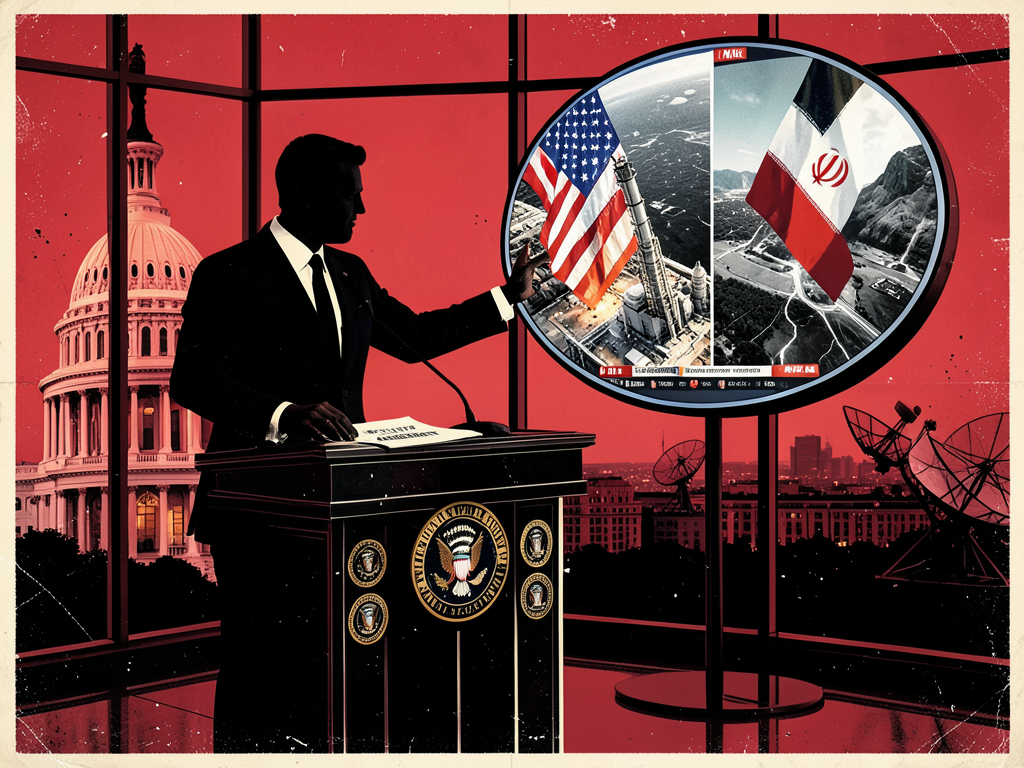
A U.S.-Iran deal is being sold as Trump's diplomatic victory, not a strategic shift
A coordinated media push spanning 56 articles across 21 outlets between June 15, 2026, and July 2, 2026, advances the framing of an emerging U.S.-Iran agreem...
Sources & Articles
2026-07-24T14:10:49.000Z
2026-07-24T06:24:29.000Z
2026-07-23T10:33:56.000Z
2026-07-23T15:05:01.000Z
2026-07-25T09:46:19.000Z
2026-07-26T10:50:45.000Z
2026-07-26T16:48:27.000Z
2026-07-24T02:20:36.000Z
2026-07-24T15:20:03.000Z
2026-07-16T12:18:00.000Z
Showing 10 of 106 articles
External Coverage(50)
Showing 10 of 50