Criminalize French Left-Wing Opposition
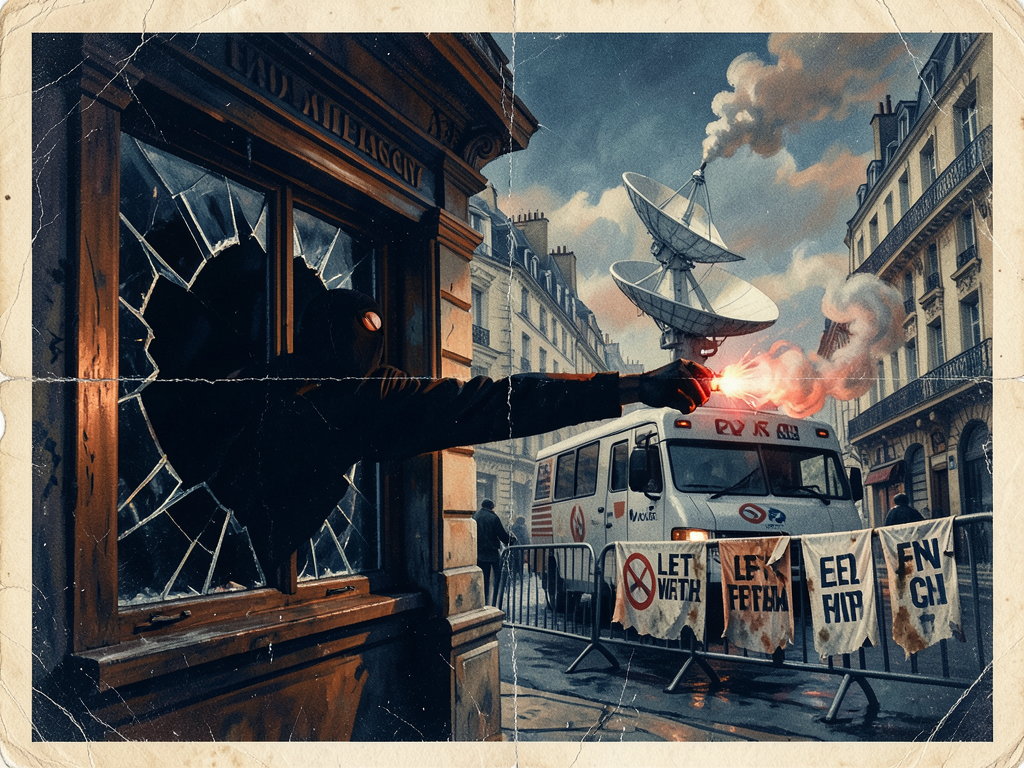
This PSYOP frames legitimate French left-wing political parties and their supporters as extremist and violent, thereby delegitimizing political opposition and benefiting the incumbent government and right-wing parties.
Cluster signature
Peak 3 articles in October 2026
Bars run to 4, not to the tallest band.
Focus, Authority, Tribe, Emotion — averaged across 5 articles.
- Loaded Language24
- Appeal to Fear/Prejudice3
- Exaggeration/Minimisation3
- Name Calling/Labeling2
- Obfuscation/Vagueness2
- Appeal to Authority1
- Causal Oversimplification1
- Doubt1
Bar length is square-root scaled so the tail stays readable; counts are exact.
Executive Summary
Power Patterns
Divide and Rule
The primary mechanism is 'Divide and Rule,' as the narrative seeks to fragment French society by demonizing a significant political bloc (the far-left) and creating internal divisions. This is achieved by 'Manufacturing Casus Belli' through the amplification of specific violent incidents (like the killing of Quentin Deranque) and linking them directly to LFI, creating a pretext for discrediting the party. The far-left is then subjected to 'Scapegoating and Displacement,' as the articles shift blame for societal unrest from systemic issues to the alleged extremism of LFI. While not explicitly 'Controlled Opposition,' the narrative effectively marginalizes genuine opposition by painting it as dangerous, thereby channeling political discourse into safer, establishment-approved channels.
Cui Bono — Who Benefits?
These actors benefit by having a significant political rival, La France Insoumise, delegitimized and associated with violence and extremism. This narrative weakens LFI's electoral prospects, reduces its ability to mobilize public support, and distracts from the government's own failures in addressing the underlying causes of the unrest. It allows the establishment to frame itself as the guarantor of order against a dangerous, radical opposition, thereby consolidating its power and potentially shifting the political center further right.
Historical Parallels
The Reichstag Fire
While not as dramatic, the amplification of specific violent incidents and their immediate attribution to a political opposition group (the far-left) to justify broader political suppression or delegitimization echoes the use of the Reichstag fire to consolidate Nazi power and suppress communists.
Manufacturing Casus Belli (general pattern)
The selective focus on a single street killing and its immediate instrumentalization to discredit a political party, as seen in RT and BBC, parallels historical instances where isolated incidents were amplified or fabricated to justify broader political or military actions.
Narrative Mechanics
Synchronized Talking Points
“The French far-left, specifically La France Insoumise (LFI), is linked to violent extremist groups (antifa).”
“LFI's leadership is morally compromised or irresponsible in its response to political violence.”
“The far-left is becoming a dangerous, extremist political force comparable to or worse than the far-right.”
Framing Evolution
The narrative evolves from CNN's initial reporting of widespread unrest with diverse causes (student protests, cost of living, police violence) to RT and BBC's more pointed framing that isolates a specific violent incident and uses it to indict an entire political party (LFI) as extremist. The focus shifts from general societal discontent to the alleged radicalization and culpability of the far-left.
Suppressed Counter-Narratives
×Detailed context regarding the dissolution of specific groups or broader statistics on political violence that might offer a more nuanced view of the 'antifascist' movement.
×LFI's own explanations or counter-arguments regarding their stance on violence or their relationship with activist groups.
×The role of far-right violence or provocation in escalating tensions, which might contextualize 'antifascist' actions.
×A deeper exploration of the socio-economic grievances driving the unrest, which CNN touches upon but RT and BBC largely sideline in favor of the 'extremist left' angle.
Outlet Coordination
CNN (score 41/100) provides a relatively factual account of the unrest, focusing on the breadth of causes and government responses. RT (score 61/100) and BBC (score 60/100) push hardest on the manipulative framing, using strong, emotional language and selective information to link LFI to violence and extremism. Their timing is not explicitly synchronized in terms of publication date (BBC and RT dates are 'unknown'), but their thematic alignment in targeting LFI suggests a coordinated narrative push to define the French far-left as a dangerous force.
Bigger Picture
This PSYOP fits into a broader pattern of delegitimizing populist or anti-establishment political movements across Western democracies. By framing the French far-left as extremist and violent, it reinforces the perceived stability and legitimacy of centrist and right-wing governance, thereby maintaining the existing power structures in France and, by extension, within the European Union.
Prediction
This PSYOP is likely building toward a public acceptance of increased state surveillance or suppression of left-wing activism, a weakening of LFI's electoral performance in upcoming elections, and a general shift in public discourse that marginalizes progressive policy alternatives. It prepares the public to view any future left-wing protests or political actions with suspicion, framing them as inherently dangerous or illegitimate.
Sources & Articles
2026-10-19T12:51:21.000Z
2026-10-20T02:51:36.000Z
2026-10-19T06:35:18.038Z
Mar 16, 2026
Feb 21, 2026