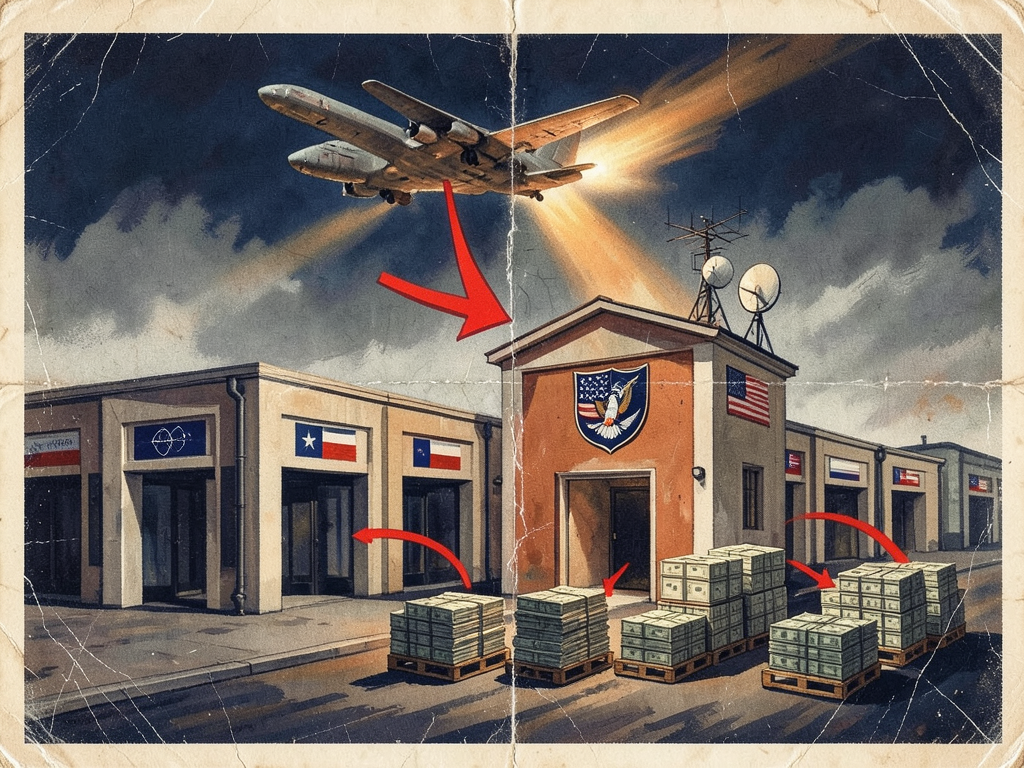
Coerce Allies for US Arms Sales
This PSYOP pressures NATO and Asian allies to increase defense spending and purchase U.S. military hardware by publicly shaming them and threatening reduced U.S. support, directly benefiting the U.S. military-industrial complex.
Cluster signature
Peak 6 articles in June 2026
Bars run to 10, not to the tallest band.
Focus, Authority, Tribe, Emotion — averaged across 17 articles.
- Loaded Language18
- Exaggeration/Minimisation14
- Appeal to Values11
- Appeal to Fear/Prejudice7
- Appeal to Authority6
- Name Calling/Labeling2
- Slogans2
- Appeal to Popularity1
Bar length is square-root scaled so the tail stays readable; counts are exact.
PSYOP Hierarchy
Executive Summary
Power Patterns
The Lobby-Industrial Complex
This PSYOP directly benefits the military-industrial complex by creating demand for U.S. arms, a classic example of the lobby-industrial complex influencing policy for profit. The pressure on allies to increase spending and grant base access is also tied to manufacturing casus belli against Iran, as seen in the CBS News and NBC News articles, which mention denying U.S. forces base access for potential attacks on Iran. This push for increased allied burden-sharing also attempts to mitigate the effects of U.S. imperial overextension by offloading costs onto allies, while simultaneously leveraging the exorbitant privilege of the dollar to compel compliance through economic and security threats.
Cui Bono — Who Benefits?
The U.S. military-industrial complex benefits directly from increased arms sales to allies. Hardline security factions benefit by securing greater allied military and logistical support for U.S. strategic objectives, particularly in the Middle East, and by reinforcing American leadership within alliances. This narrative enables them to justify increased defense budgets, consolidate military alliances under U.S. command, and project an image of strength and resolve, while externalizing the costs of imperial maintenance onto allies.
Historical Parallels
Iraqi WMDs (2002-2003)
The framing of Iran as an imminent threat requiring allied military cooperation, despite a lack of specific evidence, echoes the intelligence fabrication and media amplification used to justify the Iraq War. The CBS News and NBC News articles mention 'potential attacks on Iran' and 'operations against Iran' as the context for allied non-cooperation, creating a subtle manufacturing of casus belli.
The Sunk Cost Escalation Trap
The pressure on allies to increase spending and commitment, even when the U.S. itself is engaged in potentially costly and unpopular ventures (like the 'Iran war' mentioned by NPR and Japan Times), reflects the sunk cost trap. Allies are being told that their continued investment is necessary to support an ongoing, potentially failing, U.S. strategic direction.
Narrative Mechanics
Synchronized Talking Points
“European NATO allies are not doing enough on defense/not meeting spending commitments.”
“European allies are prioritizing social policies over military readiness.”
“European allies are denying U.S. forces base access for operations against Iran.”
“U.S. military presence in Europe is under review and could be scaled back.”
“Allies like Canada, Japan, and South Korea are 'freeloading' or 'unenthusiastic' in their contributions.”
“Increased defense spending is a prerequisite for being a 'valued partner' to the U.S.”
Framing Evolution
The narrative has evolved from general calls for increased NATO spending to specific threats of U.S. troop withdrawals and explicit demands for allied participation in U.S.-led operations against Iran. It also shifted from broad European criticism to targeting specific Asian allies like Japan and South Korea, linking their economic interests (Strait of Hormuz) to military obligations. The Globe and Mail and CBC articles show a specific escalation of pressure on Canada, including freezing joint defense boards.
Suppressed Counter-Narratives
×The actual costs and consequences of U.S. military interventions (e.g., in Iran).
×The historical context of NATO expansion and U.S. strategic interests that benefit from its military presence abroad.
×The fact that the 5% spending target is not a formal NATO rule and that many allies have already increased spending.
×The domestic political and legal constraints on military action in countries like Japan and Germany.
×Alternative diplomatic solutions or de-escalation strategies regarding Iran.
×The economic benefits derived by the U.S. from its military presence and arms sales to allies.
Outlet Coordination
Euronews, CBS News, NBC News, and NPR all published articles within a 24-hour window (June 18-19) with highly similar headlines and content regarding Hegseth's criticisms of NATO allies and the review of U.S. forces in Europe. Breitbart.com uses a more aggressive, direct tone ('Raise Defence Spending or Else'), while The Globe and Mail and CBC.ca focus on Canada's specific situation, indicating a tailored approach for different audiences. SMH.com.au and YNA.co.kr extend the pressure to Australia and South Korea, demonstrating a global reach for this coordinated message. The Japan Times and NPR (Japan article) highlight the pressure on Japan regarding the Strait of Hormuz, showing a consistent focus on specific allied vulnerabilities and interests.
Bigger Picture
This PSYOP is part of a broader strategy to reconfigure global alliances, shifting more of the financial and military burden of U.S. hegemony onto its allies. It aims to consolidate a united front against perceived adversaries, particularly Iran, while simultaneously boosting the U.S. defense industry. This push comes at a time when the U.S. is experiencing symptoms of imperial overextension and financialization, making the externalization of costs a critical component of maintaining its global posture.
Prediction
This PSYOP is likely building toward increased military spending by NATO and Asian allies, leading to significant new arms deals with U.S. defense contractors. It also prepares public opinion for potential U.S. military drawdowns in Europe, framed as a consequence of allied 'failure,' and for increased allied participation in U.S.-led military operations, particularly in the Middle East. It also sets the stage for potential diplomatic or economic repercussions against allies who resist these demands.
Sources & Articles
2026-07-06T19:35:56.000Z
2026-06-18T12:52:17.000Z
2026-07-01T17:07:59.000Z
2026-06-19T03:48:56.000Z
2026-09-19T14:51:00.000Z
2026-08-04T05:07:05.549Z
2026-07-15T22:56:56.000Z
2026-06-18T17:52:28.000Z
2026-06-18T09:20:15.761Z
2026-06-18T08:59:10.000Z
Showing 10 of 17 articles