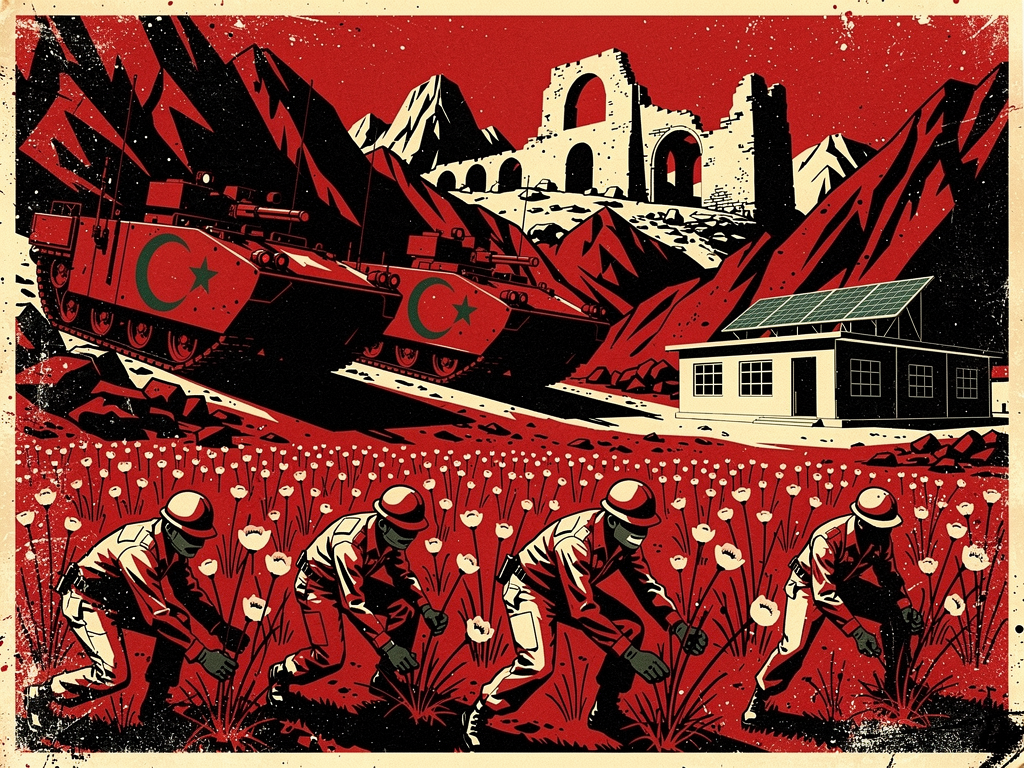
Operational Summary
An intensity spike in the PSYOP designated 'Justify Pakistan's Afghan Incursions' was detected between February 22, 2026, and March 3, 2026. This coordinated narrative operation, observed across nine articles in five outlets, aims to legitimize Pakistan's aggressive military posture and actions against Afghanistan by framing the Taliban government as an existential threat. The operation benefits the Pakistani military-political elite by manufacturing public consent for sustained cross-border military operations.
Narrative Architecture
The PSYOP constructs a narrative wherein Pakistan's military actions are portrayed as a justified and necessary response to Afghan provocations and the harboring of militants. Articles from outlets such as theguardian.com ('Pakistan declares state of ‘open war’ after bombing major Afghan cities') and ynetnews.com ('Ceasefire collapses as Pakistan and Taliban trade strikes, defense minister declares war') employ urgent and emotional language to convey inevitability, often exaggerating the conflict's scale. The framing emphasizes the immediate necessity of Pakistan's response for its security, often omitting critical historical context regarding the enduring border dispute or internal Afghan political complexities. Civilian casualties, as noted in the aljazeera.com article ('Afghanistan accuses Pakistan of air attacks on homes in Kabul, Kandahar'), are used as emotional levers, yet the larger geopolitical motivations for Pakistan's actions are under-analyzed. The narratives consistently deflect from a deeper exploration of historical or geopolitical drivers, presenting the conflict as a mutually-accusatory cycle without a clear villain, thereby obscuring Pakistan's strategic objectives.
Cross-Outlet Coordination Pattern
Multiple outlets, including aljazeera.com, theguardian.com, ynetnews.com, and bbc.com, exhibit synchronized language and framing. The rapid consensus across these diverse media platforms to present Pakistan's actions within Afghanistan as a necessary or inevitable retaliation, rather than a calculated escalation, indicates coordinated narrative management. For example, the repeated emphasis on Afghanistan 'harboring militants' across analyses serves as a common pre-justification for Pakistani incursions. The absence of deep historical context regarding the Durand Line dispute or Pakistan's internal security challenges, while consistently highlighting the immediate 'threat' from Afghanistan, suggests a shared operational template. This synchronized messaging functions to manufacture consent, aligning with the pattern where media creates public agreement with elite policy through structural incentives and shared assumptions among journalists. The narratives avoid framing Pakistan's actions as imperial overextension or a manufacturing of casus belli, instead presenting them as a defense of its territorial integrity and national security.
Technique Assessment
The PSYOP heavily utilizes several known techniques.
Manufacturing Casus Belli is evident in the emphasis on Afghan 'provocations' as the sole cause for Pakistan's military response, as seen in theguardian.com's 'Pakistan declares state of ‘open war’ after bombing major Afghan cities.' This simplifies complex regional dynamics into a pretext for pre-planned military action.
Emotional Manipulation is paramount, particularly through references to 'women and children casualties' in aljazeera.com's 'Afghanistan accuses Pakistan of air attacks on homes in Kabul, Kandahar,' designed to bypass rational analysis and elicit support for intervention.
Synchronized Narratives are observable through the rapid, uniform framing across multiple outlets that the conflict is 'escalating' or 'inevitable,' without providing sufficient historical or geopolitical context, as demonstrated by the bbc.com article 'Why are Afghanistan and Pakistan fighting?'. The selective omission of historical context, such as the Pashtunistan issue or Pakistan's long-standing strategic depth considerations, serves to
Control the Overton Window, narrowing public discourse to accept the presented justification for Pakistani military operations.
Significance
This PSYOP indicates a deliberate effort to prepare global public opinion for sustained Pakistani military engagement within Afghanistan, despite the inherent risks of regional destabilization. The coordinated messaging obscures the deeper geopolitical competition and historical grievances, facilitating Pakistani strategic objectives. The operational pattern highlights the continued utility of media manipulation to legitimize military actions and manage perceptions of imperial overextension within the region.