Legitimize Pakistan's Afghan Incursions
This PSYOP aims to legitimize Pakistan's military incursions into Afghanistan by framing them as necessary counter-terrorism measures, benefiting the Pakistani military and political establishment by deflecting international criticism and justifying potential long-term military engagement.
Executive Summary
Power Patterns
Manufacturing Casus Belli
The PSYOP manufactures a casus belli by consistently framing Pakistan's actions as a response to 'unprovoked aggression' and 'terrorist threats' emanating from Afghanistan, despite a complex history of cross-border issues. It utilizes the 'Divide and Rule' mechanism by exacerbating tensions between Pakistan and the Afghan Taliban, portraying the latter as an unreliable and hostile entity. The narrative also implicitly justifies Pakistan's 'Asymmetric Warfare Doctrine' by presenting its actions as necessary against a perceived weaker, yet dangerous, neighbor.
Cui Bono — Who Benefits?
This narrative enables the Pakistani military to conduct cross-border operations with reduced international condemnation, secure continued military aid, and maintain strategic influence in Afghanistan. For the political leadership, it provides a domestic justification for military spending and actions, rallying public support against an external 'threat'. For the US, it potentially offers a regional partner in counter-terrorism efforts, albeit one with complex and often contradictory objectives.
Historical Parallels
Iraqi WMDs (2002-2003)
Similar to the Iraqi WMDs narrative, this PSYOP relies on claims of an existential threat (terrorism) to justify military action, with limited independent verification of the specific threats or targets, and a concerted effort to shape public perception.
The Humanitarian Intervention Template (Libya 2011, Syria 2011-present)
While not framed as 'humanitarian,' the PSYOP attempts to justify military intervention by highlighting the alleged 'threat' posed by the Afghan Taliban, similar to how humanitarian concerns were leveraged to justify interventions in Libya and Syria, ultimately serving geopolitical objectives.
The Atrocity Propaganda Template (Nayirah Testimony, 1990)
Some articles, particularly those from Indian outlets, use emotionally overwhelming atrocity reports (e.g., 'massacre,' 'brutality') to generate outrage against Pakistan, mirroring the use of atrocity propaganda to build support for military action.
Narrative Mechanics
Synchronized Talking Points
“Pakistan's actions are 'self-defense' against 'terrorist threats' from Afghanistan.”
“The Afghan Taliban is 'harboring militants' and 'exporting terrorism'.”
“Pakistan's 'patience has run out'.”
“Civilian casualties are either denied, minimized, or attributed to secondary explosions/terrorist infrastructure.”
“The conflict is an 'open war' due to Afghan aggression.”
Framing Evolution
The narrative initially focused on Pakistan's 'right to defend itself' and 'targeting militant hideouts' (e.g., The Guardian, Fox News). As accusations of civilian casualties mounted, the framing shifted to either denying these claims or attributing them to the Afghan Taliban's actions, while simultaneously escalating the rhetoric to 'open war' (e.g., The Guardian, Fox News). The initial framing of 'surgical strikes' quickly gave way to a broader justification for sustained military pressure.
Suppressed Counter-Narratives
×The historical context of Pakistan's support for various militant groups in Afghanistan, including the Taliban.
×The Durand Line dispute and its role in cross-border tensions.
×Independent verification of civilian casualty figures and the nature of bombed facilities (e.g., the 'hospital' vs. 'terrorist infrastructure' claims).
×The internal political dynamics within Afghanistan and Pakistan that contribute to cross-border militancy beyond simple 'Taliban aggression'.
×The potential for diplomatic solutions or de-escalation beyond military action.
Outlet Coordination
Outlets like The Guardian, Fox News, and Al Jazeera, despite their different editorial stances, all contribute to the narrative, albeit with varying degrees of emphasis. The Guardian, for instance, reports both Pakistani justifications and Afghan accusations, but its headlines often reinforce the 'Pakistan acts against militants' frame. Fox News and Times of India push the 'Pakistan as aggressor' or 'Pakistan as justified defender' narratives more strongly, often with emotionally charged language. The rapid synchronization of claims and counter-claims, particularly around the 'hospital' incident, suggests coordinated information dissemination, likely from official sources in both Pakistan and Afghanistan, which media outlets then amplify without deep independent verification.
Bigger Picture
This PSYOP is a localized manifestation of a larger regional power struggle for influence in Afghanistan, following the US withdrawal. It positions Pakistan to assert its strategic interests in a volatile borderland region, potentially leading to a protracted low-intensity conflict or proxy warfare. The endgame is to secure Pakistan's western border and establish a compliant or at least non-hostile government in Afghanistan, or to maintain a state of controlled instability that serves Pakistani security interests.
Prediction
This PSYOP is likely building toward public acceptance of sustained Pakistani military operations in Afghanistan, potentially including deeper incursions or a more permanent military presence along the border. It also prepares the public for potential diplomatic or economic pressure on the Afghan Taliban government, framed as necessary to combat terrorism. The ultimate goal is to legitimize Pakistan's actions as defensive and necessary, thereby insulating it from international criticism and enabling its long-term strategic objectives in the region.
Intelligence Coverage
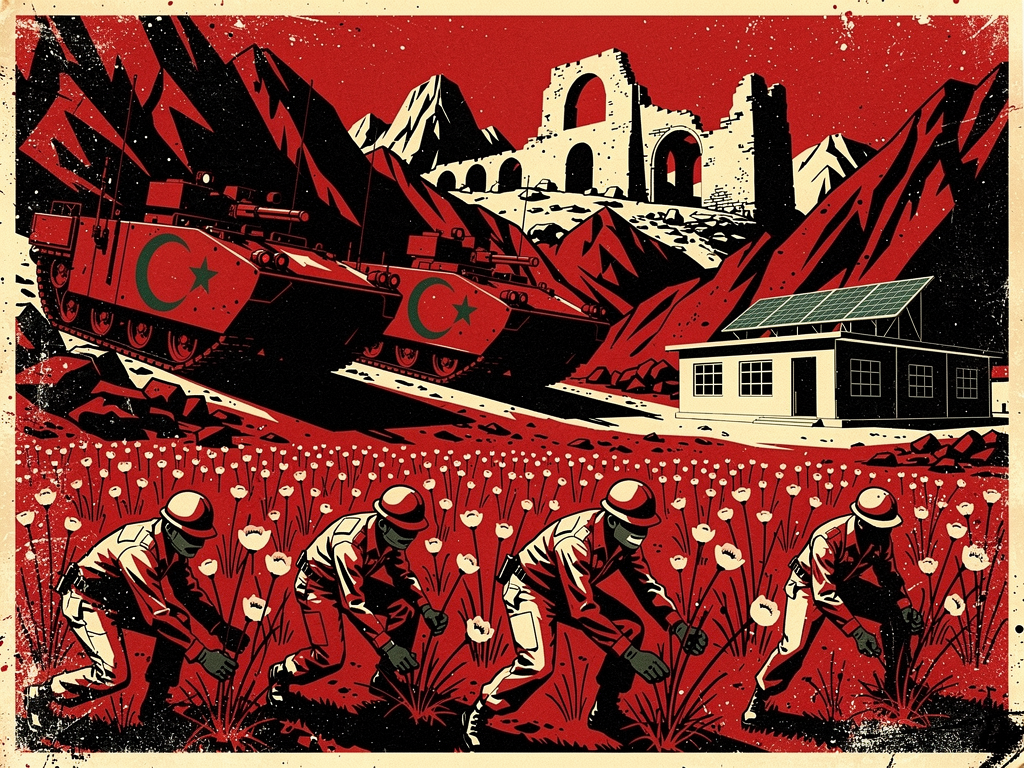
PSYOP: Justify Pakistan's Afghan Incursions Gains Traction in Western Media
An intensity spike in the PSYOP designated 'Justify Pakistan's Afghan Incursions' was detected between February 22, 2026, and March 3, 2026. This coordinated...

Pakistan Escalates Afghan Conflict: Manufactured Consent Identified
Sources: 2 outlet(s) | Articles: 4 | First detected: February 22, 2026
PSYOP: Normalize Afghanistan-Pakistan Conflict. Complex, intractable, no clear villain.
Intensity: 4/10 | Sources: 3 outlet(s) | Articles: 4 | First detected: February 27, 2026
Sources & Articles
Mar 18, 2026
Mar 17, 2026
Mar 17, 2026
Mar 17, 2026
Showing 10 of 29 articles
External Coverage(50)
Showing 10 of 50