Justify Space Militarization Spending
This PSYOP is conditioning the public to accept UAP/ET as a threat to justify massive military spending on space defense. The Military-Industrial Complex, intelligence agencies, and defense contractors benefit from this increased funding and expanded scope of operations.
Cluster signature
Peak 12 articles in June 2026
Bars run to 30, not to the tallest band.
Focus, Authority, Tribe, Emotion — averaged across 41 articles.
- Loaded Language40
- Appeal to Authority30
- Exaggeration/Minimisation21
- Appeal to Popularity11
- Appeal to Fear/Prejudice6
- Doubt4
- Obfuscation/Vagueness4
- Appeal to Values3
Bar length is square-root scaled so the tail stays readable; counts are exact.
PSYOP Hierarchy
Executive Summary
Power Patterns
Manufacturing Casus Belli
The articles are manufacturing a casus belli by creating a perceived 'threat' from UAPs, which can then be used to justify military expansion. This directly benefits the Lobby-Industrial Complex, particularly defense contractors, by opening new avenues for funding and technological development. The narrative also leverages emotional manipulation, creating a sense of mystery and urgency to bypass rational scrutiny of defense budgets.
Cui Bono — Who Benefits?
These actors benefit by creating a new, vaguely defined 'threat' that necessitates increased funding for advanced military technologies, especially in space. This allows for the expansion of budgets, research and development contracts, and the overall scope of military and intelligence operations, all under the guise of protecting national security from an unknown, potentially extraterrestrial, adversary.
Historical Parallels
Iraqi WMDs (2002-2003)
Similar to the Iraqi WMD narrative, this PSYOP relies on vague, unverified 'intelligence' and 'secret footage' (46 secret UFO clips) to create a sense of existential threat, pushing for a predetermined policy outcome (increased military spending) without concrete, verifiable evidence. The 'shocking' nature of the alleged evidence is emphasized, much like the 'mushroom cloud' rhetoric used for WMDs.
Gulf of Tonkin
The framing of UAPs as an 'unidentified' threat in sensitive military zones, as seen in the Breitbart article, echoes the Gulf of Tonkin incident where an ambiguous event was amplified to justify military escalation. The lack of clear, verifiable evidence is replaced by a sense of urgency and the need for immediate action or disclosure.
The Reichstag Fire
While not as dramatic, the creation of a climate of fear around an unknown, potentially hostile entity (UAPs) could be used to justify emergency measures or significant shifts in national priorities, similar to how the Reichstag Fire was used to expand state power and suppress opposition. The 'alien buzz' described in nbcchicago.com contributes to this climate.
Narrative Mechanics
Synchronized Talking Points
“UFO/UAP disclosure is imminent and significant.”
“Government is withholding crucial information about UAPs/aliens.”
“Presidential directives (specifically Trump's) are forcing transparency.”
“UAPs represent a national security concern, especially near military sites.”
“The topic is moving from fringe to mainstream, with scientific and political legitimacy.”
Framing Evolution
The narrative has evolved from general public curiosity about UFOs to a more urgent, national security-focused concern about UAPs, driven by official statements and congressional pressure. Initially, it was about 'disclosure' of past events, but now it's shifting towards an ongoing, active 'threat' that requires immediate attention and resources. The focus has moved from 'are they real?' to 'what are they, and how do we defend against them?'
Suppressed Counter-Narratives
×Skepticism regarding the credibility of 'secret' footage or whistleblowers without verifiable evidence.
×Alternative, prosaic explanations for UAP sightings (e.g., misidentification, advanced terrestrial technology, sensor glitches).
×The historical pattern of government over-classification and the use of 'threats' to justify military spending.
×The potential for this narrative to be a deliberate distraction from other geopolitical or domestic issues.
×The lack of any concrete, scientifically validated evidence of extraterrestrial technology or life despite decades of sightings.
Outlet Coordination
Outlets like Daily Wire, Breitbart, Ynetnews, Al Jazeera, NBC Chicago, BBC, Axios, and NPR all contribute to the narrative, often citing similar sources (Trump, Obama, congressional figures) and emphasizing the 'imminent disclosure' or 'national security threat' aspects. The timing of the articles, particularly those from February 19-20, 2026, suggests a coordinated push around the 'Trump directive' angle, even if the directive itself is vague or old. Breitbart and Daily Wire lean heavily into the 'government withholding' and 'national security' angles, while BBC and NPR maintain a slightly more detached, yet still amplifying, tone by focusing on political statements.
Bigger Picture
This PSYOP fits into the broader geopolitical landscape by providing a new, technologically advanced frontier for military expansion. As traditional terrestrial conflicts become more complex and costly, and as great power competition heats up, the 'threat from space' offers a clean, abstract enemy that can unite diverse political factions and justify unprecedented levels of investment in advanced technologies, simultaneously bolstering the US's position in a multipolar world and providing a new revenue stream for the military-industrial complex.
Prediction
This PSYOP is likely building toward public acceptance of significantly increased military budgets for space-based defense systems, the establishment of new space-focused military branches or intelligence programs, and potentially the deployment of advanced, previously undisclosed technologies. It prepares the public for a future where 'space defense' is a primary national security concern, potentially leading to a 'space race' with other nations and the militarization of the final frontier.
Intelligence Coverage

Space weapons are being normalized as a routine defense necessity
A coordinated narrative has emerged across 38 articles in 25 outlets between February 20 and September 17, 2026, to normalize the deployment of U.S. weapons ...

UAP sightings are being leveraged to justify expansion of military spending.
Sources: 11 outlet(s) | Articles: 11 | First detected: June 16, 2026
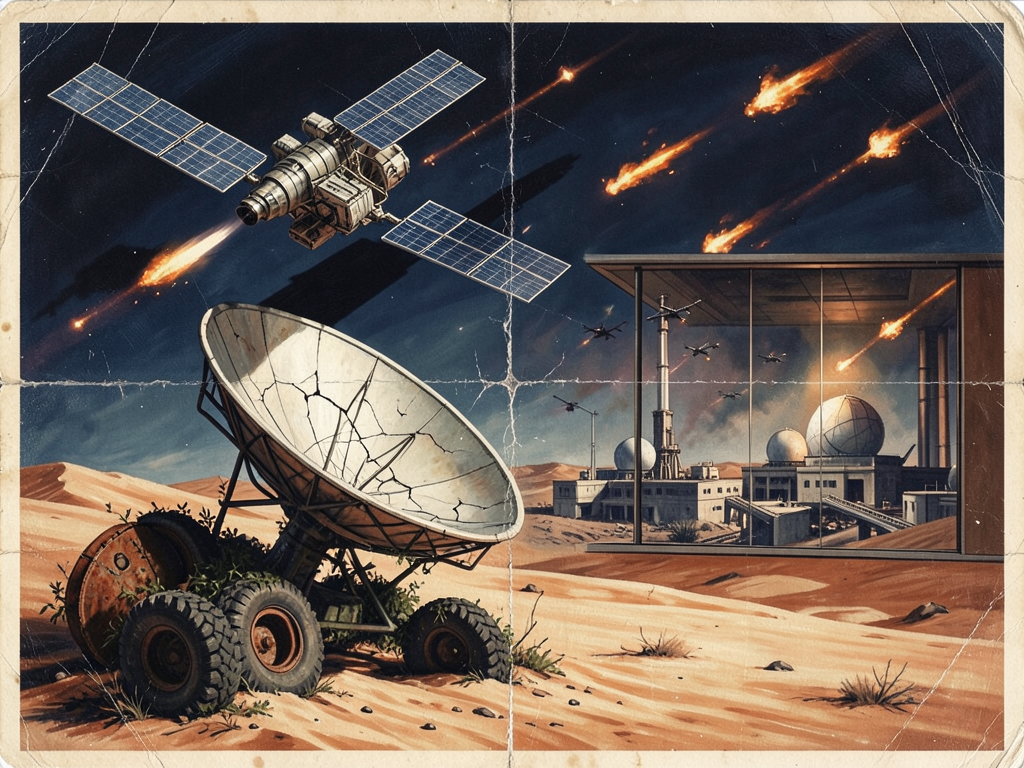
UAP Disclosures Prime Public for Space Militarization Spending
A synchronized narrative campaign is conditioning the U.S. public to accept expanded military spending on space defense under the guise of UAP disclosure. De...

Militarize Space Justify Spending: Coordinated UFO Disclosure Push
A coordinated narrative surge promoting UFO disclosure emerged on February 20, 2026, and persisted through April 20, 2026. Eight articles across ideologicall...

PSYOP ALERT: Manufacture UFO Disclosure Hype Detected Across Six Outlets
Intensity: 5/10 | Sources: 6 outlet(s) | Articles: 6 | First detected: February 19, 2026
Sources & Articles
2026-09-15T16:09:48.000Z
2026-09-14T20:56:49.000Z
2026-08-07T13:35:05.000Z
2026-10-08T11:01:01.000Z
2026-08-11T15:09:49.000Z
2026-09-18T15:13:00.000Z
2026-09-15T06:50:13.186Z
2026-09-15T20:13:43.000Z
2026-09-15T13:32:34.420Z
2026-08-08T09:29:00.000Z
Showing 10 of 41 articles