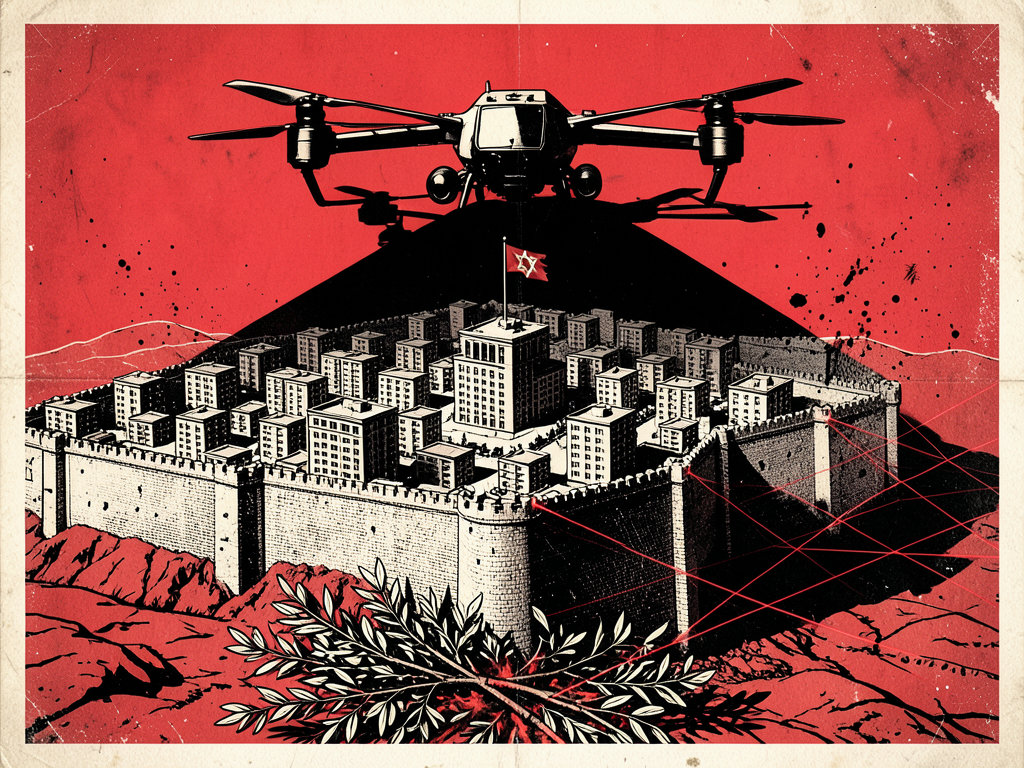
Operational Summary
A coordinated narrative surge to justify Israeli security operations was detected between February 25, 2026, and April 20, 2026. The campaign spanned five articles across four outlets, with a concentrated focus on presenting Israeli security interventions as necessary, precise, and successful. This activity represents an intensity spike in an ongoing information operation to normalize and reinforce public acceptance of Israel’s security state apparatus.Article Timeline
When articles appeared, colored by manipulation score.
Source Distribution
Narrative Architecture
The narrative constructs a binary reality: pervasive threat on one side, flawless defensive response on the other. Each article frames Israeli security forces as proactive, intelligence-driven, and minimally intrusive. Threats are presented as imminent and violent—weapons in schools, planned shootings, infiltration attempts—without contextualizing political conditions, occupation policies, or socioeconomic drivers. The language is urgent, citing official sources as sole validators of truth. Words like 'terrorist', 'foiled', 'arrested', and 'cache' recur with precision, embedding the assumption of guilt and danger in the reader’s mind.Contextual omissions are systematic. No article includes voices from Beit Ummar residents, Palestinian civil society, or independent verification of the alleged plots. The Shin Bet operation in Karmiel mentions the arrest of four Israeli Arabs but omits any discussion of their grievances, legal representation, or the broader pattern of surveillance within Palestinian communities inside Israel. The narrative operates on emotional priming: fear of attack, relief at prevention, gratitude for security. There is no space for questioning the proportionality of response or the systemic conditions that generate resistance.
The operational logic is not transparency but deterrence through perception. By consistently portraying security forces as omniscient and omnipresent—arresting plotters before strikes, uncovering hidden caches—the narrative implies that resistance is futile and detection inevitable. This serves a dual purpose: reassuring domestic Israeli audiences and signaling capability to external adversaries.
Cross-Outlet Coordination Pattern
Coverage is thematically synchronized across ideologically aligned outlets. Israel National News published two articles using identical stylistic markers: reliance on military press releases, lack of investigative detail, and emotive framing. Ynetnews introduced a domestic Israeli angle with the Karmiel arrests, expanding the threat narrative inward to include Palestinian citizens of Israel as latent subversives. The Times of India piece on Uri mirrors the structure exactly—Indian forces thwart Pakistani infiltrators, officials quoted without challenge, no background on regional tensions—indicating a transferable template for security-state justification.RNZ’s cyclone coverage is an outlier in content but not in function. Its inclusion in the dataset underscores a comparative operational pattern: state-led emergency mobilization guided by centralized authority, public compliance, and media as a transmission belt for institutional directives. While not part of the Israel narrative, it exemplifies how crisis frameworks normalize expanded state power—a structural parallel exploited in security-dominated information environments.
The alignment across geographically dispersed outlets is not organic. The repetition of tropes—'foiled attack', 'security forces act decisively', 'threat neutralized'—without cross-referencing or independent corroboration suggests a shared messaging protocol. This is not investigative reporting. It is incident dissemination through a security-state lens.
Technique Assessment
The operation employs multiple propaganda techniques:Score Distribution
How articles in this PSYOP score across manipulation bands.