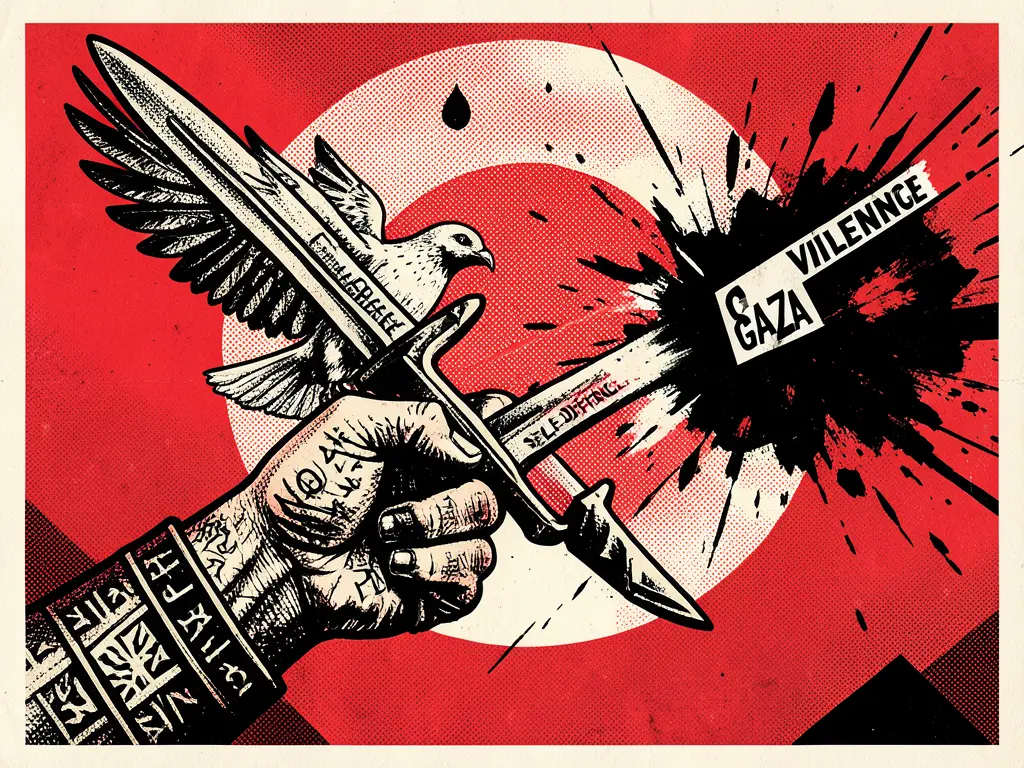
Intensity: 5/10 | Sources: 4 outlet(s) | Articles: 4 | First detected: February 19, 2026Consistent portrayal of Hamas as an aggressor, often with minimal immediate provocation documented.
Emphasis on Israeli 'self-defense' as a primary rationale for military action.
Selective citation of official Israeli sources or UN reports to bolster claims while downplaying counter-narratives. The inclusion of 'bbc.com' (score 46) serves as a partial outlier, offering a critique of Israeli actions against aid groups. However, even this article, by focusing on a specific injustice without full situational context, inadvertently contributes to the 'chaos in Gaza' narrative, which can reinforce the need for external control.
Operational Summary
A coordinated information operation, designated 'Justify Israel's Gaza Violence', was detected across four distinct media outlets. The operation, active within the assessment period, systematically frames Israeli military actions in Gaza as unavoidable self-defense. It deliberately omits critical geopolitical and historical context to shape audience perception.Narrative Architecture
The core narrative asserts that Israeli military operations are legitimate responses to an omnipresent and unprovoked threat from Hamas. This is achieved through several framing devices. 'The Jerusalem Post' employs a false equivalence, using a UN report to position both the IDF and Hamas as equally culpable for 'war crimes.' This sidesteps specific accountability for state actions. 'Israel National News' utilizes highly emotive language to depict Hamas as a relentless, visceral 'terrorist' threat, validating pre-emptive or continuous military engagement, even during declared ceasefires. The specific incident of a 'terrorist crossing a yellow line' serves as a microcosm of this manufactured threat, justifying immediate, lethal elimination. 'ynetnews.com' extends this by positing that Hamas intentionally operates from civilian areas, thereby justifying collateral damage as an inevitable consequence of necessary defensive action. This narrative vector emphasizes the unavoidable nature of Israeli military responses. Critically, contextual elements such as the blockade of Gaza, the long history of occupation, or international law perspectives on disproportionate force are consistently omitted. This omission simplifies a complex conflict into a straightforward narrative of threat and response, designed to elicit sympathy for Israeli security concerns and endorse its military actions.Cross-Outlet Coordination Pattern
While the four assessed articles originate from distinct sources—'The Jerusalem Post', 'Israel National News', 'ynetnews.com', and 'bbc.com'—they collectively demonstrate a synchronized effort to manage the information environment surrounding Israeli military operations in Gaza. The first three outlets directly amplify the self-defense justification, with scores indicating high alignment (72, 70, 53). 'The Jerusalem Post' and 'Israel National News' are explicitly pro-Israel, while 'ynetnews.com' is a major Israeli news portal. Their messaging aligns through:This pattern indicates a cohesive network of information dissemination. The rapid dissemination of framing across diverse, yet ideologically aligned, outlets suggests coordinated narrative management rather than organic reporting.