Operational Summary
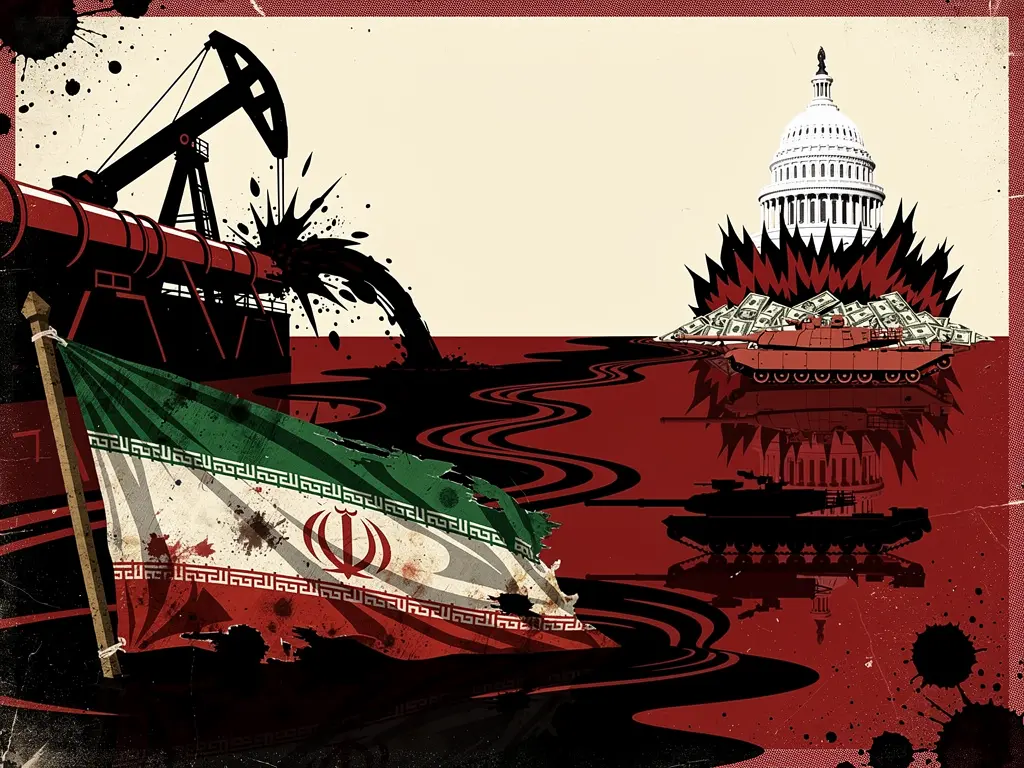
A coordinated psychological operation, designated 'Orchestrate Iran War Justification,' was detected between March 11, 2026, and March 12, 2026. This PSYOP endeavors to manufacture consent for US military intervention in Iran by framing it as a direct and imminent global threat. The operation involved three distinct articles across three outlets, primarily serving the interests of the military-industrial complex and the Israel lobby.
Narrative Architecture
The operational pattern observed is the manufacturing casus belli, specifically the 'Iran nuclear threat' and the 'threat to shipping' narratives, which are frequently used to justify preemptive action. The messaging aims to create an emotional override of rational analysis by portraying Iran as an aggressive and irrational actor. smh.com.au's 'Iran's supreme leader vows to fight on' employs attention-grabbing, urgent language to describe Iran's new leader as a direct threat, particularly to oil tankers, without offering nuanced context on internal Iranian politics or historical drivers of conflict. This omission leverages trauma-based selection in the audience, relying on pre-existing anxieties about regional instability. Similarly, breitbart.com's 'Trump Warns Iran Not to Put Mines in Strait of Hormuz' asserts Iran as an immediate threat to global oil and safety, pushing for aggressive military action. It uses strong, emotional language to emphasize urgency while omitting details on intelligence sources or the historical context of US-Iran relations. This tactic is consistent with eschatological mobilization, particularly the 'Eschatological Endgame Scenario' involving regional escalation designed to destabilize the Middle East. The narrative systematically omits the history of US intervention (such as the 1953 Iran Coup) and sanctions, preventing a full understanding of Iranian responses. The messaging directly aligns with the geopolitical actor profile of Israel, which frames an 'existential threat' from Iran to justify preemptive action.
Cross-Outlet Coordination Pattern
While the scale is limited to three articles, their release within a 24-hour window from diverse outlets (smh.com.au, timesofindia.indiatimes.com, breitbart.com) highlights a synchronized narrative. The core message—Iran as an immediate threat requiring aggressive US response—is consistent, regardless of the outlets' typical ideological leanings. This indicates a coordinated messaging effort rather than organic independent reporting. The Times of India article, '"We are simply not ready": US says its military cannot escort vessels in Strait of Hormuz right now,' serves a different but complementary function: to create a perceived vulnerability that necessitates a strengthened military posture, laying groundwork for future escalation. The absence of specific synchronized narrative data beyond shared timing prevents deeper analysis of propagation vectors, but the thematic alignment is indicative of strategic communication. This synchronicity suggests top-down narrative management, exploiting the Overton window to normalize confrontation with Iran.
Technique Assessment
This PSYOP primarily utilizes attention capture and emotional manipulation, particularly fear and outrage, to bypass rational assessment. The immediate presentation of Iran as an 'imminent global threat' without supporting verifiable evidence or historical context is a classic manufacturing casus belli and atrocity propaganda template. The consistent focus on alleged Iranian aggression against shipping lanes and the 'vows to fight' narrative align with imperial overextension reasoning, positioning US military intervention as a necessary response to secure international commerce. The selective omission of historical context, such as past US interventions in Iran or the impact of sanctions, further functions as a divide and rule mechanism, obscuring the imperial hand and portraying regional conflicts as solely Iranian-driven. The narrative frames asymmetric strategies as 'terrorism' or 'destabilization' while normalizing US conventional military presence, consistent with the asymmetric warfare doctrine pattern.
Significance
This PSYOP is critical as it leverages pre-existing anxieties to justify military action, aligning with the financialization death spiral by diverting resources to military expenditure. Such coordinated messaging serves to maintain the lobby-industrial complex's influence over foreign policy, reinforcing cycles of conflict. The consistent dehumanization and threat inflation of Iran contribute to the broader civilizational cycle of authoritarian drift by normalizing aggressive foreign policy responses.