Operational Summary
A newly detected PSYOP, designated "Contain China's Global Standing," was active between March 8, 2026, and March 11, 2026. This operation disseminates a narrative that frames China as a purely transactional and self-interested economic actor, thereby mitigating its perceived geopolitical threat and undermining its potential for global leadership or strong alliances. The operation targeted public perception across four distinct media outlets.Narrative Architecture
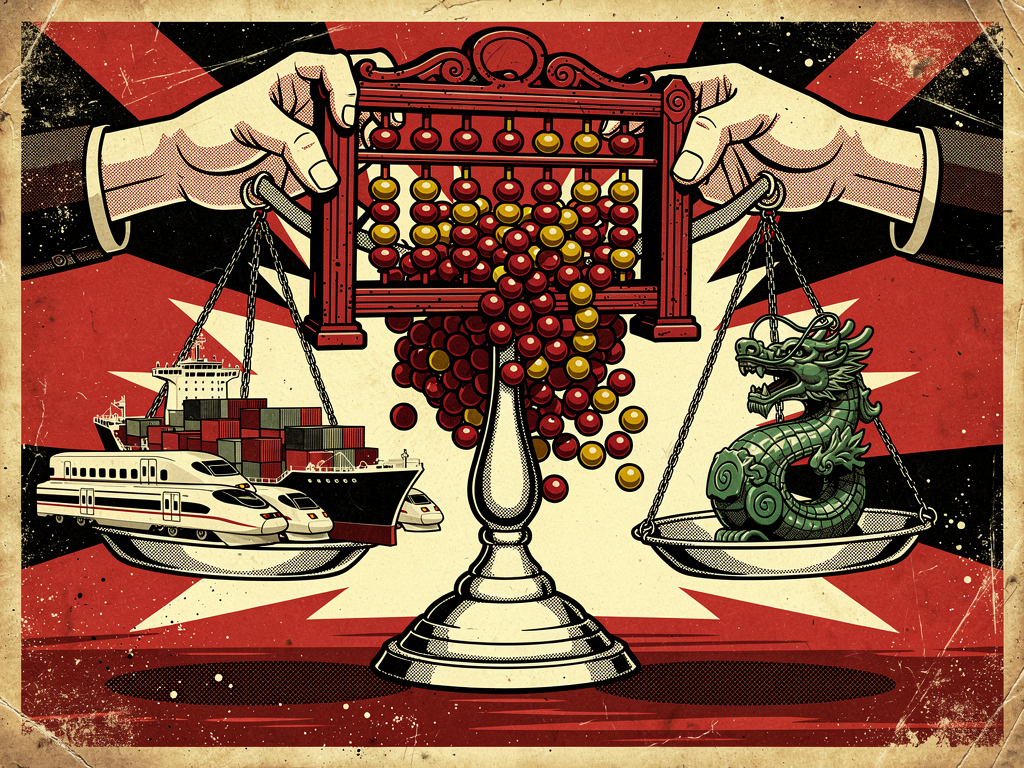
This PSYOP systematically reduces China's international engagement to self-serving economic calculus, primarily to contain its emerging global standing within the information environment. The narrative construction leverages several power mechanisms. Financialization is implicitly applied to China's actions, suggesting its primary motivation in the Middle East, for instance, is purely profit-driven rather than strategically or culturally informed. This portrayal implicitly denies China any civilizational resistance qualities or nuanced long-term strategic objectives beyond immediate material gain. The 'China needs Strait of Hormuz to remain open, but has stayed on the war’s sidelines' narrative, amplified by theglobeandmail.com, exemplifies this, depicting China's balancing act as solely self-interested. Similarly, smh.com.au's 'Trump demand for Beijing’s help with Iran lands flat' uses emotional appeals and expert opinions to normalize China's non-engagement as understandable, while simultaneously reinforcing the transactional framing. The nbcnews.com piece, 'Trump's China summit with Xi Jinping just got a lot more complicated,' employs loaded language to portray China's relationships with partners like Iran and Venezuela as financially opportunistic, implying unreliability in times of crisis or external pressure. This architecture creates a perception of China as a rational but cold actor, one less likely to challenge the existing hegemonic order. This serves the interests of the United States and Israel by preparing for a strategy of containment without portraying it as an aggressive act against a rising global contender.Cross-Outlet Coordination Pattern
Article Timeline
When articles appeared, colored by manipulation score.
Source Distribution
This PSYOP demonstrates a coordinated messaging pattern across multiple mainstream news outlets, including smh.com.au, theglobeandmail.com, nbcnews.com, and theguardian.com. The operational pattern is characterized by synchronized narrative vectors within a narrow timeframe from March 8-11, 2026. All four articles, despite originating from different geographic regions and editorial stances, converge on the central theme of China's transactional and self-interested foreign policy, particularly concerning its engagement in complex geopolitical theaters like the Middle East. The common emphasis on economic motivation, the use of expert quotes to lend authority, and the strategic omission of broader geopolitical context or China's long-term civilizational objectives indicate coordinated narrative management rather than independent journalistic inquiry. For instance, theguardian.com's 'Trump’s show of force in the Middle East creates a weakness China can exploit' mirrors the transactional framing, positioning China as an opportunist rather than a principled or ideological actor. The rapid deployment of this specific framing across diverse outlets within days suggests pre-prepared talking points or a shared analytical lens intentionally disseminated.
Technique Assessment
Score Distribution
How articles in this PSYOP score across manipulation bands.
Clean
Low
Moderate
19
High
1
Severe
Several PSYOP techniques are evident in the detected articles. A primary mechanism is the Manufacturing of Consent through the reliance on official sources and think tank experts, presented as unquestionable authorities to support the transactional narrative. The articles feature quotes from officials and experts, which are then used to validate predefined conclusions about China's motivations without deeper contextualization. Another technique involves Emotional Manipulation, employing strong, loaded words to describe the geopolitical landscape and China's role, effectively bypassing rational analysis. For example, smh.com.au labeling the Middle East a "diabolical quagmire" serves to influence reader perception without requiring substantive argument. The Omission of Context is also prevalent; articles selectively omit information regarding China's long-term strategic goals, its historical role, or the full complexity of its international relationships, particularly with nations like Iran and Venezuela. This deliberate exclusion ensures the narrative remains tightly focused on transactional self-interest, ignoring any potential for genuine alliance or leadership based on shared principles. The overall effect is to maintain an Overton Window that disallows the perception of China as a legitimate alternative global leader or a strong, reliable ally with non-economic motivations.