Sanitize Russian Aggression
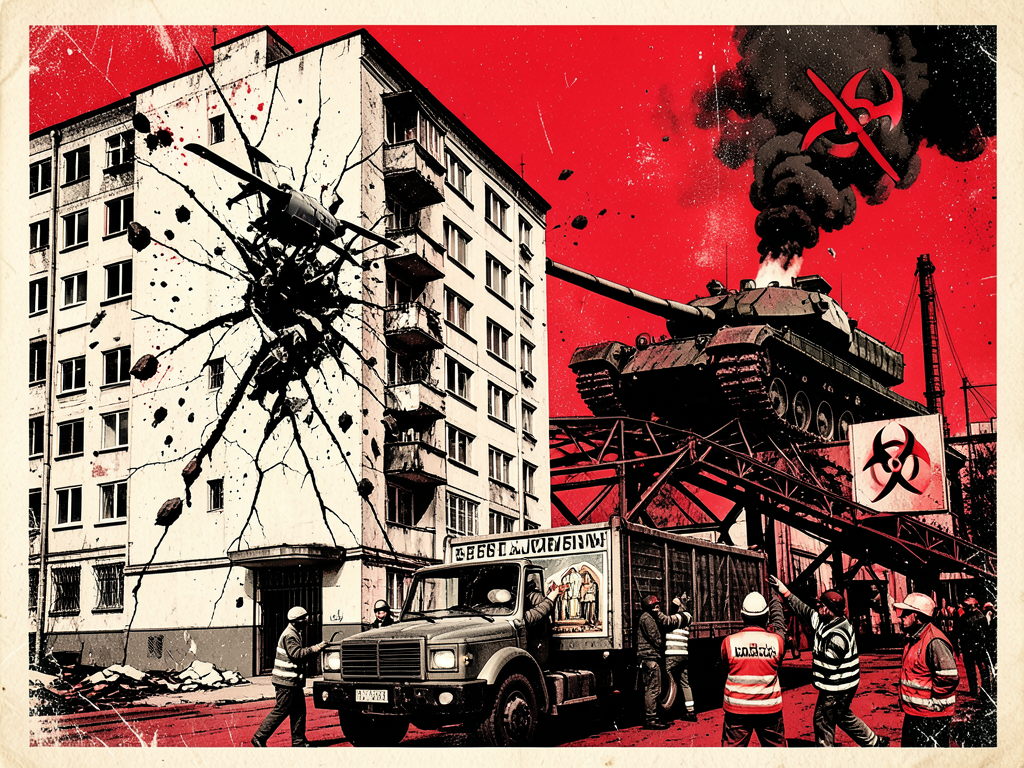
This PSYOP aims to legitimize Russia's military actions and future escalations against Ukraine by portraying Ukraine as the aggressor, thereby justifying Russian retaliation and maintaining public support for the conflict. The Russian Federation and its leadership benefit from this narrative.
PSYOP Hierarchy
Executive Summary
Power Patterns
Manufacturing Casus Belli
The PSYOP manufactures a casus belli by presenting Ukrainian drone and missile strikes as unprovoked attacks on civilians and cultural sites, justifying Russian retaliation. It scapegoats Ukraine as a 'terrorist' state to displace blame for the conflict's escalation and reinforces Russia's myth of being a defensive power against Western aggression, while framing Ukrainian asymmetric tactics as barbaric.
Cui Bono — Who Benefits?
This narrative enables the Russian government to maintain domestic support for the war, justify military escalation and retaliatory strikes as defensive measures, and potentially garner international sympathy by portraying Russia as a victim of Ukrainian aggression. It also serves to delegitimize Ukraine's actions and its Western support, while showcasing Russia's military strength and resolve.
Historical Parallels
The Reichstag Fire
The narrative uses alleged Ukrainian attacks on civilian targets (e.g., student dorms, cultural sites) to create a climate of fear and outrage, justifying emergency measures and expanded state power, similar to how the Reichstag fire was used to consolidate Nazi power.
Atrocity Propaganda Template (Nayirah Testimony, 1990)
The articles, particularly from RT.com, rely on emotionally overwhelming reports of civilian casualties (e.g., '21 students killed by Ukrainian strike,' 'teenage girls') to generate public outrage and override rational analysis, similar to the fabricated Nayirah testimony used to build support for the Gulf War.
Manufacturing Casus Belli (Iraqi WMDs, Gulf of Tonkin)
The PSYOP consistently frames Ukrainian actions as 'unprovoked' or 'terrorist' attacks, creating a pretext for pre-planned Russian military responses, mirroring how the Gulf of Tonkin incident or Iraqi WMD claims were used to justify military action.
Narrative Mechanics
Synchronized Talking Points
“Ukraine is deliberately targeting Russian civilians, including students and cultural sites.”
“Ukrainian actions are 'terrorist attacks' or 'barbaric'.”
“Russia is a victim defending itself against Ukrainian aggression and Western interference.”
“Russia possesses advanced military capabilities (e.g., Sarmat missile, drone defense).”
“Ukraine's drone strikes are destabilizing and dangerous to neighboring countries.”
Framing Evolution
The narrative has evolved from initially focusing on Russia's 'special military operation' as a defensive measure against NATO expansion (as seen in 'Russia fighting solo against entire West – Putin') to actively portraying Ukraine as a perpetrator of war crimes and terrorism against Russian civilians and cultural heritage. This shift aims to justify more aggressive Russian retaliation and to reframe the conflict as Russia defending itself against a barbaric enemy.
Suppressed Counter-Narratives
×Context of Russia's initial invasion and ongoing occupation of Ukrainian territory.
×Independent verification of claims regarding civilian targets and military significance of attacked sites.
×Ukrainian perspectives on their strategic objectives for strikes within Russia.
×International law regarding self-defense and proportionality in armed conflict.
×The role of Russian military presence in or near alleged civilian targets in Ukraine.
Outlet Coordination
RT.com is the primary outlet pushing this PSYOP, with 9 out of 14 articles directly contributing to the 'Justify Russian Escalation' narrative. These articles consistently use emotionally charged language, focus on civilian casualties attributed to Ukraine, and frame Russian actions as defensive. Other outlets like CBS News, The Globe and Mail, Al Jazeera, and France24 provide more balanced reporting on Ukrainian strikes into Russia, often framing them as strategic responses, but their inclusion in the cluster highlights the contrast with the RT.com narrative. The Australian (smh.com.au) and ynetnews.com also contribute to the broader context of attacks and counter-attacks, but without the explicit pro-Russian framing of RT.com. The timing of RT.com articles often coincides with reports of Ukrainian strikes, immediately framing them as unprovoked aggression.
Bigger Picture
This PSYOP is a critical component of Russia's broader information warfare strategy, aiming to shape both domestic and international perceptions of the conflict. By portraying Ukraine as a terrorist state, Russia seeks to erode international support for Kyiv, legitimize its own military actions, and prepare its population for a prolonged and potentially escalating conflict. It fits into a larger geopolitical landscape where Russia is attempting to reassert its influence and challenge Western hegemony.
Prediction
This PSYOP is likely building toward public acceptance of more aggressive and widespread Russian retaliatory strikes against Ukraine, potentially including targets previously considered off-limits. It also prepares the public for a narrative that justifies a protracted conflict, framing any Russian escalation as a necessary defense against Ukrainian 'terrorism' and Western 'provocation.'
Related PSYOPs
Sources & Articles
Jun 7, 2026
Jun 12, 2026
Jun 12, 2026
Jun 10, 2026
Jun 13, 2026
Jun 13, 2026
Jun 15, 2026
Jun 13, 2026
Showing 10 of 35 articles
External Coverage(50)
Showing 10 of 50