Protect U.S. Tech Monopolies
This PSYOP frames U.S. AI dominance as a geopolitical threat to justify state-funded national AI projects in allied countries, benefiting U.S. Big Tech and local telecom-defense monopolies. By stoking fears of dependency, it drives partnerships and subsidies that entrench existing corporate power under the guise of technological sovereignty.
Cluster signature
Peak 8 articles in June 2026
Bars run to 12, not to the tallest band.
Focus, Authority, Tribe, Emotion — averaged across 20 articles.
- Loaded Language27
- Appeal to Values11
- Appeal to Authority8
- Exaggeration/Minimisation8
- Appeal to Fear/Prejudice7
- Flag Waving5
- False Dilemma3
- Whataboutism3
Bar length is square-root scaled so the tail stays readable; counts are exact.
Executive Summary
Power Patterns
Manufacturing Consent
The cluster operates by manufacturing consent for domestic consolidation of AI under nationalized tech monopolies by framing U.S. policy as an external threat. Articles from CNBC and ABC News echo concerns among European and Canadian officials about being treated as security risks, positioning American export controls as unjustified protectionism rather than strategic defense—thereby legitimizing the push for 'sovereign AI' ecosystems. The U.S. government’s own messaging on whitehouse.gov simultaneously promotes American AI superiority and disparages global governance, creating a controlled opposition dynamic where both sides reinforce the necessity of national-scale AI monopolies. This aligns with financialization, as AI dominance becomes less about innovation and more about rent extraction through infrastructure control.
Cui Bono — Who Benefits?
The narrative enables U.S. tech giants to maintain their global dominance by positioning their platforms as indispensable, while allowing foreign state-linked telecom and defense firms to justify massive public investments in AI infrastructure under the guise of national security. By portraying the U.S. as both a rival and a technological gold standard, the narrative ensures continued dependency on the American AI stack even as 'sovereign' alternatives are promoted. This duality allows corporate monopolies in allied nations to receive state subsidies and regulatory protection without challenging the core financialized ecosystem that funnels profits back to Wall Street and Silicon Valley.
Historical Parallels
Iraqi WMDs (2002-2003)
Just as the WMD narrative achieved rapid, uniform consensus across mainstream outlets using anonymous intelligence and elite sourcing to justify military action, this AI dominance narrative uses synchronized language about 'strategic vulnerability' and 'technological colonialism' from G7 summits and telecom CEOs to justify massive state spending on AI infrastructure before independent scrutiny.
Divide and Rule in the British Empire
By amplifying tensions between the U.S. and its allies over AI access, the narrative fractures Western technological cooperation, ensuring that European, Indian, and Canadian AI efforts remain fragmented and dependent on core U.S. components—mirroring how colonial powers exploited internal divisions to prevent unified resistance.
Narrative Mechanics
Synchronized Talking Points
“U.S. AI dominance threatens national security”
“Reliance on American tech creates strategic vulnerability”
“Sovereign AI ecosystems are urgent and necessary”
“G7 allies are unfairly treated as security risks”
“Global governance of AI is a threat to innovation”
Framing Evolution
The narrative has shifted from early concerns about AI ethics and transparency in the 2020s to a current focus on geopolitical control and infrastructure dependency. Initially framed as a regulatory challenge, it is now portrayed as an existential economic and military issue, with AI equated to nuclear capability or energy independence. This escalation in stakes raises the perceived need for state intervention and massive public investment.
Suppressed Counter-Narratives
×The role of Western venture capital and corporate monopolies in blocking decentralized, open-source AI development
×The possibility of international scientific cooperation as an alternative to nationalized AI monopolies
×The ecological cost and financialization of AI infrastructure spending
×The fact that U.S. 'restrictions' often target dual-use technologies with legitimate security concerns
Outlet Coordination
The narrative is pushed most aggressively by CNBC and ABC News, both of which cover G7-level discussions with authoritative sourcing but no critical inquiry into the motives behind the 'sovereign AI' push. Whitehouse.gov's piece from February 2026 is particularly instructive—though older, its messaging is being echoed now, suggesting a coordinated rollout. The foreign outlets like The Cradle and New Arab amplify the anti-American framing, while Politico EU and ThinkChina position the narrative as a civilizational challenge, indicating a globally synchronized effort to reframe AI as a zero-sum power struggle.
Bigger Picture
This PSYOP is part of a broader struggle to manage the decline of U.S. productive hegemony by shifting the basis of power to financialized control of AI and data infrastructure. Rather than fostering open, scientific collaboration, the aim is to lock the world into nationalized, rent-seeking AI systems that maintain Western corporate dominance under the guise of competition. The end game is not decoupling, but deeper integration into a dollar- and tech-denominated global hierarchy.
Prediction
This PSYOP is building toward major legislative pushes in Europe, India, and Canada to fund state-backed AI infrastructure projects—effectively creating protected national monopolies in partnership with incumbent telecom and defense firms. These projects will be sold as acts of technological independence but will remain dependent on U.S. chips, models, and cloud platforms, ensuring continued profit extraction by American tech giants while appearing to empower domestic industry.
Intelligence Coverage
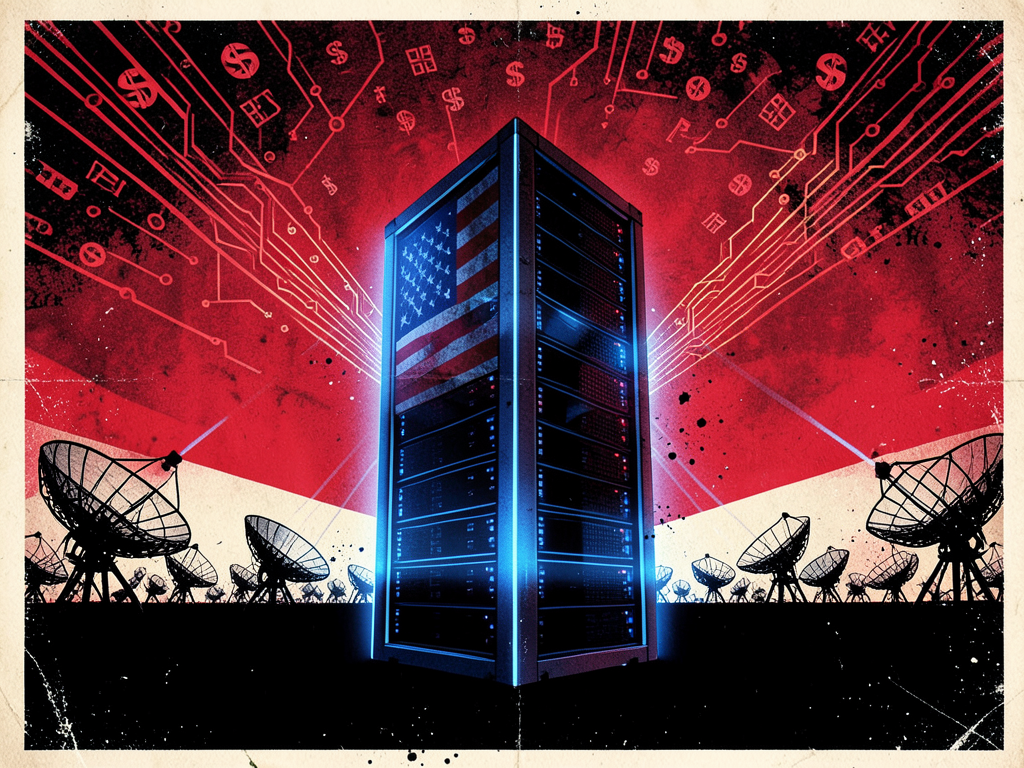
U.S. AI dominance is being framed as a global threat to justify tech subsidies
A coordinated narrative has emerged across 19 articles in 9 outlets between June 17, 2026 and September 17, 2026. The messaging reframes U.S. corporate leade...

U.S. tech dominance is being sold as a global threat to justify AI partnerships
A synchronized narrative push ran from June 17, 2026 to July 18, 2026 across 12 articles in 7 outlets. The operation reframes U.S. AI leadership as a geopoli...
Sources & Articles
Sep 16, 2026
2026-09-15T02:45:26.000Z
2026-09-14T14:23:29.000Z
2026-09-14T12:14:29.544Z
2026-09-08T15:07:00.000Z
2026-07-17T07:17:04.000Z
2026-07-17T05:43:49.000Z
Showing 10 of 20 articles