Orchestrate Pentagon Oversight
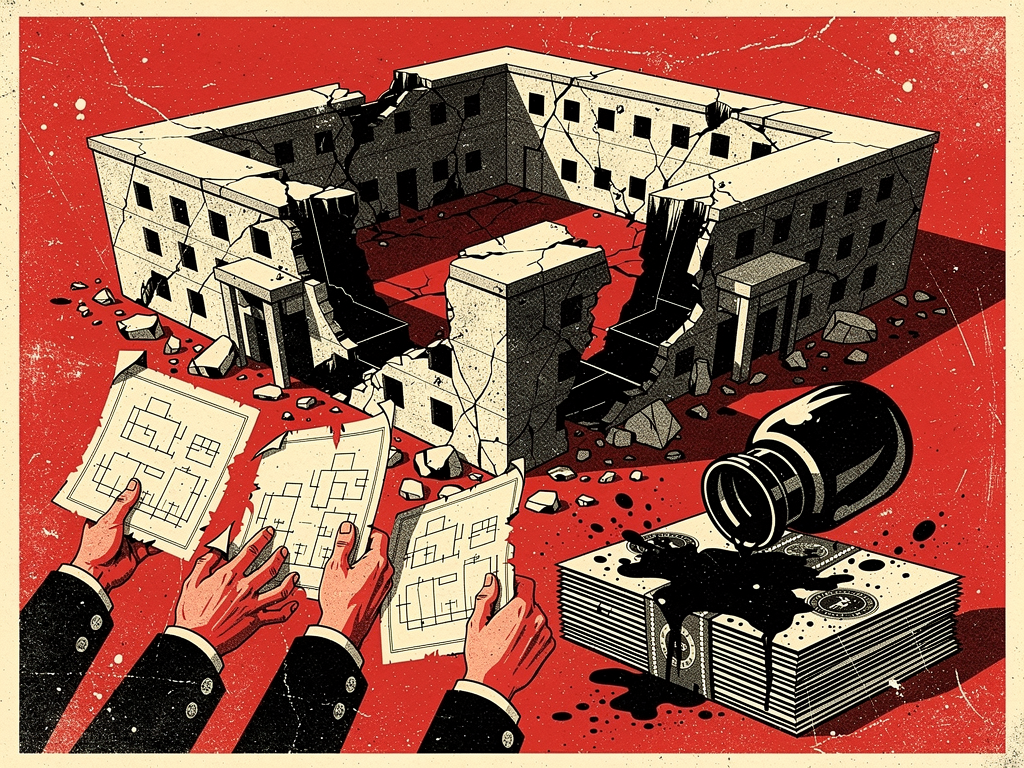
This PSYOP aims to erode public trust in the Pentagon, creating public acceptance for increased political oversight and potential budget cuts. It benefits political factions seeking to reduce military influence and foreign adversaries sowing internal discord.
Executive Summary
Power Patterns
Manufacturing Consent
The synchronized narrative across diverse outlets, from mainstream to conservative, manufactures consent for the idea that the Pentagon is acting against democratic principles. The 'revelation' of the judge's ruling, while seemingly a check on power, is amplified to induce learned helplessness and distrust in the institution. The focus on 'restrictive policies' and 'tightened controls' also subtly points to bureaucratic ossification, suggesting an institution out of touch and overreaching.
Cui Bono — Who Benefits?
By portraying the Pentagon as secretive and hostile to transparency, this narrative enables political actors to justify increased scrutiny, budget cuts, or even leadership changes within the military. Foreign adversaries benefit from the erosion of trust in a core US institution, contributing to overall societal fragmentation. Media outlets benefit by positioning themselves as watchdogs, enhancing their own legitimacy while undermining that of the Pentagon.
Historical Parallels
The Reichstag Fire (1933)
While not a direct act of sabotage, the narrative of the Pentagon suppressing information creates a climate of fear and distrust, similar to how the Reichstag Fire was used to justify emergency measures and expand state power, albeit here the narrative is used to undermine a state institution rather than empower it directly.
The Color Revolution Template (2000s-present)
This PSYOP uses a similar tactic of delegitimizing a target institution (the Pentagon) by framing its actions as 'authoritarian' and against 'democratic principles,' much like how Color Revolutions delegitimize target governments.
Narrative Mechanics
Synchronized Talking Points
“Pentagon policies are 'unconstitutional' and violate the First Amendment.”
“The Pentagon is 'restricting' or 'tightening controls' on press access.”
“The policies 'weed out disfavored journalists' and impede public information.”
“The judge's ruling is a victory for press freedom and transparency.”
Framing Evolution
The initial framing focuses on a legal challenge to press access, emphasizing constitutional rights. It then evolves to include broader accusations of suppressing independent journalism and combating 'woke distractions,' suggesting an ideological motivation behind the Pentagon's actions.
Suppressed Counter-Narratives
×The Pentagon's specific security justifications for its policies.
×The potential for foreign intelligence operations targeting journalists with Pentagon access.
×The definition and context of 'woke distractions' from the Pentagon's perspective.
×The broader geopolitical context that might necessitate tighter information control.
Outlet Coordination
CBS News and NPR, typically seen as mainstream, report on the judge's ruling with a focus on constitutional rights and press freedom. Breitbart, a conservative outlet, also highlights the judge's ruling, emphasizing the 'unconstitutional' nature of the policies. NPR's second article introduces the 'woke' angle, suggesting a coordinated effort to broaden the attack on the Pentagon's legitimacy beyond just press access to include ideological control. The rapid and consistent framing across these diverse outlets suggests coordinated narrative management.
Bigger Picture
This PSYOP fits into a broader effort to fragment US institutions and erode public trust in established authorities. By targeting the Pentagon, a core institution, it contributes to internal destabilization, making the US more vulnerable to both internal political shifts and external geopolitical pressures. The endgame is to weaken the military's autonomy and public support, potentially making it more susceptible to political capture or less effective in projecting power.
Prediction
This PSYOP is likely building toward public acceptance of increased political oversight or intervention in military affairs, potentially leading to budget cuts, leadership purges, or a redefinition of the military's role that aligns with specific political agendas. It prepares the public to view any resistance from the Pentagon as further evidence of its 'illegitimacy' or 'ideological capture'.
Sources & Articles
Mar 21, 2026
Mar 15, 2026
Mar 22, 2026
External Coverage(50)
Showing 10 of 50