Normalize Western Naval Aggression
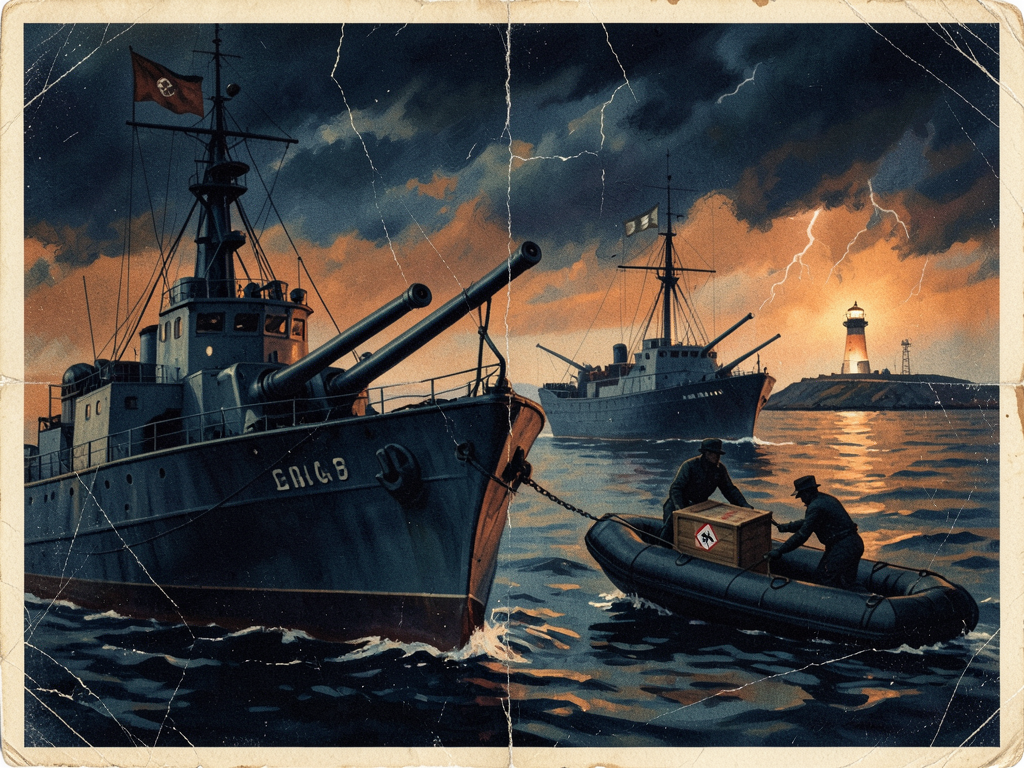
This PSYOP normalizes increased Western naval aggression and enforcement actions against perceived adversaries, particularly Russia, under the guise of upholding international law. It benefits the United States, France, United Kingdom, and NATO by building public acceptance for expanded maritime interdictions and enforcement capabilities.
Cluster signature
Peak 6 articles in June 2026
Bars run to 6, not to the tallest band.
Focus, Authority, Tribe, Emotion — averaged across 7 articles.
Bar length is square-root scaled so the tail stays readable; counts are exact.
PSYOP Hierarchy
Executive Summary
Power Patterns
Manufacturing Casus Belli
The narrative manufactures a casus belli by framing the 'shadow fleet' as an illicit, existential threat to international order, justifying aggressive naval actions. The repeated emphasis on 'funding Putin's war' and 'upholding maritime law' serves as a modern religious legitimation of power, framing Western actions as morally imperative. Russia's response, labeled 'borderline piracy' by rt.com, highlights the asymmetric warfare doctrine at play, where Western powers use economic and naval pressure to target vulnerabilities.
Cui Bono — Who Benefits?
These nations benefit by normalizing and expanding their capacity for naval interdictions in international waters, effectively extending their enforcement reach under the guise of sanctions compliance. This enables them to project power, disrupt adversaries' economic lifelines, and establish precedents for future maritime control, all while maintaining a narrative of upholding a 'rules-based order'.
Historical Parallels
Iraqi WMDs (2002-2003)
Similar to the WMD narrative, the 'shadow fleet' narrative creates an urgent, existential threat (funding war, evading sanctions) to justify pre-planned aggressive actions, with limited independent verification of the claims.
Sanctions as Siege Warfare
The naval interdictions are an extension of sanctions, aiming to collectively punish and disrupt Russia's economy, presented as an alternative to direct military conflict but with potentially devastating economic consequences.
Narrative Mechanics
Synchronized Talking Points
“The 'shadow fleet' is funding Russia's war in Ukraine.”
“Naval interdictions are a 'major step' or 'significant strike' against Russian sanctions evasion.”
“These actions uphold international law and maritime norms.”
“Western coordination is crucial for effective enforcement.”
Framing Evolution
The narrative has evolved from general concerns about sanctions evasion to specific, publicized naval interdictions, with an increasing emphasis on the 'effectiveness' and 'legitimacy' of these aggressive actions. The initial reports focused on the event itself, while later ones, particularly from nbcnews.com and aljazeera.com, leaned into the broader justification and impact.
Suppressed Counter-Narratives
×Detailed legal justifications for seizing vessels in international waters, especially regarding the definition of 'shadow fleet' and proof of sanctions evasion.
×The potential for these actions to be perceived as acts of piracy or aggression by non-Western nations.
×The broader economic impact of these interdictions on global shipping and energy markets.
×Russia's perspective on the legality and proportionality of these actions, beyond a brief mention of 'piracy' in rt.com.
Outlet Coordination
The cbc.ca and nbcnews.com articles, with scores of 52 and 48 respectively, lean into the 'decisive action' and 'undermining Putin's war' framing, highlighting British and French leadership. Aljazeera.com also emphasizes the 'legitimate and necessary action' aspect. NPR.org provides a more factual account with less overt amplification, while rt.com presents the Russian counter-narrative of 'borderline piracy,' indicating a clear divergence in framing based on geopolitical alignment.
Bigger Picture
This PSYOP fits into the broader geopolitical landscape of escalating economic warfare and maritime control against Russia. It aims to solidify Western dominance over global trade routes and establish precedents for enforcing unilateral sanctions through naval power, thereby reinforcing the existing unipolar order against emerging multipolar challenges.
Prediction
This PSYOP is likely building toward public acceptance of more frequent and aggressive naval interdictions, potentially involving a wider range of targets beyond Russia, and a broader expansion of Western maritime enforcement capabilities under the guise of upholding international law and combating illicit activities.
Intelligence Coverage
Sources & Articles
2026-08-12T09:20:18.000Z
Jun 1, 2026
Jun 14, 2026
Jun 1, 2026
2026-06-14T12:22:35.387Z
Jun 1, 2026