Justify Pakistan's Afghan Aggression
This PSYOP aims to legitimize Pakistan's military incursions into Afghanistan by framing them as necessary counter-terrorism measures. It benefits the Pakistani military and political establishment by deflecting criticism and securing international support for its actions.
Executive Summary
Power Patterns
Manufacturing Casus Belli
The PSYOP manufactures a casus belli by amplifying claims of Afghan-backed terrorism against Pakistan, justifying retaliatory strikes. It uses 'Divide and Rule' by portraying the Afghan Taliban as an unreliable and hostile entity, creating a narrative of perpetual conflict. The framing of Pakistan's actions as 'self-defense' against 'terrorist hideouts' (The Guardian, foxnews.com) serves to legitimize military actions that might otherwise be seen as imperial overextension.
Cui Bono — Who Benefits?
This narrative enables the Pakistani military to conduct cross-border operations with reduced international condemnation, secure continued military aid and diplomatic support, and consolidate domestic power by presenting itself as a protector against external threats. It also allows the US to maintain influence in the region by backing a key strategic partner against a perceived common enemy (militant groups).
Historical Parallels
Gulf of Tonkin
The amplification of alleged cross-border attacks and the immediate, decisive military response by Pakistan, framed as necessary self-defense, mirrors the way the Gulf of Tonkin incident was used to justify escalation in Vietnam.
Iraqi WMDs (2002-2003)
The consistent framing of 'terrorist hideouts' and 'militant threats' as justification for strikes, despite conflicting reports on targets and casualties, echoes the WMD narrative used to justify the Iraq War, where intelligence claims were amplified without independent verification.
The Humanitarian Intervention Template (Libya 2011, Syria 2011-present)
While not a direct intervention, the narrative attempts to sanitize Pakistan's military actions by framing them as necessary to prevent a larger 'terrorist' threat, similar to how humanitarian concerns are used to justify interventions that often lead to greater instability.
Narrative Mechanics
Synchronized Talking Points
“Pakistan's actions are 'self-defense' against 'terrorist' threats emanating from Afghanistan.”
“The Afghan Taliban government is failing to control militants and is actively supporting attacks against Pakistan.”
“Civilian casualties in Afghanistan are either denied, downplayed, or attributed to secondary explosions/terrorist actions.”
“Pakistan's 'patience has run out' due to Afghan provocations.”
“The conflict is an 'open war' or an 'escalating conflict'.”
Framing Evolution
The narrative evolves from initially reporting specific suicide bombings in Pakistan (cbc.ca, france24.com) to justifying Pakistani retaliatory strikes as 'necessary' (theguardian.com, aljazeera.com). When reports of Afghan civilian casualties emerge, the narrative shifts to either deny them, attribute them to 'terrorist' targets (timesofindia.indiatimes.com), or create ambiguity around the facts (news.sky.com, aljazeera.com). Later, it incorporates US backing for Pakistan's 'right to defend itself' (theguardian.com) to further legitimize the actions.
Suppressed Counter-Narratives
×Historical context of Pakistan's past support for and involvement with various militant groups in Afghanistan.
×Independent verification of the nature of targets hit by Pakistani strikes (e.g., whether the 'drug rehab hospital' was indeed a civilian facility or a militant stronghold).
×The long-standing border dispute (Durand Line) and its role in fueling tensions.
×The Afghan Taliban's perspective on the alleged 'terrorist' groups and their operational capabilities.
×The potential for Pakistan's actions to further destabilize the region and create more radicalized elements.
Outlet Coordination
Outlets like The Guardian, Al Jazeera, and Times of India initially report on the Pakistani perspective, emphasizing 'self-defense' and 'militant hideouts.' When civilian casualty claims emerge, outlets like NPR, CBS News, and The Globe and Mail highlight Afghan accusations, often with emotional language, while still presenting Pakistan's denials. RT.com and Times of India amplify Indian condemnation of Pakistan, using strong, emotionally charged language. The Guardian and Fox News are prominent in pushing the 'open war' and 'justified self-defense' framing, often quoting Pakistani officials directly.
Bigger Picture
This PSYOP is part of a broader regional power struggle, where Pakistan seeks to assert its security interests and influence in Afghanistan, while the Afghan Taliban aims to consolidate its rule and resist external interference. The US, having withdrawn from Afghanistan, is keen to maintain regional stability through allies like Pakistan, even if it means tacitly supporting cross-border military actions. The end game is to establish a new regional security equilibrium that benefits Pakistan's strategic interests and contains perceived threats from Afghanistan.
Prediction
This PSYOP is likely building toward public acceptance of sustained Pakistani military operations within Afghanistan, potentially including deeper incursions or a more permanent military presence along the border. It prepares the public for a prolonged period of regional instability, where Pakistan's actions are framed as a necessary evil for counter-terrorism, potentially leading to increased international aid or military support for Pakistan.
Intelligence Coverage
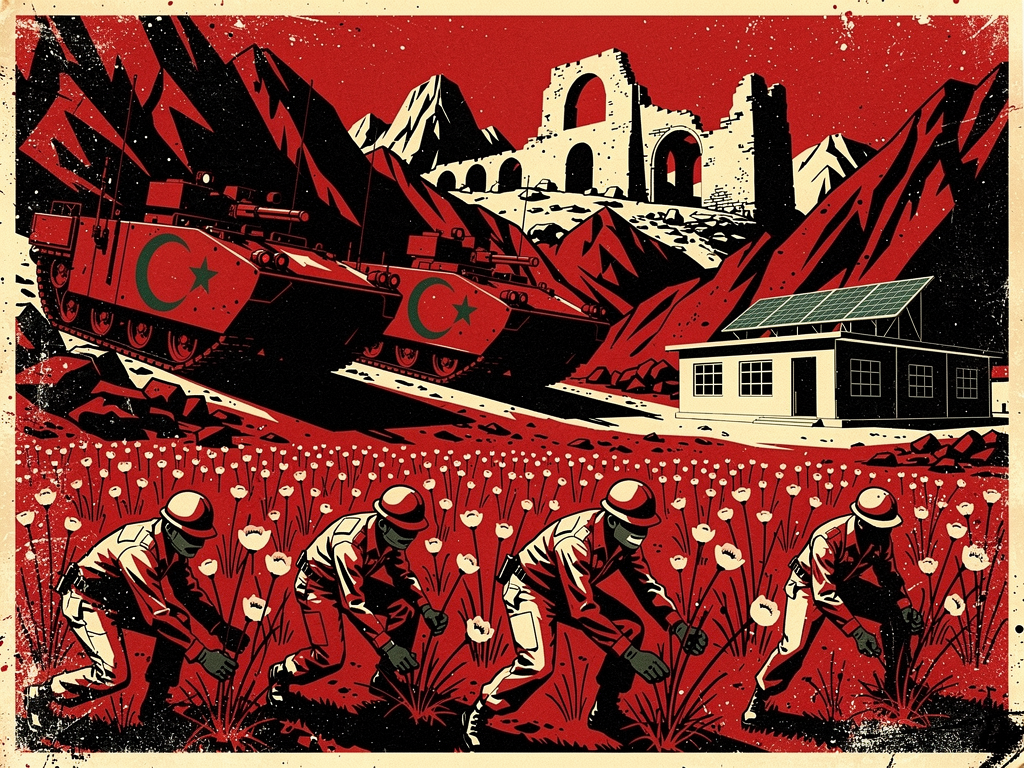
PSYOP: Justify Pakistan's Afghan Incursions Gains Traction in Western Media
An intensity spike in the PSYOP designated 'Justify Pakistan's Afghan Incursions' was detected between February 22, 2026, and March 3, 2026. This coordinated...
Pakistan Escalates Afghan Conflict: Manufactured Consent Identified
Sources: 2 outlet(s) | Articles: 4 | First detected: February 22, 2026
PSYOP: Normalize Afghanistan-Pakistan Conflict. Complex, intractable, no clear villain.
Intensity: 4/10 | Sources: 3 outlet(s) | Articles: 4 | First detected: February 27, 2026
Sources & Articles
Mar 18, 2026
Mar 17, 2026
Mar 17, 2026
May 25, 2026
Mar 18, 2026
Showing 10 of 32 articles
External Coverage(50)
Showing 10 of 50