Operational Summary
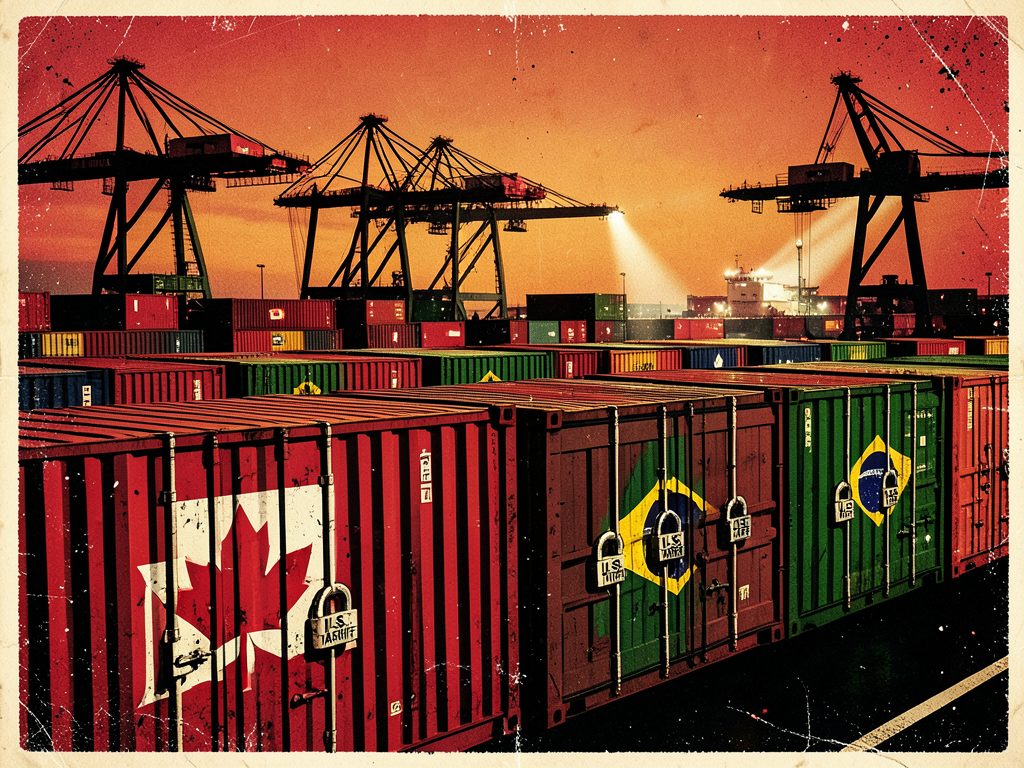
On July 21–22, 2026, a spike in near-simultaneous reporting occurred across multiple outlets—CNBC, Al Jazeera, and NBC News—framing U.S. tariffs against Canada and Brazil as a proportionate and necessary enforcement action. The narrative presents tariffs as a legitimate, policy-driven response to alleged trade discrimination and environmental practices. This intensity spike indicates a coordinated messaging vector reinforcing the official U.S. position with minimal room for dissent or critical evaluation.Article Timeline
When articles appeared, colored by manipulation score.
Source Distribution
Narrative Architecture
The messaging relies on procedural legitimacy—citing legal justifications, trade laws, and formal government statements—to portray the tariffs as routine and reactive. Terms like 'unfair trade practices,' 'discrimination against American goods,' and 'forced labor' are used as anchor points to morally weight the actions. In each article, U.S. officials are quoted without attribution challenges, while Brazilian and Canadian pushback is presented as an expected but ultimately secondary response. The tone assumes the righteousness of the U.S. stance rather than interrogating the evidence behind claims such as Brazil’s Pix payment system harming U.S. credit card firms or Canada’s trade policies being discriminatory.Critical omissions include the economic impact on U.S. consumers—briefly acknowledged by Al Jazeera as 'past analysis shows American consumers end up paying most of the cost'—and the absence of any deeper geopolitical context. Using emotionally neutral language like 'targeting 60 countries' or '25% tariff on most imports' sanitizes the coercive nature of the measures. The narrative avoids terms like 'economic pressure,' 'coercion,' or 'retaliation,' instead framing consequences as procedural outcomes of rule enforcement. This is consistent with financial elites’ broader preference for de-politicized economic language that masks power asymmetries.
Cross-Outlet Coordination Pattern
CNBC, Al Jazeera, and NBC News published articles within 24 hours of each other, using effectively identical framing language—'unfair trade practices,' 'unjustified,' 'failed to address'—to describe Brazilian and Canadian actions. While Al Jazeera and NBC News are structurally independent, their alignment with CNBC’s market-oriented narrative suggests sourcing from a common official pipeline or coordinated release strategy. The articles do not vary in tone based on geography or audience: U.S.-based outlets and international platforms present the same underlying logic. This uniformity, particularly given Al Jazeera’s historically more critical stance on U.S. foreign policy, indicates a calibrated narrative deployment across divergent platforms to project consensus.The timing of publication—peaking on July 21–22, 2026—with no prior coverage spike, suggests this was a deliberate information operations release tied to U.S. announcement cycles. The absence of pre-existing reporting in the dataset does not indicate the event was fabricated; rather, it confirms a synchronized post-announcement amplification. This operational pattern aligns with past trade conflicts involving the Office of the U.S. Trade Representative, where coordinated messaging supports enforcement actions.