Justify Trump's Trade Wars
This PSYOP frames Trump's aggressive tariff policies as necessary and righteous, manufacturing public consent for a sustained period of protectionist trade actions. It benefits the Trump administration and specific American industries by presenting these actions as justified and downplaying negative consequences.
Executive Summary
Power Patterns
Manufacturing Casus Belli
The articles consistently frame the U.S. tariffs as responses to alleged transgressions by other nations (forced labor, unfair trade practices, discrimination, retaliation), effectively manufacturing a casus belli for economic aggression. This narrative serves rent-seeking behavior by protecting specific American industries from competition, while the media acts as an instrument of power by amplifying these justifications and suppressing counter-narratives.
Cui Bono — Who Benefits?
This narrative enables the Trump administration to implement aggressive trade policies under the guise of defending American interests and values (e.g., labor rights, fair trade). It allows specific American industries to gain market advantage by reducing foreign competition, and it strengthens the political position of factions advocating for protectionism by presenting their policies as necessary and justified.
Historical Parallels
Iraqi WMDs (2002-2003)
Similar to the Iraqi WMDs narrative, this PSYOP creates a threat narrative (unfair trade, forced labor) that achieves mainstream consensus with suspicious speed, supported by official government claims, with dissenting economic analyses or alternative perspectives marginalized. The threat is framed as existential to American jobs or values, and the solution is presented as necessary punitive action.
Manufacturing Casus Belli
The consistent framing of foreign actions as 'discrimination,' 'unfair practices,' or 'forced labor' to justify tariffs mirrors historical instances where incidents (real or fabricated) were amplified to generate public outrage and support for pre-planned military or economic actions.
Narrative Mechanics
Synchronized Talking Points
“Tariffs are a justified response to foreign 'discrimination' or 'unfair trade practices'.”
“Canada's actions (e.g., halting U.S. goods, tariffs) are 'retaliation' or 'unjust' rather than responses to prior U.S. tariffs.”
“The U.S. is taking a 'principled stand' against forced labor.”
“The tariffs are 'legal' and 'measured' actions under U.S. trade law (e.g., Section 338, Section 301).”
“The U.S. is 'reconstructing its protectionist trade agenda' using 'durable legal authorities'.”
Framing Evolution
The narrative initially focused on specific trade disputes with Canada and Brazil, framing U.S. actions as responses to their 'unfair practices.' It then broadened to include a 'sweeping' new tariff regime against 60 countries, with the justification shifting to 'forced labor' as a moral imperative, providing a more universally palatable reason for protectionism beyond mere economic competition. The evolution shows an attempt to legitimize a broader protectionist agenda with increasingly moralistic justifications.
Suppressed Counter-Narratives
×The fact that Canadian and Brazilian 'retaliation' or 'discrimination' were often direct responses to earlier U.S. tariffs.
×Independent verification or evidence for the claims of forced labor or specific trade discrimination.
×The potential negative impacts of tariffs on American consumers (higher prices) and businesses (supply chain disruptions).
×Alternative diplomatic or multilateral solutions to trade disputes.
×The broader geopolitical context of U.S. trade aggression and its impact on international relations and alliances.
×The economic analysis that American consumers often bear the cost of tariffs.
Outlet Coordination
CNBC and NBC News consistently push the administration's framing, often using similar language and emphasizing official U.S. statements without critical examination. For example, CNBC's 'Trump to slap 'sweeping' new tariffs on 60 trade partners as global duties expire' and 'White House teases new trade action 'soon' as it works to re-create global tariff regime' both heavily rely on official sources to justify the tariffs. Al Jazeera, while also reporting the U.S. justifications, sometimes includes slightly more context about the retaliatory nature of foreign actions or mentions the lack of outside verification, as seen in 'Trump’s new 50 percent Canada tariffs: What products are affected and why?'. NPR's coverage is generally more balanced but still prominently features the U.S. administration's justifications. The higher-scoring articles from CNBC and NBC News show a stronger alignment with the PSYOP's objectives by amplifying the administration's narrative more uncritically.
Bigger Picture
This PSYOP is part of a broader effort by the U.S. to reassert economic nationalism and protectionism, potentially signaling a shift away from the post-WWII globalized trade order. It aims to prepare the public for a more confrontational approach to international trade, where economic leverage is used aggressively to achieve perceived national advantage, often at the expense of international cooperation and established trade norms. The end game is to reshape global trade relationships to favor U.S. domestic industries and strategic interests, even if it means destabilizing existing alliances and trade agreements.
Prediction
This PSYOP is likely building toward public acceptance of a sustained period of aggressive U.S. protectionist trade policies, potentially including a full-scale trade war with multiple partners. It prepares the public to view such actions as necessary, justified, and even morally righteous, rather than as economically disruptive or diplomatically damaging. It also lays the groundwork for future administrations to continue or expand these policies, having normalized the use of tariffs as a primary tool of foreign policy.
Intelligence Coverage
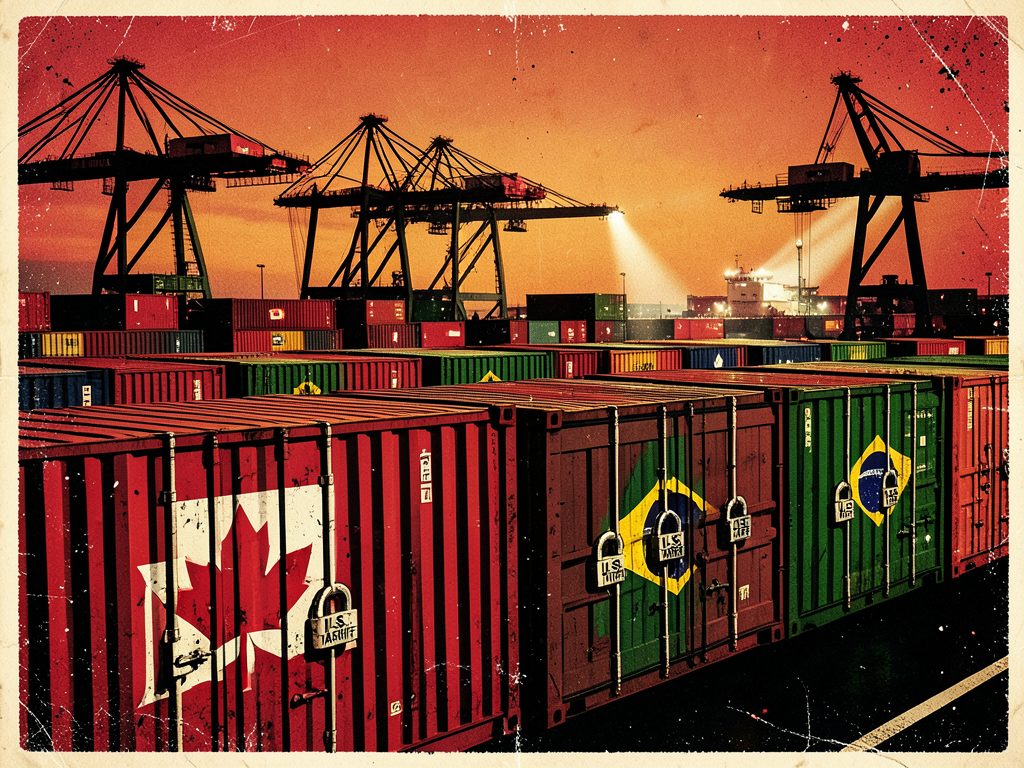
New US tariffs on Canada and Brazil are being framed as necessary and justified responses to trade disputes
On July 21–22, 2026, a spike in near-simultaneous reporting occurred across multiple outlets—CNBC, Al Jazeera, and NBC News—framing U.S. tariffs against Cana...
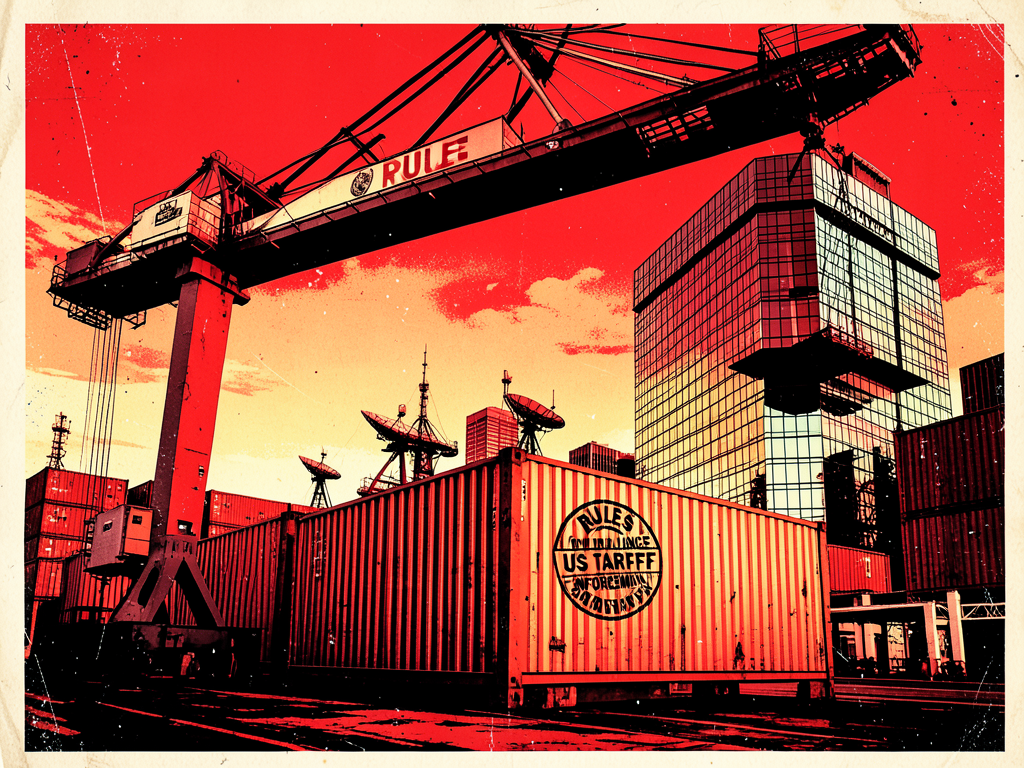
New US tariffs are being framed as rules-based responses to trade abuses
A coordinated narrative emerged on July 22, 2026, across three major outlets, normalizing U.S. tariff escalations against Canada and Brazil as legally justif...
Sources & Articles
2026-07-23T21:05:15.000Z
2026-07-21T13:06:36.000Z
2026-07-20T21:00:39.000Z
2026-07-21T01:15:38.000Z
2026-07-16T05:04:30.000Z
2026-07-21T13:25:37.000Z
2026-07-21T15:54:13.000Z
2026-07-20T21:42:42.658Z
2026-07-16T07:36:17.096Z
2026-07-21T10:31:34.000Z
Showing 10 of 11 articles