Operational Summary
A synchronized narrative push ran from July 22 to July 26, 2026, across six international and U.S. outlets, normalizing aggressive U.S. trade policy under President Trump. Eighteen articles presented new tariffs—imposed on over 60 countries including allies—as necessary responses to forced labor and unfair trade practices, not as unilateral protectionism. The messaging shift occurred amid legal setbacks, following a Supreme Court decision that blocked a prior tariff framework.Narrative Architecture
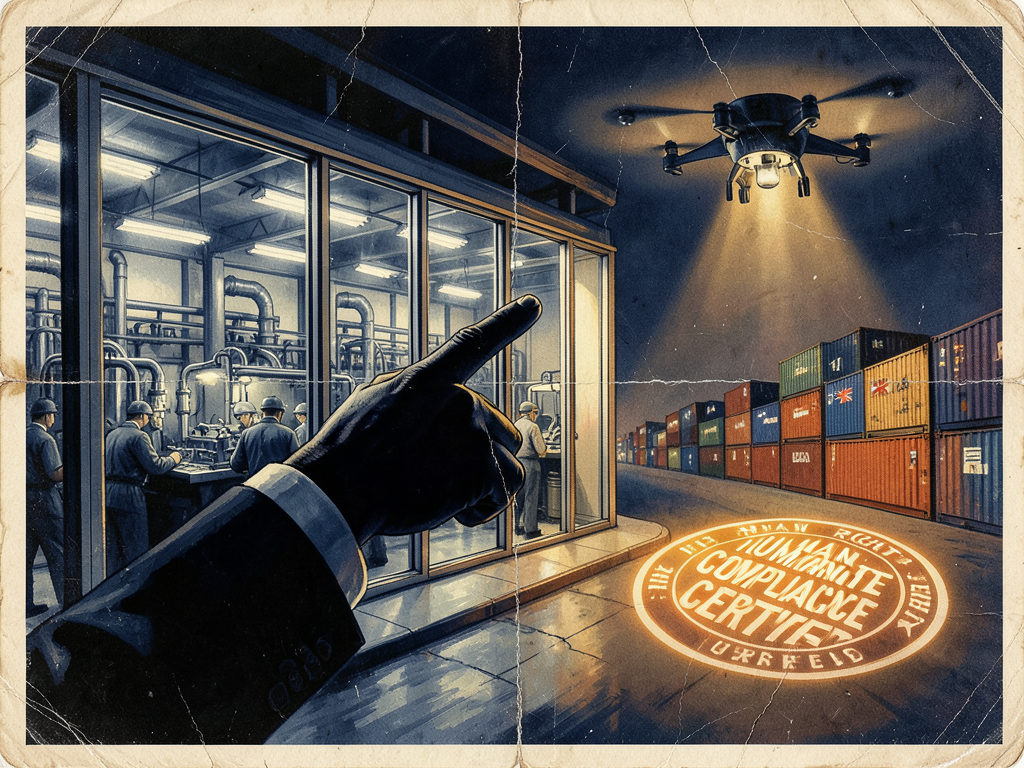
The narrative repackages economically motivated trade aggression as morally justified enforcement of labor standards. Articles repeatedly invoke "forced labor" as the stated rationale for broad tariff imposition, citing U.S. law as legitimizing authority. This frames punitive trade measures not as economic warfare or retaliation, but as duty-bound compliance with human rights statutes—specifically Section 307 of the Tariff Act. The moral framing transfers legitimacy from financial policy to ethical governance, aligning with the Religious Legitimation of Power mechanism, where economic authority is cloaked in ethical imperative.Critical context is omitted: the lack of verified evidence for forced labor claims in the majority of targeted nations, the selection of geopolitical allies over actual worst offenders, and the timing of the measures following a Supreme Court rebuke. Al Jazeera’s multiple reports do not question the evidentiary basis for the claims, nor do they explore whether enforcement is being applied uniformly or selectively. Instead, officials’ statements are presented as fact, reinforcing reliance on official sources as a structural filter in media production.
Fox News amplifies the narrative by emphasizing the novelty and legal strength of Section 338, describing it as a "powerful trade weapon." The framing of unprecedented presidential action serves to normalize expansion of executive power in trade, while downplaying historical failures of tariff-based policy. This mirrors Financialization dynamics—shifting focus from productive trade relations to state-manipulated economic control—while elevating the president’s discretion over systemic economic health.
Emphasis falls on retaliation against the EU for fining Google, positioning U.S. tech firms as victims of foreign bias. This aligns with the Bureaucratic Ossification pattern: rather than reforming antitrust policy or promoting competition, the response is escalation via tariff threats, preserving domestic corporate monopolies under the guise of national defense.
Cross-Outlet Coordination Pattern
Outlets include Al Jazeera, Fox News, and CNBC—ideologically diverse but unified in narrative structure. Al Jazeera, typically critical of U.S. foreign policy, adopts pro-administration framing without skepticism. All three outlet groups published multiple articles between July 24 and July 25, indicating temporal clustering. The identical focus on "forced labor tariffs" as a singular, justified policy instrument—despite targeting allies with no documented systemic forced labor—suggests narrative laundering through a common source, likely U.S. government or allied think tank messaging.The speed and uniformity of the framing—particularly the immediate adoption of "forced labor" as the dominant explanatory lens—exceeds organic journalistic response standards. Independent investigation would require cross-verification of labor conditions; instead, the narrative assumes guilt by decree. This reflects Synchronized Narratives driven by pre-cleared talking points, not emergent reporting.
Source Distribution
Article Timeline
When articles appeared, colored by manipulation score.
Technique Assessment
Score Distribution
How articles in this PSYOP score across manipulation bands.