Operational Summary
A coordinated media push to normalize Donald Trump’s aggressive tariff policies as drivers of national economic revival was detected between July 22, 2026, and August 12, 2026. Thirty articles across eight outlets amplified the narrative that tariffs on China and other nations are catalyzing a manufacturing renaissance, with emphasis on stock gains, job growth, and national sovereignty. The operation exhibits high narrative uniformity and strategic timing, aligning with political efforts to cement protectionism as a permanent economic doctrine.Article Timeline
When articles appeared, colored by manipulation score.
Narrative Architecture
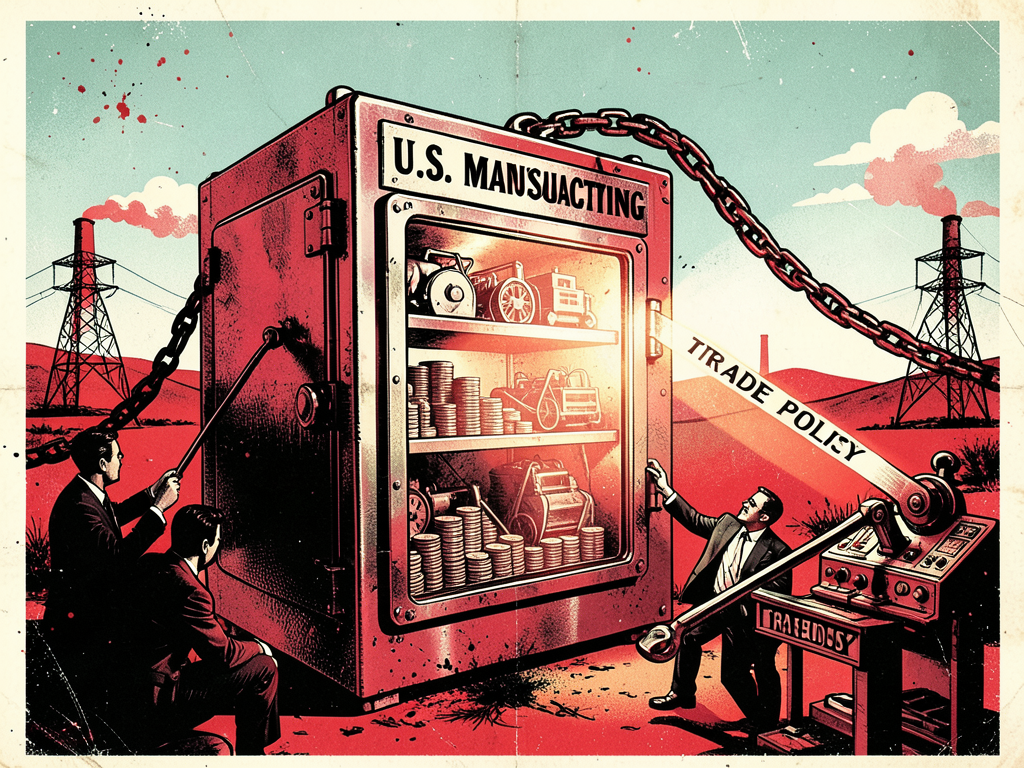
The messaging centers on economic transformation framed as irreversible and empirically validated. Articles highlight rising stock prices for U.S. solar companies following new polysilicon tariffs, presenting market reactions as definitive proof of policy success. Causality is asserted without scrutiny: higher valuations are attributed solely to tariffs, not broader market dynamics, supply chain shifts, or speculative behavior. The human impact of potential cost increases, inflation, or retaliatory measures is absent. National security is invoked to elevate trade policy beyond economic debate, positioning tariffs as essential to semiconductor and energy independence.Patriotic urgency is a core emotional lever. Language such as "ripping off America" and "fighting unfair trade" constructs a moral binary: the U.S. as victim, foreign nations as predators. This framing bypasses cost-benefit analysis by casting opposition as unpatriotic. The narrative dismisses prior warnings of economic harm as outdated or ideologically driven, reinforcing a theme of elite miscalculation overcome by strong leadership. Optimism is treated as evidence: phrases like "manufacturing renaissance" and "golden age" project inevitability, reducing policy to destiny.
The deeper legitimating myth is the revival of national productive capacity after decades of deindustrialization. This taps into Religious Legitimation of Power, where economic policy is sacralized as national redemption. The working class is invoked symbolically, though no data on wage growth, employment duration, or regional investment is provided. The narrative serves Elite Overproduction by offering a unifying cause for a fractured conservative elite: economic nationalism as a replacement for ideological coherence.
Cross-Outlet Coordination Pattern
The operation spans mainstream financial media and right-leaning outlets, creating an illusion of cross-spectrum consensus. CNBC provides market credibility, presenting tariff impacts through stock movements and executive quotes. Breitbart delivers ideological reinforcement, publishing multiple installments of its "Business Digest" series that declare a manufacturing revival underway. Fox News contributes political momentum, spotlighting allies like Senator Rick Scott to validate the policy’s institutional support.Xinhua’s inclusion is notable. Its article frames U.S. tariffs as responses to forced labor, lending a veneer of moral legitimacy by adopting human rights rhetoric. This allows the narrative to claim international normative alignment, even as it targets 60 countries with minimal evidence. The absence of critical counterpoints across all outlets—no discussion of WTO challenges, inflation risks, or supply chain disruptions—indicates synchronized messaging rather than independent reporting.
The speed and repetition suggest pre-developed content modules. Multiple Breitbart articles use identical phrasing—"manufacturing renaissance," "hiring surge," "efficiency gains"—implying a shared template. CNBC and Fox News publish within hours of policy announcements, indicating access to advance briefings or coordinated release schedules.