Operational Summary
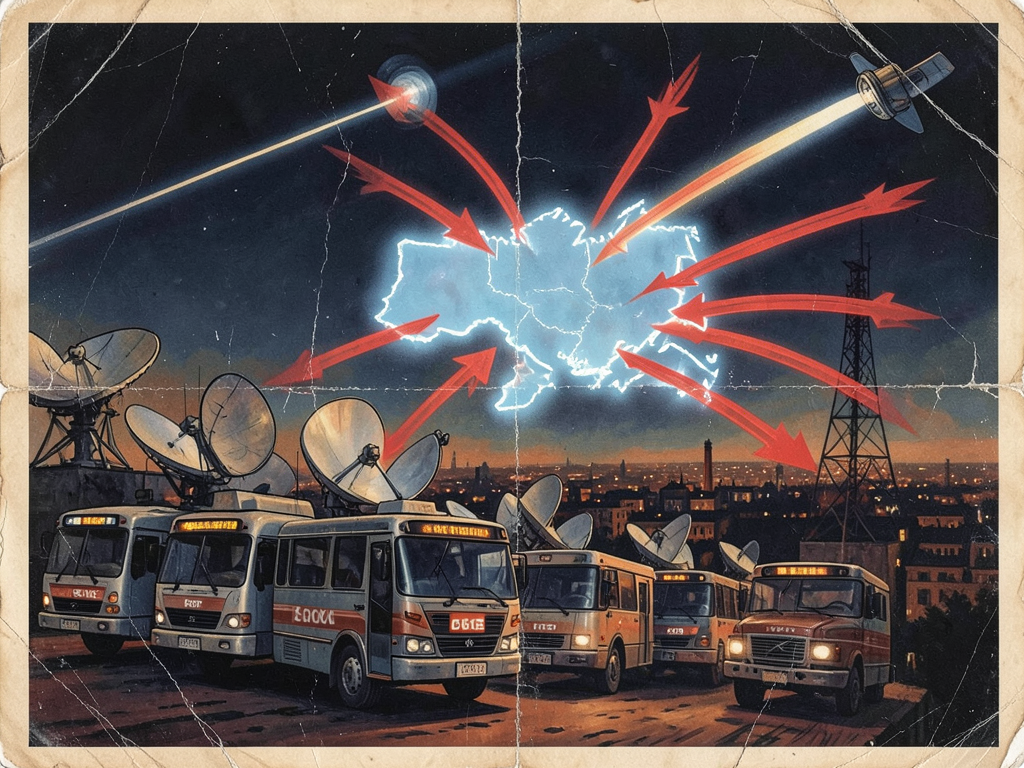
A synchronized media campaign has amplified narratives on Russian maritime aggression, NATO nuclear posture shifts, and Eastern European defense mobilization to advance the case for direct NATO military intervention in the Ukraine conflict. The operation spans 53 articles across 18 outlets from February 27 to July 3, 2026, with a marked shift toward justifying offensive military postures under the guise of defensive necessity.
Narrative Architecture
The messaging constructs a threat environment in which Russian actions are framed as systematic violations of maritime law and strategic norms. Coverage of Russia’s ‘shadow fleet’ emphasizes the conflation of commercial and military functions, portraying neutral shipping as complicit in war funding. This framing removes the presumption of innocence from civilian infrastructure, laying narrative groundwork for broadening the rules of engagement. Emotional leverage centers on civilizational peril—Russia is depicted not as an adversary but as a rogue actor operating outside the norms of lawful war, thereby legitimizing exceptional responses.
Finland’s nuclear posture shift is presented as a technical adjustment rather than a strategic rupture, despite the reversal of decades of non-nuclear policy. The omission of historical context—Finland’s deliberate balancing act with Russia since the Cold War—erases strategic nuance, reframing a radical policy shift as routine adaptation. Similarly, German conscription is portrayed as an inevitable consequence of external threat, not a political decision, suppressing debate on militarization and entrenching fatalism.
Zelensky’s ultimatum to Belarus is reported as a decisive diplomatic maneuver, reinforcing a narrative of Ukrainian agency while framing Belarus as an active co-belligerent. The selective focus on Belarusian logistical support—without comparable scrutiny of NATO’s own supply networks or escalation risks—narrows the audience’s analytical frame. The narrative primes acceptance of cross-border action, normalizing deep strikes on infrastructure in allied or neutral states under the doctrine of anticipatory self-defense.
Cross-Outlet Coordination Pattern
The campaign exhibits high thematic and linguistic alignment across ideologically diverse outlets. kyivindependent.com and rt.com—occupying different ends of the geopolitical spectrum—both publish stories on the ‘shadow fleet’ and conscription with near-identical emphasis on inevitability and threat escalation. breitbart.com covers the Poland-Germany defense pact as a natural progression of European unity, omitting any reference to internal dissent or alternative security models. The synchronization indicates centralized narrative management rather than organic reporting.
Distinct framing patterns emerge: pro-Western outlets emphasize moral urgency and civilizational defense; state-aligned outlets (e.g., RT) amplify the same policies while presenting them as unavoidable responses to Russian provocation. This dual-path strategy ensures message penetration across both hawkish and ostensibly neutral audiences. The absence of critical voices questioning the desirability or legality of escalation confirms the narrowing of the Overton window.
Technique Assessment
Manufacturing Consent: Coverage uniformly treats military expansion—nuclear deployment, conscription, cross-border targeting—as logistical responses to external pressure, not policy choices. This erases agency from decision-makers and frames escalation as a technical requirement rather than a strategic decision.
Synchronized Narratives: Multiple outlets adopted the 'shadow fleet as military target' framing within 48 hours of its emergence, despite lack of independent verification or standardized definition. The speed and uniformity of adoption indicate pre-circulated talking points.
Controlled Opposition: No major outlet in the sample challenges the core assumption that deeper NATO involvement is necessary or justified. The debate is constrained to tactical differences—how fast to expand, how far to strike—never whether escalation serves long-term stability.
Revelation of Method: The open discussion of nuclear deployment and conscription, typically sensitive topics, functions as a signal of resolve rather than transparency. Its public normalization conditions audiences to accept policies once considered red lines, aligning with the learned helplessness mechanism.
Manufacturing Casus Belli: The shadow fleet narrative constructs a justification for targeting civilian infrastructure under international law, echoing historical precedents where dual-use designations have expanded the battlefield. This reframing prepares legal and public opinion groundwork for future strikes beyond Ukraine.
Significance
The campaign reflects an advanced phase of narrative preparation for direct NATO intervention. It leverages real incidents—Belarusian cooperation, Russian maritime logistics—to advance a policy objective that benefits hawkish factions and the military-industrial complex. The absence of meaningful dissent in mainstream coverage indicates a captured information environment where escalation is no longer debated but managed.
PSYOP Hierarchy
Manipulation Profile
Average FATE dimensions across 180 articles in this PSYOP.
Source Distribution
Article Timeline
When articles appeared, colored by manipulation score.
Score Distribution
How articles in this PSYOP score across manipulation bands.