Manufacture NATO Intervention Consent
A coordinated media campaign amplifying Russian threats and Ukrainian civilian suffering to build public and political consent for direct NATO military intervention beyond current arms support. Primarily serves military-industrial complex and hawkish NATO factions. Distinct from legitimate accountability coverage of Russian aggression.
Cluster signature
Peak 52 articles in September 2026
Bars run to 120, not to the tallest band.
Focus, Authority, Tribe, Emotion — averaged across 180 articles.
- Loaded Language231
- Appeal to Fear/Prejudice90
- Appeal to Authority71
- Exaggeration/Minimisation67
- Appeal to Values37
- Flag Waving22
- Whataboutism16
- Doubt12
Bar length is square-root scaled so the tail stays readable; counts are exact.
PSYOP Hierarchy
Executive Summary
Power Patterns
Manufacturing Casus Belli
The cluster manufactures a casus belli by amplifying Russian threats and the use of advanced weaponry, creating a sense of imminent danger that justifies a more aggressive response. The focus on 'systematic strikes' and 'hypersonic missiles' (nbcnews.com, theglobeandmail.com, france24.com, smh.com.au, cbsnews.com, cbc.ca, timesofindia.indiatimes.com, ndtv.com) serves to escalate the perceived threat, while simultaneously downplaying or ignoring Ukrainian actions that Russia cites as justification (rt.com articles). This emotional manipulation aims to bypass rational analysis and push for intervention.
Cui Bono — Who Benefits?
The military-industrial complex benefits from increased demand for advanced weaponry and military deployments. Hawkish political factions gain leverage for more aggressive foreign policy stances. Ukraine's leadership seeks to secure direct NATO intervention to bolster its defense. NATO as an institution benefits from a renewed sense of purpose and expanded operational scope, justifying its continued expansion and budget.
Historical Parallels
Gulf of Tonkin
The narrative amplifies alleged Russian threats and actions, similar to how the alleged North Vietnamese attack was exaggerated to justify US escalation in Vietnam. The focus is on Russian 'systematic strikes' and 'hypersonic missiles' as unprovoked aggression, despite Russian claims of retaliation for Ukrainian attacks (rt.com articles).
Iraqi WMDs (2002-2003)
The consistent framing of Russia's advanced weaponry (hypersonic missiles, nuclear-capable missiles) as an existential threat, despite a lack of independent verification of their specific use or intent, mirrors the WMD narrative used to justify the Iraq War. The emphasis on the 'Oreshnik' missile (cbc.ca, theglobeandmail.com, timesofindia.indiatimes.com, ndtv.com) serves to create a sense of overwhelming danger.
The Atrocity Propaganda Template (Nayirah Testimony, 1990)
While not a direct fabrication, the selective amplification of civilian casualties in Ukraine (aljazeera.com, cbsnews.com, cbc.ca) while downplaying or ignoring Russian civilian casualties (rt.com articles) serves to generate outrage and moral certainty, similar to the Nayirah testimony that fueled support for the Gulf War. The emotional impact of 'dead children' is used to bypass rational debate.
Narrative Mechanics
Synchronized Talking Points
“Russia is escalating threats against Kyiv with 'systematic strikes' and advanced weapons like 'hypersonic missiles' (Oreshnik).”
“These Russian actions are 'unprovoked' or 'retaliatory' for unspecified Ukrainian actions, but the focus is on Russian aggression.”
“NATO allies and Ukraine are resilient and will not be intimidated.”
“Civilian casualties and damage to civilian infrastructure are a direct result of Russian aggression.”
Framing Evolution
The narrative has evolved from focusing on general Russian aggression and the need for aid to emphasizing specific, advanced Russian weaponry and direct threats to Kyiv, thereby escalating the perceived danger and the need for a more direct NATO response. The introduction of 'nuclear-capable missiles' (cbsnews.com) and 'nuclear munitions' (cbsnews.com) further heightens the stakes.
Suppressed Counter-Narratives
×Ukrainian attacks on Russian civilians and infrastructure, which Russia cites as justification for its strikes (prominently featured in rt.com articles but largely absent from Western mainstream media).
×The potential for NATO expansion and military buildup to be perceived as a provocation by Russia.
×The economic and human costs of prolonged conflict and sanctions on all parties, including Western nations.
×The historical context of NATO expansion and Russian security concerns.
Outlet Coordination
Outlets like NBC News, The Globe and Mail, France24, CBS News, and CBC.ca consistently push the narrative of escalating Russian aggression, focusing on advanced weaponry and civilian impact. RT.com, conversely, consistently highlights Ukrainian attacks on Russian civilians and frames Russian actions as justified retaliation. The timing of reports on 'hypersonic missiles' across multiple Western outlets suggests coordinated messaging, particularly after Russia's claims of retaliation.
Bigger Picture
This PSYOP is a critical component in the broader geopolitical struggle for influence in Eastern Europe and the erosion of Russian power. It aims to solidify Western resolve for a prolonged conflict and prepare the public for a potential direct confrontation with Russia, framing it as a necessary defense against an increasingly aggressive and technologically advanced adversary. The end game is to either force a Russian capitulation or significantly degrade its military and economic capabilities, securing NATO's eastern flank and reinforcing American hegemony.
Prediction
This PSYOP is likely building toward public acceptance of direct NATO military involvement in Ukraine, potentially through a 'no-fly zone,' deployment of 'peacekeeping' forces, or direct military aid that includes offensive capabilities. It prepares the public for a scenario where the current level of support is deemed insufficient, necessitating a more robust and direct intervention, potentially leading to a wider conflict.
Intelligence Coverage
NATO’s war posture is being framed as inevitable, not chosen
A coordinated narrative has intensified across Western media since February 27, 2026, amplifying Russian threat rhetoric and Ukrainian civilian suffering to ...
Russian threats are being amplified to build support for deeper NATO intervention
A coordinated media campaign has intensified from February 27, 2026, to October 7, 2026, across 26 outlets and 160 articles, amplifying narratives of Russian...
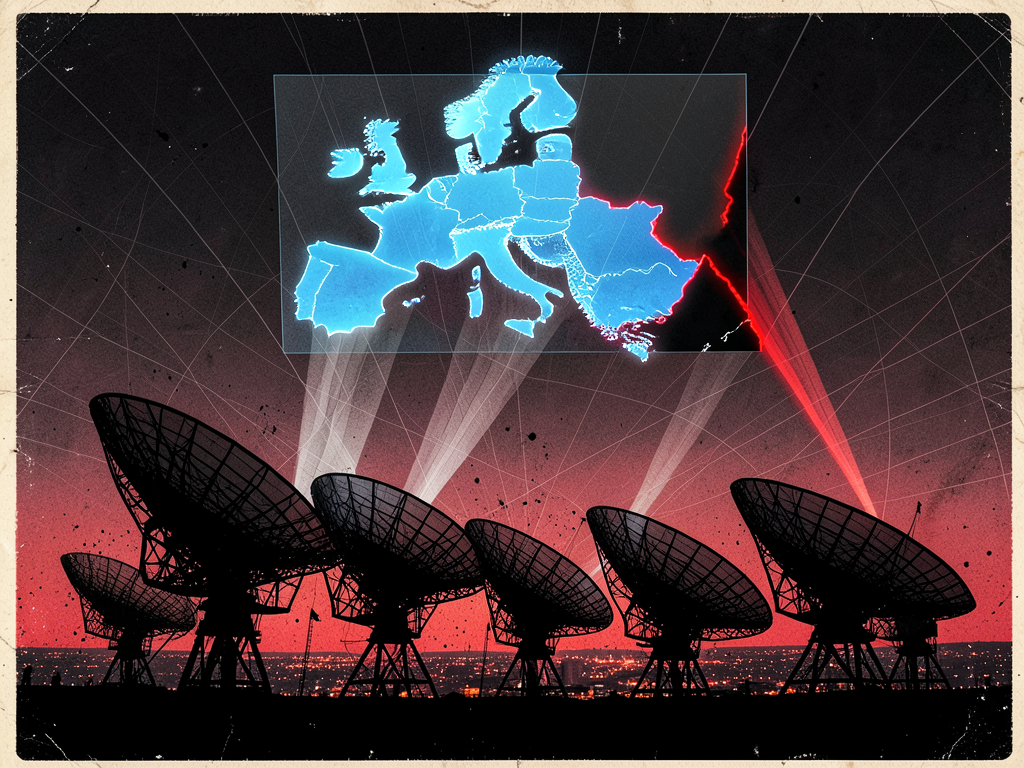
NATO expansion is being framed as an urgent defensive necessity
A coordinated media campaign has amplified narratives of Russian hybrid threats and Ukrainian civilian suffering to build public and political support for di...

NATO intervention is being framed as an unavoidable response to Russian escalation
A coordinated media campaign has amplified incidents involving Russia and Ukraine to build public and political support for direct NATO military intervention...
Russian sabotage drills are being framed as imminent threats to justify deeper NATO involvement
A coordinated narrative has intensified across Western media from February 27, 2026 to September 12, 2026, amplifying isolated Russian military activities in...
NATO's response to Russian threats is being framed as urgent and unavoidable
A coordinated media campaign has been detected amplifying claims of Russian sabotage against European infrastructure to build political and public momentum f...
NATO intervention in Ukraine is being framed as unavoidable
A synchronized media campaign spanning 25 outlets and 96 articles from February 27, 2026 to September 1, 2026 amplifies the inevitability of direct NATO mili...

NATO is being drawn into direct war through amplified threat narratives
A coordinated narrative surge occurred between February 27 and August 18, 2026, across 25 outlets. The pattern served to normalize direct NATO military inter...

NATO intervention is being primed as unavoidable despite diplomatic openings
A coordinated narrative has emerged across 25 outlets, producing 77 articles between February 27, 2026 and August 12, 2026. The messaging amplifies Russian h...
NATO's war footing is being sold as a defensive necessity, not a policy choice
A synchronized media campaign has intensified from February 27 to August 12, 2026, across 25 outlets and 77 articles. The messaging amplifies isolated incide...

NATO's eastern flank is being framed as a target for Russian provocation
A coordinated narrative has been detected amplifying the risk of Russian attacks on NATO territory. First identified on February 27, 2026, and peaking betwee...
NATO is being primed for direct war through amplified Russian threat narratives
A coordinated media campaign has intensified from February 27, 2026 to August 8, 2026, across 70 articles in 21 outlets. The operation centers on framing Rus...
Romanian drone encounters are being framed as deliberate acts of war
From February 27, 2026 to July 28, 2026, a coordinated messaging campaign amplified incidents involving drones near Romanian airspace. Sixty-three articles a...
Coordinated media push is building case for NATO war escalation
A synchronized media campaign has amplified narratives on Russian maritime aggression, NATO nuclear posture shifts, and Eastern European defense mobilization...
Outlets are amplifying unverified attacks to escalate pressure for NATO war with Russia
A coordinated media campaign has intensified between February 27, 2026 and June 10, 2026, across 48 articles in 16 outlets, framing isolated cross-border inc...
Escalate Ukraine-Russia Conflict: Coordinated Messaging Amplifies Escalatory Threats
Between May 21, 2026, and May 23, 2026, an intensification of narrative activity was detected across five major media outlets. Eleven articles promoted a uni...
Sources & Articles
2026-10-13T01:27:05.000Z
2026-10-05T18:26:15.000Z
2026-10-12T09:56:24.000Z
2026-10-11T17:21:00.000Z
2026-10-12T14:59:01.000Z
2026-10-13T06:01:49.000Z
2026-10-07T09:33:49.000Z
2026-10-12T19:27:41.000Z
2026-10-13T14:52:22.000Z
2026-10-13T00:22:08.000Z
Showing 10 of 180 articles