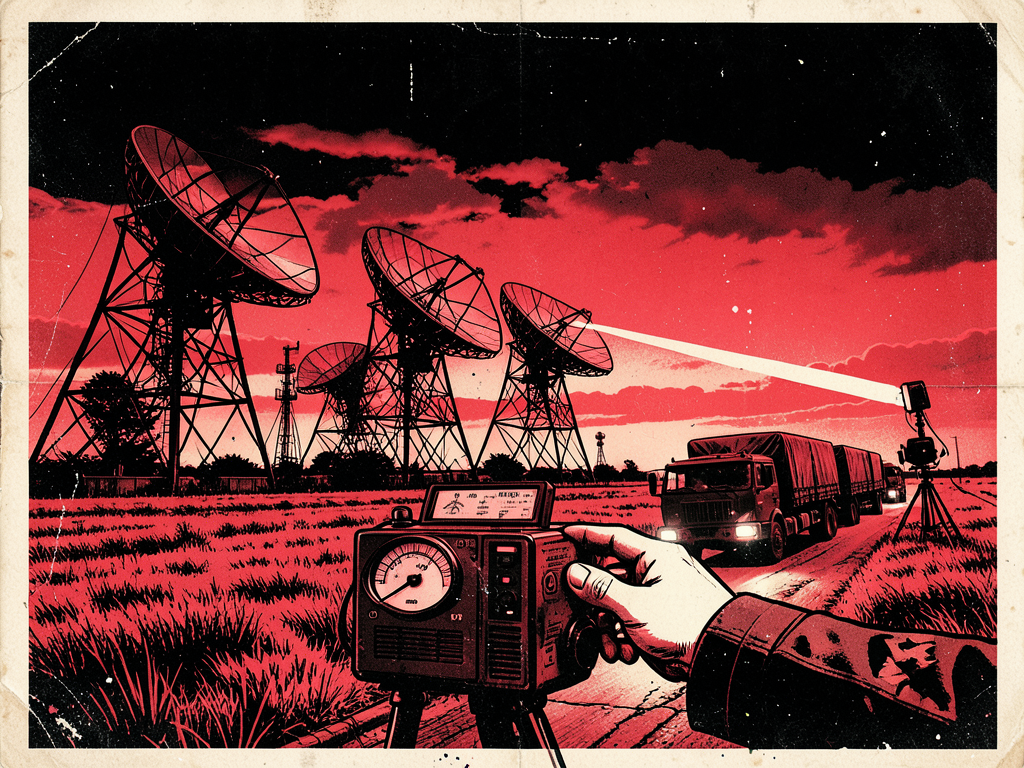
Operational Summary
A coordinated media campaign has intensified from February 27, 2026, to October 7, 2026, across 26 outlets and 160 articles, amplifying narratives of Russian aggression and nuclear threats. The pattern serves to build political and public consent for direct NATO military intervention in Ukraine beyond current arms supply, aligning with interests of the military-industrial complex and hawkish NATO factions.Narrative Architecture
The messaging centers on three interlocking frames: Russian unpredictability, NATO vulnerability, and the necessity of preemptive escalation. Articles such as 'Russia warns NATO of possible nuclear response if Kaliningrad is cut off' and 'Russia prepared to use ‘all weapons’ to protect Kaliningrad, Putin warns West' present Russian nuclear rhetoric as both immediate and irrational, while omitting the context that NATO’s forward deployments and exercises in the Baltics are the stated trigger for Russian concern. This omission reframes NATO’s expansion as passive and defensive, while Russian reactions are portrayed as escalatory by default.The sinking of a grain ship in Romanian waters, reported by Al Jazeera, is framed as evidence of war spillover, despite no confirmation of Russian responsibility. The narrative vector is clear: isolated incidents are presented as part of a pattern of Russian aggression threatening NATO territory. This constructs a perception of encroachment and vulnerability, priming audiences to accept deeper military involvement as necessary for collective defense.
Breitbart’s report on a suspected lab leak in Siberia introduces a secondary threat vector—biological instability—without verification. The article leverages unconfirmed illness among lab workers to insinuate systemic Russian recklessness, reinforcing a broader portrayal of the Russian state as dangerously opaque and untrustworthy. This narrative functions independently of military developments, contributing to a generalized atmosphere of threat.
Euronews’ profile of NATO Secretary General Mark Rutte, 'Off the Record: Teflon Rutte is on a mission to keep NATO together', serves as a stabilizing counter-narrative, presenting NATO as unified and resolute. This functions as reassurance messaging: while the threat is severe, the alliance is steady. The effect is to normalize the idea of prolonged, high-intensity confrontation and to delegitimize internal dissent or calls for de-escalation.
Cross-Outlet Coordination Pattern
The campaign exhibits synchronized narrative management across ideologically diverse outlets. Al Jazeera, CNN, Euronews, and Breitbart—all with distinct editorial postures—converge on identical threat assessments and temporal urgency. The repetition of Putin’s nuclear warnings across multiple platforms within 48 hours of each other, using similar language and sourcing, indicates coordinated amplification rather than independent reporting.Al Jazeera and CNN both published near-identical framing of Russian nuclear threats on September 30 and October 1, 2026, despite differing regional audiences. The absence of critical follow-up on NATO’s own nuclear posture or historical precedents of threat inflation (e.g., Iraq WMDs) suggests a shared narrative filter. Breitbart’s inclusion demonstrates that the operation extends beyond mainstream liberal media, penetrating outlets typically skeptical of NATO orthodoxy, thereby broadening the campaign’s reach and credibility.
The lack of investigative follow-up on the Romanian ship incident—such as Romanian authorities’ non-confirmation of Russian involvement—confirms that the story’s function is not accountability but escalation. The timing of the lab leak report, coinciding with naval and nuclear threat coverage, indicates a deliberate strategy to saturate the information environment with multiple, non-overlapping threat signals.
Technique Assessment
PSYOP Hierarchy
Manipulation Profile
Average FATE dimensions across 180 articles in this PSYOP.
Source Distribution
Article Timeline
When articles appeared, colored by manipulation score.
Score Distribution
How articles in this PSYOP score across manipulation bands.