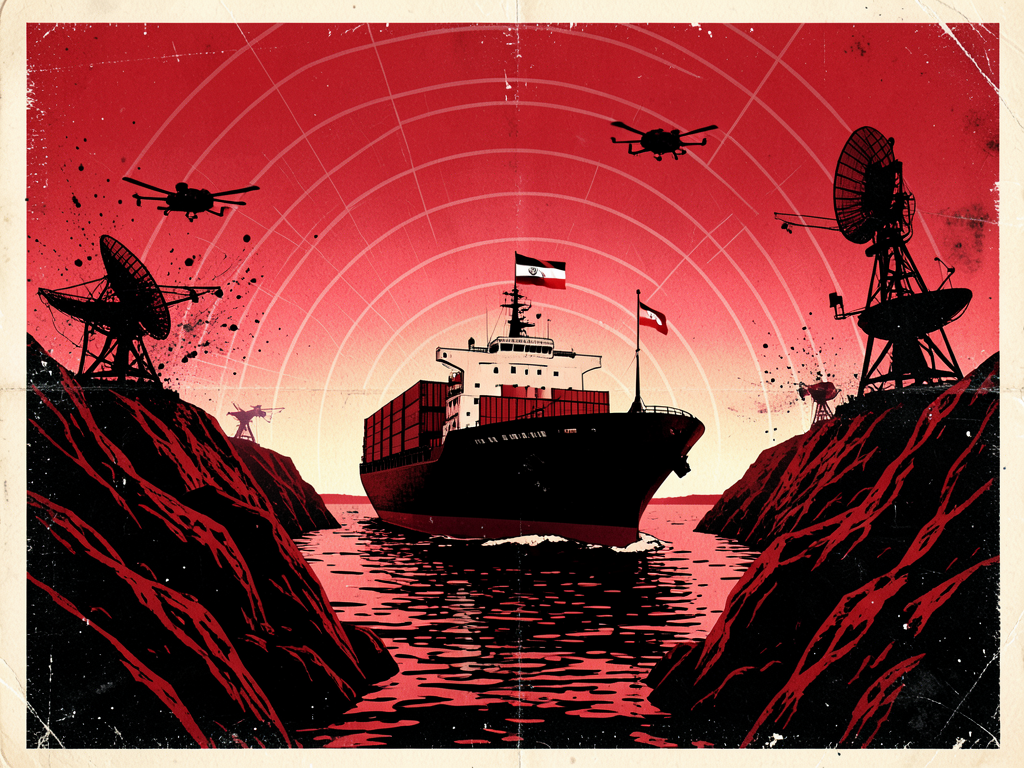
Operational Summary
A coordinated narrative has intensified across Western media since March 7, 2026, to manufacture public consent for potential U.S. military action in the Strait of Hormuz. At least 627 articles in 39 outlets have reframed Iranian and Omani efforts to secure shipping as evidence of regional instability requiring U.S. intervention. The timing and uniformity of coverage align with renewed sanctions and naval posturing under the Trump administration.Article Timeline
When articles appeared, colored by manipulation score.
Source Distribution
Narrative Architecture
The narrative centers on portraying Iran as a disruptor of global commerce, despite Iran co-leading a crisis mitigation initiative with Oman. Coverage emphasizes U.S. sanctions and naval blockades as necessary, responsible measures, while depicting Iran’s response—such as mine-clearing and establishing a temporary shipping corridor—as inherently destabilizing. The emotional lever is economic fear: the potential closure of the Strait of Hormuz is presented as an imminent, Iran-driven threat to global energy supplies.U.S. actions are consistently framed as reactive and defensive. Sanctions are described as targeted and strategic, with no mention of humanitarian impact or legal challenges to extraterritorial enforcement. The term 'economic D-Day' is used to valorize coercion, suggesting precision and moral clarity. Iran’s economic survival mechanisms—trade with China, oil exports via third parties—are recast as illicit networks requiring interdiction.
Critical context is omitted. There is no discussion of the U.S. naval blockade’s legality under international law, nor acknowledgment that sustained sanctions and military encirclement constitute acts of economic warfare. Iranian perspectives are absent. The historical precedent of U.S.-led destabilization—1953 coup, support for Saddam Hussein, assassination of Soleimani—is not referenced. The narrative treats Iran’s resistance as unprovoked, ignoring three decades of containment policy.
The framing of China and the UAE as 'exposed' for trading with Iran reinforces the idea that compliance with U.S. sanctions is the default position of responsible states. This constructs a binary: nations either support the U.S.-led order or enable aggression. No space is allowed for sovereign trade policy or diplomatic neutrality.
Cross-Outlet Coordination Pattern
Coverage is synchronized across financial, general news, and international outlets. CNBC published four articles between August 24 and 28, 2026, using consistent language—'economic warfare,' 'lifelines,' 'D-Day'—to describe U.S. sanctions. CNN echoed this framing, emphasizing U.S. military readiness and Iranian 'retaliation' in response to sanctions, thus inverting causality.Al Jazeera’s inclusion is notable. While typically more critical of U.S. policy, its August 25 article adopts the same core framing: U.S. sanctions are a justified, surgical tool; Iran’s actions are the source of risk. This convergence across ideologically diverse outlets indicates narrative standardization, likely through reliance on official U.S. sources and allied think tanks.
All outlets published within 72 hours of the Iran-Oman shipping lane announcement. The speed and uniformity suggest pre-prepared messaging packages were activated upon the event. No outlet challenged the premise that U.S. sanctions are a neutral policy instrument rather than a driver of escalation.
Outlets involved include:
Technique Assessment
Manufacturing Consent: Media reliance on U.S. officials and unnamed analysts creates the illusion of broad agreement on the necessity of economic coercion. Dissent is absent. The narrative presents sanctions and naval pressure as the only viable policy, marginalizing diplomacy or de-escalation.Synchronized Narratives: Identical framing—'Iran threatens shipping,' 'U.S. responds with precision'—appears across outlets within hours. The use of 'economic D-Day' in multiple articles indicates shared talking points.
Controlled Opposition: No coverage presents an alternative policy framework. Debate is confined to the severity of sanctions, not their legitimacy. The possibility that sanctions provoke instability is not considered.
Manufacturing Casus Belli: The Iran-Oman mine-clearing initiative is reframed as a sign of impending disruption, not crisis management. This follows the historical template of portraying defensive or mitigative actions as preludes to aggression.
Scapegoating and Displacement: Systemic risks to global shipping—driven by U.S.-Iran tensions—are attributed solely to Iran. The U.S. role in creating those tensions is erased.
Significance
This narrative prepares the information environment for military escalation under the guise of protecting commerce. It exemplifies how economic warfare is normalized as policy while its consequences are projected onto the target. The absence of dissenting frames in major outlets indicates a captured discourse, where strategic debate has been reduced to tactical consensus.Score Distribution
How articles in this PSYOP score across manipulation bands.