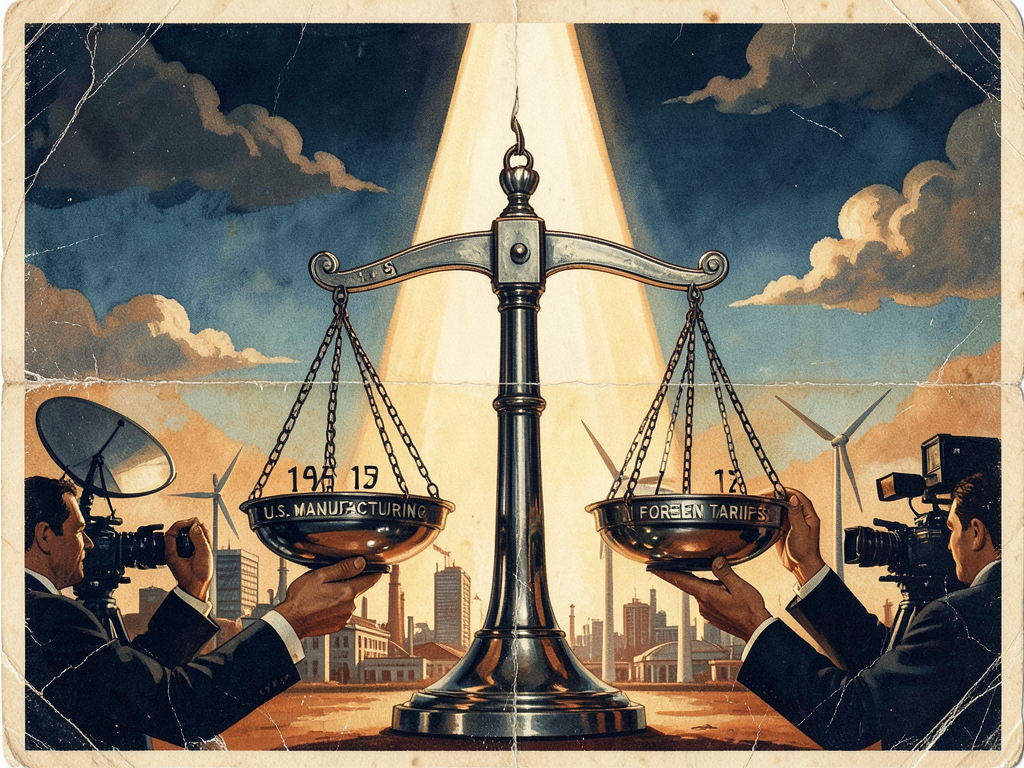
Operational Summary
A coordinated media push intensified between July 22 and July 24, 2026, across five major outlets—CNBC, CBS News, NPR, NBC News, and additional CNBC coverage—promoting the framing of Donald Trump’s sweeping new tariffs as a justified defense of human rights and fair trade. Fourteen articles advanced a consistent narrative justifying aggressive trade actions under the banner of combating forced labor, despite inconsistent application and a lack of independently verified evidence. The timing and uniformity indicate pre-planned narrative deployment following a Supreme Court setback to prior tariff mechanisms.Narrative Architecture
The narrative is constructed around two primary legitimating frames: moral righteousness and national security. Articles uniformly cite “forced labor” as the stated rationale, positioning the tariffs as a protective measure for global workers and U.S. economic integrity. This aligns with the Religious Legitimation of Power mechanism, where economic policy is sanctified through ethical claims. The moral framing overrides cost-benefit analysis, shifting public focus from economic retaliation, supply chain disruption, or diplomatic fallout to a dichotomy of good (U.S. enforcement) versus evil (global forced labor).Emphasis is placed on Trump’s determination, with language like “refuses to give up” and “sweeping new tariffs” reinforcing a narrative of resolve. National security is layered into the justification, particularly in the NPR and CBS News pieces, despite no linkage between targeted countries and direct security threats. This serves to inflate the stakes, triggering affective responses—outrage at exploitation and fear of inaction.
Critical omissions define the narrative. The exemption of oil imports from scrutiny, despite acknowledged forced labor in petrostates, undermines the claim of principled consistency. Canada’s retaliatory measures are described as “unjust” rather than defensive, reframing escalation as resistance to legitimate policy. Allegations lack evidentiary support; sourcing relies exclusively on administration claims, with no third-party verification of forced labor practices in the 60 targeted nations. The narrative avoids discussion of prior tariff policies ruled illegal, framing the new action as evolution rather than circumvention.
Cross-Outlet Coordination Pattern
The operation spans CNBC (2 articles), CBS News, NPR, NBC News, and was amplified within a 48-hour window. All outlets adopted nearly identical language: “citing forced labor concerns,” “dozens of countries,” and “global tariffs.” The speed and repetition of this phrasing, across outlets with distinct editorial brands, indicate synchronized messaging. CNBC and CBS News, typically more economically focused, emphasized the moral imperative, abandoning cost analysis. NPR and NBC injected national security and bilateral friction, tailoring the narrative to their audience’s expectations while preserving core messaging.The spike began July 23 with CBS News and CNBC, followed by NPR and NBC, culminating in a second CNBC report. This rollout pattern matches historical templates for manufacturing consent: official claims are seeded in one outlet, echoed with slight variation in others, and reinforced through repetition. Diplomatic pushback is acknowledged but marginalized—described as “rejection” or “retaliation” rather than proportionate response—limiting its impact on the dominant narrative.
Technique Assessment
Manufacturing Consent: Reliance on official sources and avoidance of independent verification create a perception of policy legitimacy. The narrative presents broad executive action as a bipartisan, morally necessary response, bypassing scrutiny of its legal or economic basis.Synchronized Narratives: Multiple outlets repeated the same core claims—forced labor justification, 60 targeted countries, Trump’s unwavering stance—within a 48-hour period, with minimal variation in framing. This level of alignment exceeds standard wire-service reporting and suggests coordinated narrative management.
Controlled Opposition in Media: No dissenting perspectives are included. No alternative interpretations—such as economic protectionism, legal overreach, or geopolitical leverage—are presented, even in outlets known for critical reporting. The absence of counter-narratives indicates a narrowing of the Overton Window on trade policy.
Emotional Manipulation: The invocation of forced labor bypasses rational analysis by triggering moral outrage. Visual and verbal cues (e.g., “babies in incubators” in past operations) are absent, but the semantic framing performs the same function—activating empathy and righteous anger to justify expansive state action.
Manufacturing Casus Belli: The forced labor claims serve as a pretext for maintaining broad tariff authority after judicial constraint. The mechanism mirrors prior operations where humanitarian concerns justified economic warfare—Libya 2011, Iraq 2003—presenting policy continuity as moral innovation.
Article Timeline
When articles appeared, colored by manipulation score.
Source Distribution
Score Distribution
How articles in this PSYOP score across manipulation bands.