Operational Summary
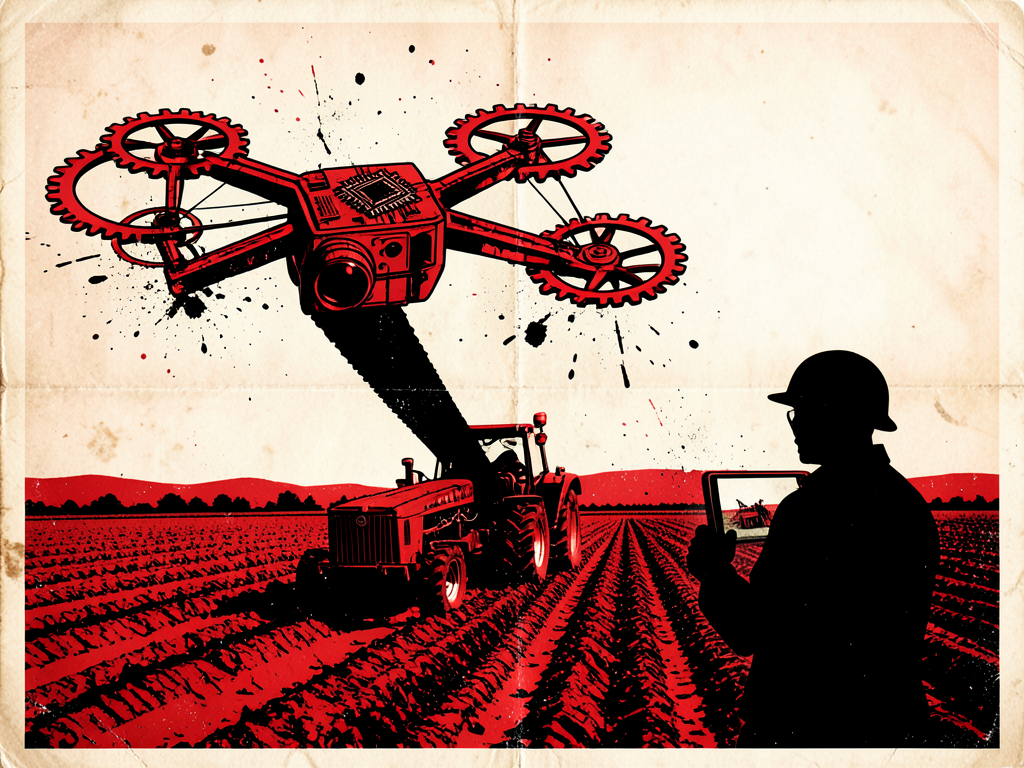
A coordinated narrative has emerged across multiple international outlets between April 18, 2026, and May 1, 2026, promoting the adoption of AI-driven robotic warfare by Ukrainian forces. Five articles in four countries advance a unified framing: Ukraine’s use of drones and autonomous systems is portrayed as heroic, innovative, and inevitable. The operation amplifies admiration for military technology while marginalizing ethical, legal, and geopolitical scrutiny.
Article Timeline
When articles appeared, colored by manipulation score.
Source Distribution
Narrative Architecture
The narrative constructs Ukraine as a high-tech battleground where necessity breeds innovation. Articles emphasize AI-enabled combat drones, unmanned ground vehicles, and automated fire systems as tools that mitigate Ukrainian troop losses and counter Russian numerical superiority. The framing equates technological sophistication with moral superiority—Ukraine fights smart, Russia relies on brute force.
Emotional levers include heroism, survival, and defiance. Machines are anthropomorphized as life-saving and courageous. Human stories center on wounded soldiers evacuated by robots or units spared from direct combat due to drone strikes. This sentimentalization redirects attention from civilian casualties, infrastructure destruction, or long-term implications of autonomous warfare.
Critical omissions define the narrative. No article identifies which foreign governments or defense contractors provide the AI systems. The role of NATO partners in testing battlefield AI under real combat conditions is absent. The potential for dual-use data collection—training Western military algorithms via Ukrainian operations—is not raised. Diplomatic alternatives, de-escalation, or ceasefire mechanisms are excluded from discussion. Technological deployment is presented not as a political choice but as an emergent inevitability.
The story arc follows a deterministic logic: war accelerates innovation, innovation wins battles, therefore war enables progress. This reframes military escalation as technological advancement, displacing accountability onto technological momentum.
Cross-Outlet Coordination Pattern
The articles follow a synchronized thematic structure despite geographic and editorial diversity. Al Jazeera, The Times of India, El País, The Jerusalem Post, and Radio New Zealand adopt overlapping framing conventions: emphasis on battlefield efficiency, celebration of Ukrainian tech ingenuity, normalization of machine-led operations, and minimal engagement with oversight or proliferation risks.
The Jerusalem Post and Times of India employ the most overt valorization, describing Ukraine’s campaign as a 'drone revolution' and 'reinvention of modern warfare.' Al Jazeera and RNZ use softer language but retain core components: AI as a response to necessity, robotic systems as life preservers, and technological adoption as irreversible.
El País stands out as non-ideological reporting, focusing narrowly on tactical utility without broader civilizational or normative claims. Its lower score reflects absence of emotional or political amplification.
Despite varied editorial postures, all but El País reinforce a shared operational pattern: positioning Ukraine as a proving ground for next-generation Western military AI. The uniformity of tone and omission suggests centralized narrative shaping, likely through defense-linked think tanks or official briefings distributed to embedded journalists.
Score Distribution
How articles in this PSYOP score across manipulation bands.
Technique Assessment
Significance
This messaging campaign advances the interests of the Western military-industrial complex and Ukrainian leadership by legitimizing battlefield AI under conditions of war. It accelerates procurement cycles, pressures neutral states to adopt or regulate, and desensitizes publics to autonomous killing systems. The normalization of AI warfare in Ukraine sets a precedent for global military adoption, with little democratic oversight or transparency on development pipelines.
PSYOP Hierarchy
Manipulation Profile
Average FATE dimensions across 76 articles in this PSYOP.