Operational Summary
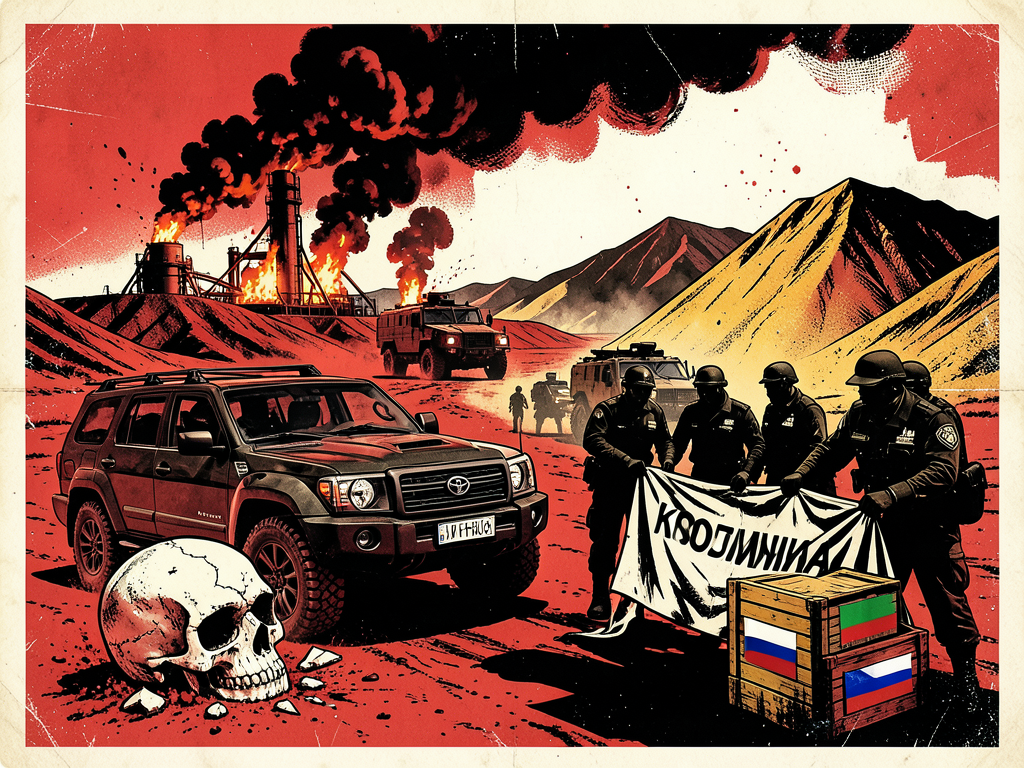
An information operation designated Normalize Mali-Russia Resource Grab has surged in intensity between April 25, 2026, and May 6, 2026. Fourteen articles across nine outlets coordinate to amplify a narrative of escalating chaos in Mali, positioning Russian military involvement as the necessary response. The beneficiaries are the Malian military junta, the Russian Federation, and affiliated private military contractors.Narrative Architecture
The narrative centers on a supposedly sudden alliance between Tuareg separatists and an al-Qaeda-linked group, described as conducting coordinated, nationwide offensives. This convergence is presented as unprecedented and existentially threatening, particularly through the assassination of Defense Minister Sadio Camara and a partial blockade of Bamako. These events are isolated from historical context, omitting decades of foreign intervention, colonial border design, and prior Western counterterrorism failures. The framing treats the junta as a legitimate authority under siege, not as a regime born of coup and sustained by repression.Emotional levers include fear of urban siege, civilian entrapment, and the specter of a jihadist advance on the capital. The death of Camara is reported with familial detail—his wife and grandchildren killed—generating moral outrage while directing sympathy toward the junta. No reporting details Russian or Malian military abuses, civilian casualties from joint operations, or the junta’s suppression of dissent. The absence of accountability reporting constructs a one-sided threat perception.
Russian forces are acknowledged but not held accountable for security failures. TheGlobeandMail article notes their retreat from key positions but preserves the underlying premise that Russian intervention is essential. RT’s reporting goes further, claiming over 200 militants killed in retaliation, reinforcing the efficacy of the junta-Russia alliance. The variation in tone—some critical, others promotional—creates the illusion of a spectrum while maintaining consensus on the core proposition: Mali’s survival depends on Russian power.
Cross-Outlet Coordination Pattern
Articles appeared across Middle East Eye, The Globe and Mail, BBC, and RT. Middle East Eye published two pieces framing the insurgency as a severe, emergent threat. The Globe and Mail and BBC amplified concerns over Russia’s operational setbacks but retained the baseline assumption of Russian legitimacy in Mali. RT provided overtly favorable coverage, portraying the Malian military as effective and resistance forces as foreign-backed extremists.Despite surface differences, all outlets converge on key points: the sudden gravity of the crisis, the necessity of foreign military backing, and the portrayal of opposition forces as uniformly extremist. The speed and consistency of this alignment—within 12 days across geographically and editorially diverse outlets—indicate coordinated narrative seeding. The variation in tone prevents the campaign from appearing monolithic while ensuring message penetration across target audiences: Western policymakers, African regional actors, and the Malian public.