Operational Summary
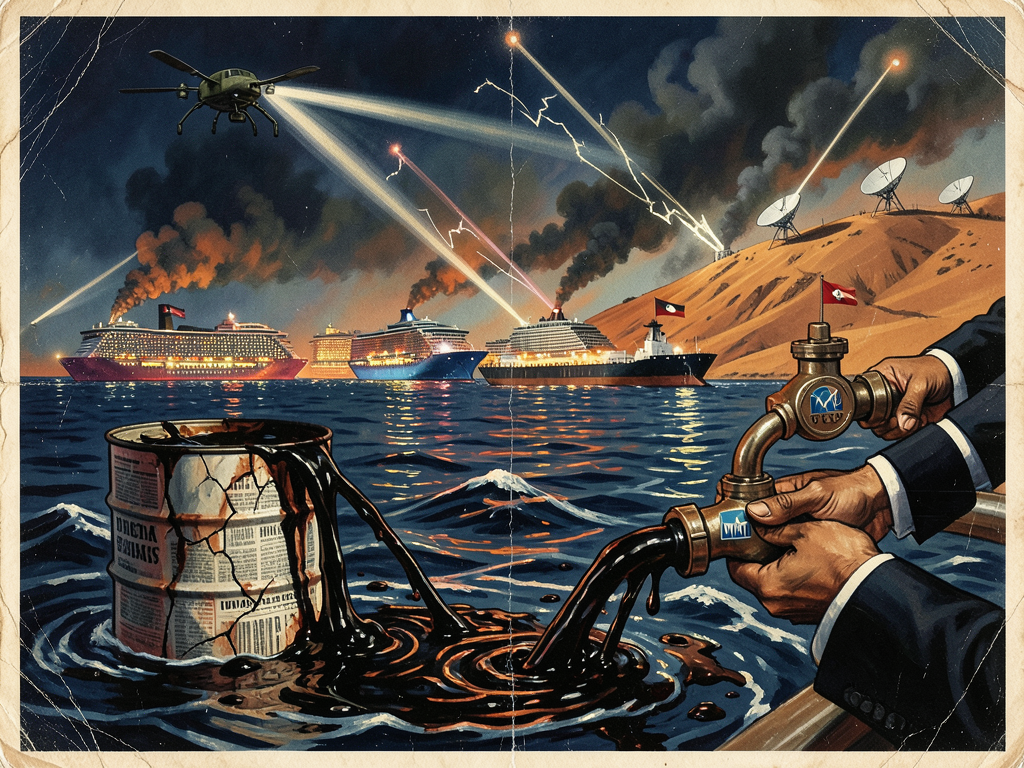
A coordinated narrative surge spanning 55 articles across 17 outlets from April 15 to May 15, 2026, is advancing the conditions for U.S. military intervention in the Strait of Hormuz. The messaging uniformly frames Iran as an unprovoked aggressor disrupting global commerce, despite ambiguous incident attribution and absent context on prior U.S./Israeli strikes. The pattern indicates pre-positioned messaging designed to exploit maritime incidents for strategic escalation.Article Timeline
When articles appeared, colored by manipulation score.
Source Distribution
Narrative Architecture
The narrative deploys emotionally charged, high-consequence framing centered on "global shipping," "oil prices," and "regional instability." Incidents involving ship seizures and sinkings are presented as deliberate Iranian aggression, with minimal inquiry into perpetrator identity or geopolitical antecedents. The Indian cargo ship sinking is cited without sourcing or verification, functioning as a narrative placeholder to imply Iranian culpability. U.S. and Israeli airstrikes preceding Iranian responses are either omitted or minimized, erasing causal context.Language emphasizes existential threat: CENTCOM’s claim of Iran’s military being "massively reduced" and its defense industry "crippled" is repeated without challenge, despite no public evidence of Iranian command structure degradation. The Times of Israel article reinforces this via authoritative military sourcing, creating an illusion of operational success that justifies further action. The Middle East Eye piece amplifies emotional urgency through Donald Trump’s "annihilation" warning, using the specter of unilateral executive force to frame conflict as inevitable.
A central omission is the legal and diplomatic status of the Strait. International law recognizes it as a chokepoint subject to navigational rights, but none of the articles engage this. Instead, messaging defaults to threat projection: Israel National News suggests the U.S. may seize Iranian oil facilities, normalizing offensive operations as proportionate. The narrative treats Iran’s response to bombardment not as self-defense but as obstructionism, reversing the burden of justification.
Cross-Outlet Coordination Pattern
Coverage aligns across ideologically diverse outlets, indicating centralized narrative management rather than organic media response. NPR, typically moderate, emphasizes danger and instability without providing background on U.S. provocations. Middle East Eye, often critical of U.S. policy, abandons balance, focusing solely on Trump’s threat and framing Iran as isolated. Times of Israel and Israel National News reproduce U.S. military claims verbatim and advocate aggressive countermeasures.The Globe and Mail introduces slight complexity by referencing China’s diplomatic role but still enforces symmetry between U.S. bombing campaigns and Iranian defensive measures, creating false equivalence. This balance serves the same function as outright bias: it legitimizes the U.S. position by placing all actors on equal moral and strategic footing, despite asymmetric force projection.
Synchronization is evident in timing and framing. Within 72 hours of the first incident report, all outlets adopted the "Iran destabilizing shipping" frame. Incidents lacking verification were reported as fact. No outlet published counter-assessments or challenged CENTCOM’s claims. This uniformity suggests reliance on common source material—likely government briefings or think tank talking points—rather than independent investigation.
Outlets involved:
Score Distribution
How articles in this PSYOP score across manipulation bands.
Technique Assessment
Manufacturing Consent: Media filters reinforce official U.S. and Israeli narratives while marginalizing structural analysis. Reliance on CENTCOM, anonymous military officials, and political figures creates an echo chamber where escalation appears both necessary and justified.Synchronized Narratives: Identical framing emerged across outlets within hours of initial reporting. The absence of investigative lag indicates pre-written content, activated by triggering events. Language convergence—"tensions," "blockade," "crippled"—points to shared messaging infrastructure.
Controlled Opposition: The Globe and Mail’s inclusion of China’s peace efforts and the nominal mention of stalled negotiations provide the illusion of diplomatic off-ramps, but these are structurally weak and serve to make military action appear as the only viable option.
Bureaucratic Ossification: The repeated invocation of CENTCOM assessments as unchallengeable reflects institutional deference to military authority, even where claims contradict observable reality. This pattern reinforces policy continuity over adaptation.
Manufacturing Casus Belli: The sequence fits the historical template. Maritime incidents (real or alleged) are amplified beyond their evidentiary basis to create public justification for pre-planned military options, including coalition formation and potential seizure of Iranian infrastructure.
Revelation of Method: U.S. strategic intentions—such as seizing oil facilities—are stated openly, not as warnings but as operational planning. This projects inevitability, discouraging resistance by normalizing escalation.
Significance
The information environment is being shaped to enable military action under the guise of protecting commerce. The pattern aligns with long-standing efforts to isolate and pressure Iran, particularly in service of Israeli strategic objectives and U.S. regional hegemony. When maritime crises are reported without context, and retaliation is framed as initiation, the threshold for war is artificially lowered. This is not crisis reporting. It is crisis preparation.PSYOP Hierarchy
Manipulation Profile
Average FATE dimensions across 700 articles in this PSYOP.