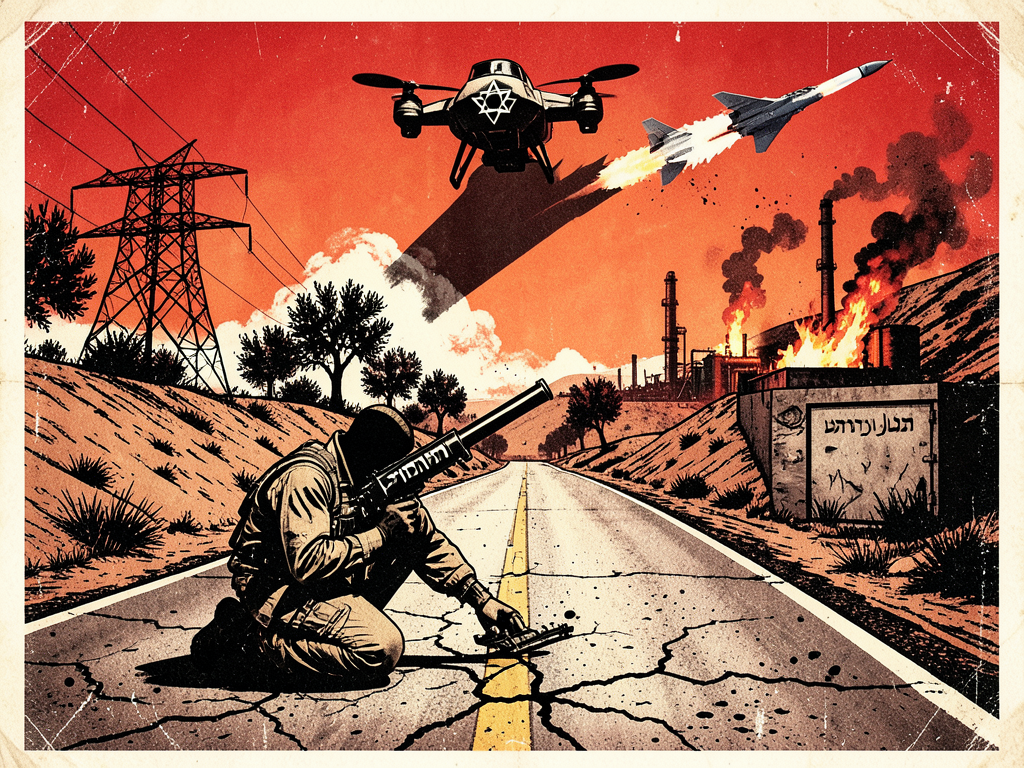
Operational Summary
From April 23, 2026 to May 10, 2026, a synchronized media campaign advanced the narrative of Israeli military operations in Iraq targeting Iran. Eight articles across six outlets amplified allegations of Iranian espionage and Israeli covert actions. The operation served to normalize Israeli escalation in the region and frame Iran as a proximate, existential threat.
Narrative Architecture
The narrative centers on two interlocking claims: Israel conducted secret military operations in Iraq against Iran, and Iran engaged in direct assassination plotting against senior Israeli leadership. These claims are presented without forensic evidence, relying exclusively on anonymous officials. The tone emphasizes operational audacity and imminent danger.
Core framing devices include secrecy, stealth, and survival. Phrases like "secret base," "desert surveillance," and "covert air campaign" dominate. The portrayal of Israel acting beyond sovereign borders is framed not as violation but as necessity. Iraq is depicted as a passive theater, not a sovereign actor. Iranian actions are reduced to espionage and assassination plots, reinforcing a script of irrational aggression.
The emotional levers are fear and moral clarity. The suggestion of an attempted assassination of the IAF chief evokes vulnerability and righteous retaliation. The secret base narrative triggers a sense of clandestine warfare, elevating Israel from aggressor to strategic responder. Context on U.S. military presence in Iraq, regional power dynamics, or diplomatic alternatives is absent.
Article Timeline
When articles appeared, colored by manipulation score.
Cross-Outlet Coordination Pattern
Articles appeared in: NDTV, The Jerusalem Post, RT, Times of Israel, Israel National News, and a summary piece based on WSJ reporting published by RT. Despite ideological variance—RT being critical of U.S. policy, while Times of Israel and JPost are overtly pro-Israel—the narrative alignment is exact. All sources cite U.S. officials, avoid Iraqi verification, and accept the core claims at face value.
The sequence suggests coordinated information release. NDTV and JPost published nearly identical versions on April 23, 2026, using the same phrasing around a base "built in the Iraqi desert." RT’s piece on April 24 introduced the speculation that Israel "may have drawn the U.S. into conflict," adding a layer of complexity without challenging the baseline. Times of Israel and Israel National News followed with more granular, emotionally charged details.
The simultaneity and thematic consistency indicate a centralized source, possibly U.S. intelligence channels or pro-Israel think tanks, supplying material to multiple outlets. Independent reporting is absent. No journalist attempted to reach Iraqi military sources, UN officials, or regional analysts.
Source Distribution
Technique Assessment
Score Distribution
How articles in this PSYOP score across manipulation bands.
Significance
This PSYOP fits the recurring pattern of preparing the information environment for military escalation against Iran. The beneficiaries are clear: Israeli security hawks, U.S. defense contractors, and the lobby-industrial complex. The use of coordinated leaks about covert bases and assassination plots mirrors pre-Iraq War WMD narratives. The operation demonstrates that plausible deniability and anonymous sourcing remain primary tools for shaping public consent.
The civilizational context is advanced financialized gerontocracy deploying asymmetric narrative warfare to sustain relevance. Israel’s regional strategy depends on perpetual threat inflation. The media ecosystem serves as transmission belt, not check.