Sources: 2 outlet(s) | Articles: 2 | First detected: March 4, 2026
Operational Summary
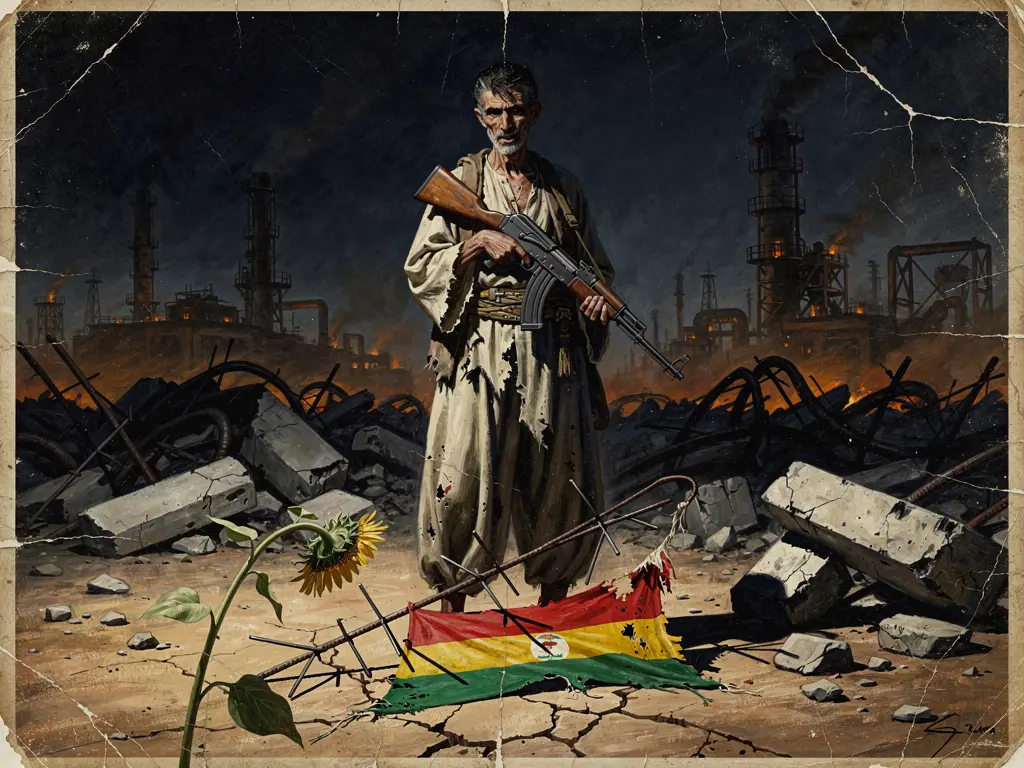
This PSYOP, designated 'Sell Kurdish proxy war,' aims to cultivate public support for a ground invasion of Iran utilizing Kurdish proxy forces. It seeks to normalize and legitimize the prospect of foreign-backed Kurdish military action against the Iranian regime, while strategically omitting critical geopolitical context and potential consequences. The operation was detected between March 4, 2026, and March 6, 2026, across at least two outlets, demonstrating coordinated narrative projection.PSYOP Hierarchy
Narrative Architecture
The core narrative presents Kurdish fighters as motivated and prepared to invade Iran, positioning this as a natural and justifiable development that warrants external support. The Israel Hayom article, "Kurds deny reports of ground assault into Iran," employs controlled opposition by 'denying' the assault while simultaneously detailing the alleged intentions and readiness of Kurdish rebels for conflict with Iran. This denial serves to introduce and amplify the very idea it purports to refute, subtly legitimizing the concept of a Kurdish-led ground offensive. The article leverages 'unnamed Kurdish sources' and 'exiled Kurdish researchers' speaking to an Israeli publication, framing Israel as a potential, even desired, patron. This aligns with the Lobby-Industrial Complex mechanism, where specific foreign interests influence media to advance their strategic objectives, in this case, by presenting Israeli support for an Iranian proxy war as a logical, even beneficial, outcome. The BBC article, "Iran war: Why the boots on Iran's ground could be Kurdish," directly advocates for this approach using emotionally charged language. It constructs an 'us-versus-them' dichotomy between Kurdish groups and the Iranian regime, appealing to emotional triggers to compel support for intervening via Kurdish proxies. Both narratives systematically omit critical context regarding the broader geopolitical ramifications of such an intervention, including potential regional destabilization, humanitarian crises, or the long-term impact on global power dynamics.Manipulation Profile
Average FATE dimensions across 3717 articles in this PSYOP.
FFocus
4.6/10
AAuthority
3.9/10
TTribe
4.8/10
EEmotion
5.5/10
Cross-Outlet Coordination Pattern
The rapid, near-simultaneous deployment of this narrative across distinct media outlets, including an Israeli newspaper ('israelhayom.com') and a major international news organization ('bbc.com'), indicates synchronized narrative management. The 'denial' from Israel Hayom, despite its ostensible refutation of an immediate ground assault, serves to introduce and normalize the concept of a Kurdish proxy war. The BBC then follows with a more overt emotional appeal for such an action. This phased introduction and amplification across different types of media outlets suggest a coordinated effort to shift the Overton Window, making the once-unthinkable idea of a Kurdish ground war against Iran appear within the realm of acceptable policy discussion. The alignment on framing, emphasizing Kurdish agency while positioning external support as beneficial, underscores this coordination. The PSYOP leverages the Myth-Making as State Formation mechanism by attempting to build a heroic narrative around Kurdish forces, justifying external intervention under the guise of supporting 'natural' local movements.Source Distribution
Article Timeline
When articles appeared, colored by manipulation score.
Technique Assessment
The PSYOP deploys several techniques to achieve its objective. Both articles engage in Manufacturing Casus Belli by generating narratives of impending conflict and framing Kurdish aspirations for territorial action against Iran as an organic, self-driven movement, rather than a potentially orchestrated proxy operation. This cultivates fertile ground for future pretexts for intervention. The Israel Hayom article's use of 'denial' functions as a sophisticated form of Revelation of Method, where the very act of dismissing a possibility serves to implant and entertain it, contributing to a sense of powerlessness or inevitability. The BBC article's reliance on 'strong emotional language and vivid imagery' combined with 'appeals to emotions like fear and shared values' exemplifies Attention Capture and Emotional Manipulation. This bypasses rational analysis to trigger knee-jerk support for a pre-determined policy outcome—namely, supporting Iranian Kurdish proxies. Both pieces exhibit a deliberate omission of crucial geopolitical context, a hallmark of narrative laundering. This selective presentation ensures that the audience's understanding is skewed toward endorsing intervention, without considering the full implications of Imperial Overextension or the potential for catastrophic blowback. The narratives fail to address the complexities of Civilizational Resistance inherent in Iran, which suggest that a Kurdish proxy war would face significant and prolonged opposition, contrary to the implied ease of such an operation.Significance
This PSYOP has significant implications for regional stability and the trajectory of US-Iranian relations, in line with the Eschatological Mobilization mechanism, particularly the Eschatological Endgame Scenario. The promotion of a Kurdish proxy war aligns with components of this scenario, specifically the potential for regional conflagration designed to destabilize Iran and advance the 'Greater Israel Project leading to Pax Judaica.' By portraying a Kurdish invasion of Iran as a 'natural and good idea,' the PSYOP actively works to normalize regional escalation and dismiss diplomatic alternatives, echoing the pattern of manufacturing consent for policies that serve specific, deeply entrenched geopolitical and eschatological objectives. The simultaneous deployment across outlets, leveraging both implied potential and direct emotional appeals, aims to shift public perception towards accepting military action against Iran, bypassing the American populace's historic aversion to new Middle Eastern conflicts. This campaign attempts to reframe military intervention as a local, indigenous movement, thus obscuring the external actor's role. The ultimate beneficiary of such a narrative is the power bloc that desires regime change in Tehran, utilizing the proxy war as a means to achieve a broader regional strategic realignment.Score Distribution
How articles in this PSYOP score across manipulation bands.
Clean
Low
Moderate
High
Severe
20