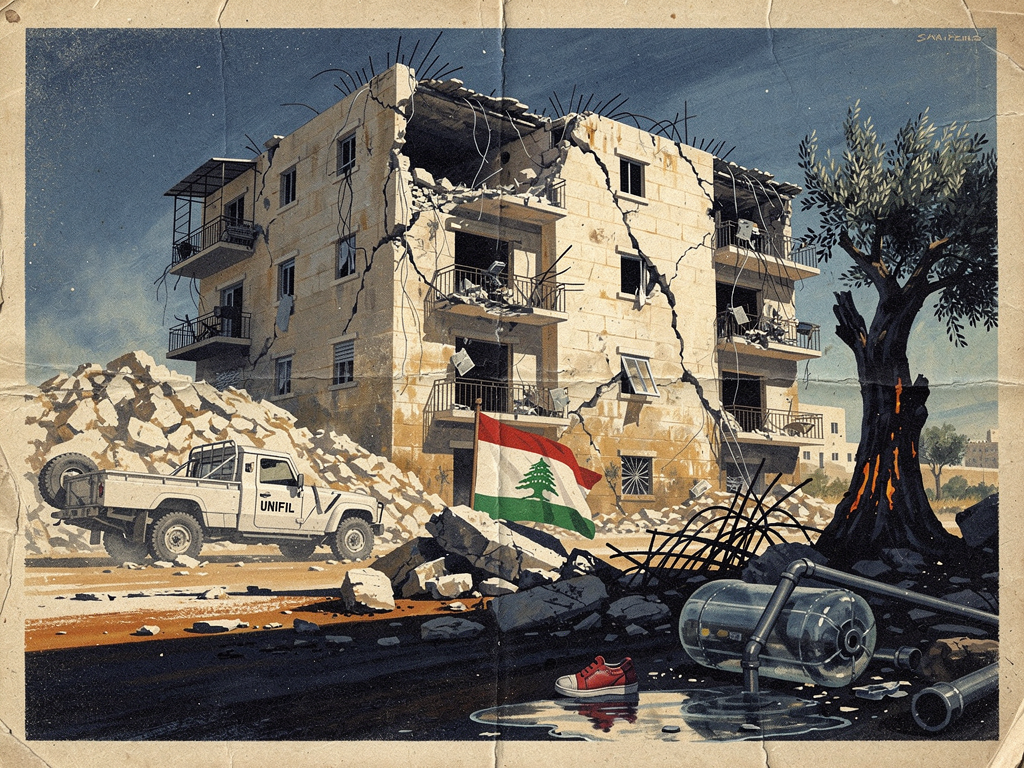
Operational Summary
A coordinated narrative has been detected across five articles in four outlets between April 14 and April 15, 2026, rebranding Israel’s military escalation in southern Lebanon as defensive and precise. The operation centers on the town of Bint Jbeil, where Israeli forces have expanded their presence under the justification of targeting Hezbollah infrastructure. The scale and timing indicate a deliberate effort to shape perception ahead of prolonged occupation.Article Timeline
When articles appeared, colored by manipulation score.
Narrative Architecture
The core framing positions Israel’s incursion as a necessary and measured response to Hezbollah rocket fire. Language emphasizes operational precision, defensive posture, and the exposure of terrorist infrastructure. IDF claims of eliminating over 1,400 militants and dismantling thousands of sites are repeated without independent verification. The narrative hinges on threat inflation: northern Israel is portrayed as under siege, justifying deep penetration into Lebanese territory.Civilian impacts are systematically omitted. No article reports on displacement, casualties, or humanitarian conditions in Bint Jbeil or surrounding areas. The legal status of a foreign military conducting operations inside Lebanon is not examined. Quotes from Israeli military and political leaders dominate sourcing. Hezbollah is uniformly labeled a terrorist organization with no contextual analysis of its political or social role in Lebanon. The emotional appeal rests on fear and victimhood—images of Israeli communities under rocket fire anchor the justification for escalation.
The concept of a buffer zone is introduced without critical engagement. "Pressure off Beirut" implies strategic necessity, reframing occupation as relief. There is no exploration of diplomatic alternatives, Lebanese sovereignty, or regional destabilization risks. The narrative relies on repetition of key terms—"terrorist infrastructure," "security threat," "defensive operation"—to reinforce legitimacy.
Cross-Outlet Coordination Pattern
Coverage appears across a mix of U.S. public media and explicitly pro-Israel outlets: npr.org, israelnationalnews.com, ynetnews.com, and israelhayom.com. NPR’s piece, while carrying more neutral language, still defaults to Israeli official sources and frames the operation as a response to Hezbollah actions. The other three outlets operate with minimal editorial distance from the IDF.israelnationalnews.com and israelhayom.com align in their portrayal of military success, using terms like "expose Hezbollah infrastructure" and "prepare for years in security zone." ynetnews.com amplifies casualty figures and operational progress. All three sources echo the same strategic logic: Hezbollah is embedded in civilian areas, necessitating ground operations. The emergence of identical framing across outlets with differing audiences suggests a unified narrative strategy. The clustering of publication dates—April 14 to 15—indicates synchronized release rather than organic news flow.
Source Distribution
Technique Assessment
Score Distribution
How articles in this PSYOP score across manipulation bands.