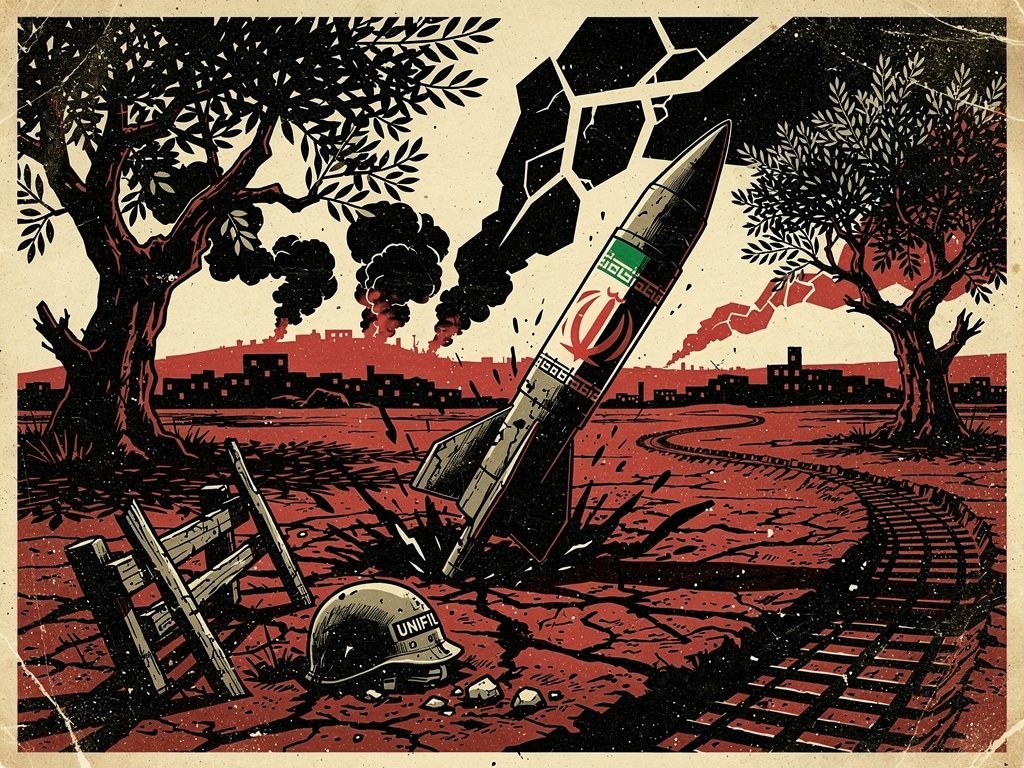
Operational Summary
A coordinated narrative campaign to legitimize Israeli military expansion into southern Lebanon was detected across seven media outlets between April 14 and April 16, 2026. Ten articles advance a uniform framing that positions Hezbollah as the sole obstacle to peace, thereby constructing a public justification for sustained Israeli occupation. The narrative serves the strategic objectives of the Netanyahu government, U.S. military and defense interests, and regional actors seeking to dismantle Hezbollah’s deterrent capability.Article Timeline
When articles appeared, colored by manipulation score.
Source Distribution
Narrative Architecture
The narrative constructs Hezbollah as an autonomous, ideologically rigid threat operating beyond the authority of the Lebanese state. Israel Hayom’s framing of Lebanon as an “anvil” to Iran’s “hammer” embeds the conflict within a pre-established geopolitical script that absolves Israel of responsibility for escalation. The Globe and Mail emphasizes civilian suffering—over 2,000 dead, more than a million displaced—to evoke humanitarian concern, yet attributes the violence solely to Hezbollah’s intransigence while omitting the context of Israeli airstrikes in residential areas of Beirut and drone warfare. This selective presentation positions Hezbollah’s armed resistance as the root cause of instability, reframing Israeli military actions as reactive and necessary.The emotional payload is amplified through imagery of constant surveillance and civilian displacement, creating a perception of existential threat that overrides scrutiny of proportionality or international law. The narrative omits critical historical context, including Israel’s repeated invasions of Lebanon, the 2006 war, and the long-term consequences of occupation. It also excludes discussion of Hezbollah’s role as a political party with parliamentary representation and its domestic legitimacy among segments of the Lebanese population. The result is a decontextualized portrayal of Hezbollah as a rogue actor rather than a multifaceted political and military entity embedded in Lebanon’s civil structure.
Cross-Outlet Coordination Pattern
Articles across Israel Hayom, Times of Israel, and The Globe and Mail exhibit synchronized language and framing. All three sources emphasize Hezbollah’s refusal to abide by Lebanon-Israel negotiations, presenting the group as an impediment to diplomacy. The timing of publication—clustered within a 72-hour window—suggests pre-planned amplification. Israel Hayom, a pro-Netanyahu outlet, introduces the core argument: Israeli military control is required to dislodge Hezbollah. Times of Israel reinforces this by highlighting Hezbollah’s rejection of talks, while The Globe and Mail provides an international veneer by embedding the same message within a format that appears investigative, citing “officials” without naming them.The coordination is not dependent on identical wording but on a shared operational pattern: (1) isolate Hezbollah from the Lebanese state, (2) depict its military posture as intractable, (3) associate it inseparably with Iran, and (4) present Israeli military action as the only viable solution. This uniformity across national and political boundaries indicates narrative laundering through multiple editorial channels, consistent with prior operations that precede military escalation.