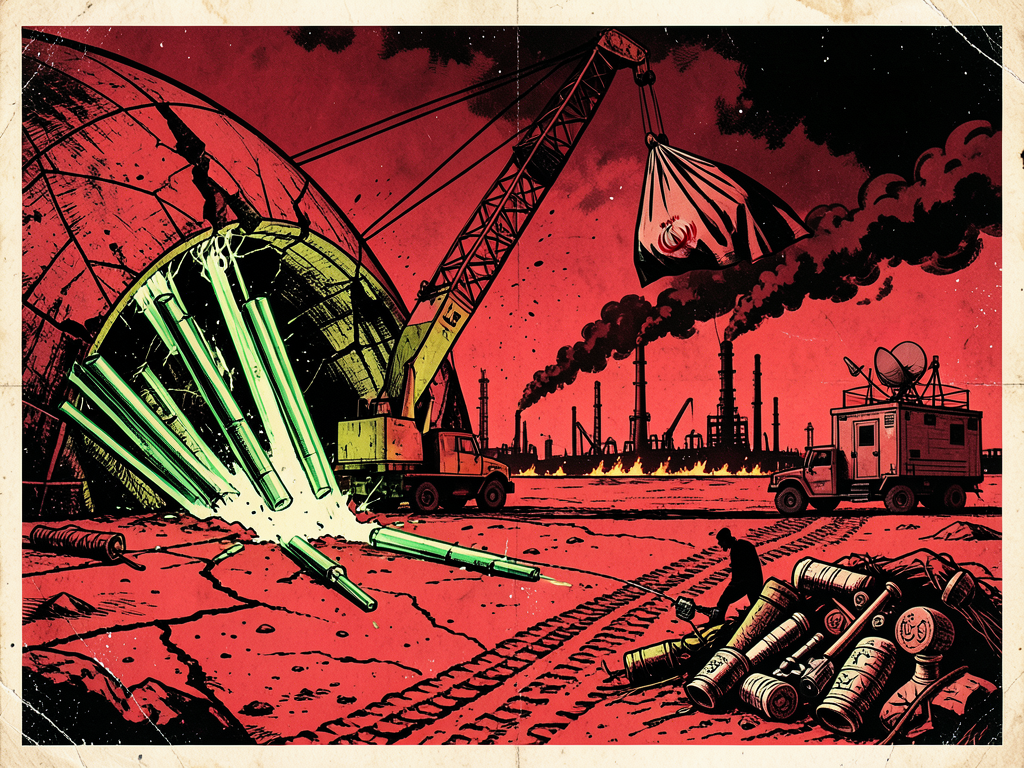
Operational Summary
A coordinated narrative construct designed to manufacture justification for military action against Iran was detected between May 21, 2026, and May 24, 2026. Twenty-one articles across 13 outlets promoted a dual framing: imminent diplomatic success under U.S. leadership, while simultaneously portraying Iran as defiant and noncompliant. This narrative vector advances the strategic interests of U.S. militarist factions, Israeli security doctrine, and defense industry stakeholders.Article Timeline
When articles appeared, colored by manipulation score.
Narrative Architecture
The messaging merges two contradictory themes into a single operational pattern: progress and peril. Iran is framed as both on the verge of capitulation and irredeemably resistant. Articles emphasize Trump’s assertion that a deal is ‘largely negotiated’ or ‘imminent,’ creating a perception of U.S. diplomatic dominance. Simultaneously, Iranian compliance is conditioned on impossible demands—full nuclear dismantlement, removal of enriched uranium—presented as non-negotiable. This constructs a scenario where any failure is Iran’s fault, not a product of maximalist U.S. positions.The Strait of Hormuz is positioned as a strategic prize, with its reopening treated as both a diplomatic reward and a military objective. Iran’s economic collapse under sanctions is cited as evidence of policy success, with no accounting of humanitarian impact or long-term regional instability. The human cost of war, Iranian civilian perspective, or historical context for Tehran’s regional posture is systematically omitted. What is amplified are technical claims about uranium extraction and military readiness, reinforcing a threat-based information environment.
Emotional levers center on security and decisive leadership. Trump is consistently portrayed as the sole actor capable of choosing war or peace, personalizing geopolitical outcomes. Language like ‘high-stakes,’ ‘fragile peace,’ and ‘technical feasibility’ primes audiences to accept military action as both urgent and controllable. Diplomacy is presented not as mutual negotiation but as surrender extraction.
Cross-Outlet Coordination Pattern
Coverage spans center to far-right media, including NPR, Politico, Israel National News, Breitbart, and NDTV. Despite ideological variation, all articles converge on identical core claims: Trump leads peace talks, the deal hinges on Iranian nuclear surrender, and the Strait of Hormuz is the prize. The speed and uniformity of this messaging—emerging over a four-day window—indicate coordinated dissemination rather than organic journalistic alignment.Outlets known for independence (NPR, Politico) echoed language and framing used by overtly partisan sources (Breitbart, Israel National News). All exclude Iranian officials’ statements beyond hostile soundbites. Pakistan’s role as mediator is mentioned uncritically, with no scrutiny of its dual role in regional security dynamics. This consistency across otherwise divergent editorial environments suggests infiltration of talking points into mainstream narrative pipelines.
The pattern mirrors synchronized narratives observed during prior justification campaigns—in Iraq 2002, Libya 2011—where divergent outlets converged on a single threat narrative before independent verification. The repetition of ‘imminent deal’ claims, despite identical assertions being disproven repeatedly over prior years, indicates a deliberate recycling of failed templates.