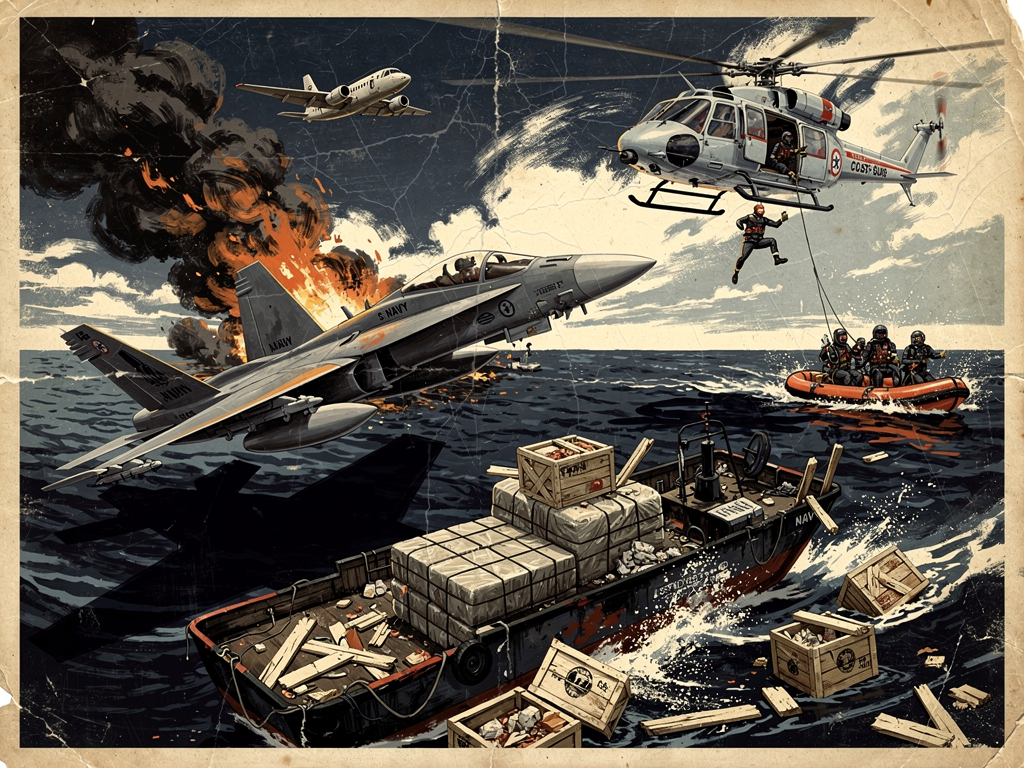
Operational Summary
A coordinated narrative operation has been detected normalizing extrajudicial lethal actions by the U.S. military in the eastern Pacific. The campaign, active from February 17, 2026 to April 17, 2026, focused on framing military strikes against maritime targets as legitimate responses to narco-terrorism. Five articles across The Guardian, CBS News, and Fox News served as primary vectors.
Narrative Architecture
The narrative relies on strategic framing of targets as 'narco-terrorists' without evidentiary support. This conflation merges the threat of terrorism with drug trafficking, invoking national security imperatives to justify lethal force. Official statements from U.S. Southern Command and the DEA are presented as self-evident, while questioning of legality is confined to isolated quotes from human rights groups or legal experts, positioned as secondary to operational claims.
Language is weaponized to dehumanize: bodies in the water are not individuals but components of a 'threat network.' Casualties are reported as numerical outcomes of 'successful interdictions,' not as potential unlawful killings. The absence of forensic detail—no recovered drugs, no vessel identification, no chain of command linking targets to cartels—is treated as irrelevant. The narrative implies operational necessity through repetition, not proof.
Emotional levers center on fear of drug infiltration and terrorism. The eastern Pacific is framed as a lawless zone requiring militarized response. There is no contextualization of regional fishing economies, no acknowledgment that small vessels may be engaged in subsistence activity. The target audience is the U.S. domestic public, conditioned to accept distant violence as inevitable and morally neutral when labeled counter-narcotics.
Cross-Outlet Coordination Pattern
The Guardian, CBS News, and Fox News all carried variants of the same core narrative within a seven-week window. While Fox News provides uncritical amplification—describing operations as 'precise' and 'justified'—The Guardian and CBS News include nominal skepticism, yet still foreground official claims and embed the term 'narco-terrorist' without challenge.
This tripartite alignment follows a classic pattern: one outlet (Fox) serves as overt advocate, two others (The Guardian, CBS) provide the illusion of balance by including dissenting voices while maintaining the narrative’s foundational assumptions. The result is a synchronized information environment where even critical reporting reinforces the legitimacy of the operation by accepting its basic premises.
All articles appear within hours or days of Pentagon press releases, indicating reliance on official feeds. No investigative follow-up is evident. No mapping of strike zones against known fishing routes, no interviews with regional maritime authorities, no attempt to verify the existence of recovered narcotics. The speed and similarity of framing suggest pre-existing editorial coordination or dependence on a shared source pool.
Technique Assessment
Source Distribution
Article Timeline
When articles appeared, colored by manipulation score.
Significance
This operation normalizes the use of lethal military force without due process or verifiable threat. It advances the institutional interests of U.S. Southern Command and the military-industrial complex by expanding the overseas kill matrix under a non-war designation. The pattern fits the broader shift toward permanent, unaccountable security operations outside declared conflict zones.