Legitimize Trump's Protectionism
This PSYOP aims to legitimize the Trump administration's protectionist trade policies, including tariffs and trade wars, by framing them as necessary for national security, economic fairness, or human rights. It benefits the Trump administration, specific American industries, and protectionist political factions by manufacturing public consent for these actions.
Executive Summary
Power Patterns
Manufacturing Casus Belli
The articles, particularly those from CBS News and CNBC, frame the tariffs on dozens of countries as a 'principled stand' against forced labor, effectively manufacturing a moral casus belli for economic aggression. This religious legitimation of power (using human rights as a moral shield) allows the administration to pursue protectionist policies that benefit specific industries (rent-seeking behavior) while presenting them as universally righteous rather than economically self-serving.
Cui Bono — Who Benefits?
The Trump administration benefits by fulfilling campaign promises, consolidating its base, and projecting an image of decisive action on the global stage. Protected industries benefit from reduced foreign competition. The narrative enables these actors to pursue protectionist policies with reduced public scrutiny and increased domestic support, by framing them as morally or defensively necessary rather than economically costly or arbitrary.
Historical Parallels
Iraqi WMDs (2002-2003)
Similar to the WMD narrative, the 'forced labor' justification for tariffs is presented as an urgent moral imperative, with little independent evidence provided or demanded by the amplifying media, creating a pretext for pre-planned economic action.
Manufacturing Casus Belli
The use of 'forced labor' claims against dozens of countries, often without specific evidence, mirrors historical instances where a convenient, emotionally charged pretext is manufactured to justify pre-decided actions, such as military interventions or economic sanctions.
Narrative Mechanics
Synchronized Talking Points
“Tariffs are a 'principled stand' against forced labor.”
“Tariffs are a 'justified response' to unfair trade practices or discrimination by other nations.”
“The administration is 'determined' or 'refuses to give up' on tariffs despite legal setbacks.”
“The tariffs are a 'strategic' or 'moral' stance.”
Framing Evolution
Initially, the narrative focused on Trump's general commitment to tariffs as an economic legacy (NPR). It then evolved to emphasize the 'forced labor' justification as a new, legally robust mechanism (CNBC, CBS News), and simultaneously presented tariffs on Canada and Brazil as responses to specific 'discrimination' or 'unfair practices' (NBC News, Al Jazeera). The shift highlights an adaptation to legal challenges and an attempt to broaden the moral and legal basis for protectionism.
Suppressed Counter-Narratives
×Independent verification of widespread forced labor in dozens of targeted countries.
×The economic costs of tariffs for American consumers and businesses.
×The retaliatory nature of many foreign tariffs as a direct response to prior U.S. actions.
×The potential for tariffs to disrupt global supply chains and foster international instability.
×Alternative, less confrontational approaches to addressing trade imbalances or labor concerns.
Outlet Coordination
Outlets like CNBC and CBS News push hardest on the 'principled stand' and 'justified response' framing, often quoting U.S. officials without critical scrutiny. For example, CBS News and CNBC (July 23-24) both highlight the 'forced labor' justification as a primary driver. NBC News and Al Jazeera, while reporting the facts, also include framing that leans towards justifying the U.S. actions by emphasizing foreign 'discrimination' or 'retaliation' without fully contextualizing the U.S. as the initial aggressor in many trade disputes. NPR's 'Trump refuses to give up on tariffs' frames it as an ideological commitment, while other CNBC articles like 'Trump revives his tariff playbook with Canada' present it as decisive action.
Bigger Picture
This PSYOP fits into a broader geopolitical landscape where economic nationalism and protectionism are on the rise, challenging the post-WWII liberal trade order. It signals a continued shift away from multilateral trade agreements towards unilateral economic coercion, potentially fragmenting global trade and supply chains. The endgame is to reassert American economic dominance through aggressive trade policies, even at the cost of international cooperation.
Prediction
This PSYOP is likely building toward public acceptance of a sustained period of protectionist trade policies, potentially including further tariff escalations and trade wars, framed as necessary for national security, economic fairness, or human rights. It prepares the public for the economic consequences of these actions by preemptively justifying them as righteous and unavoidable.
Intelligence Coverage
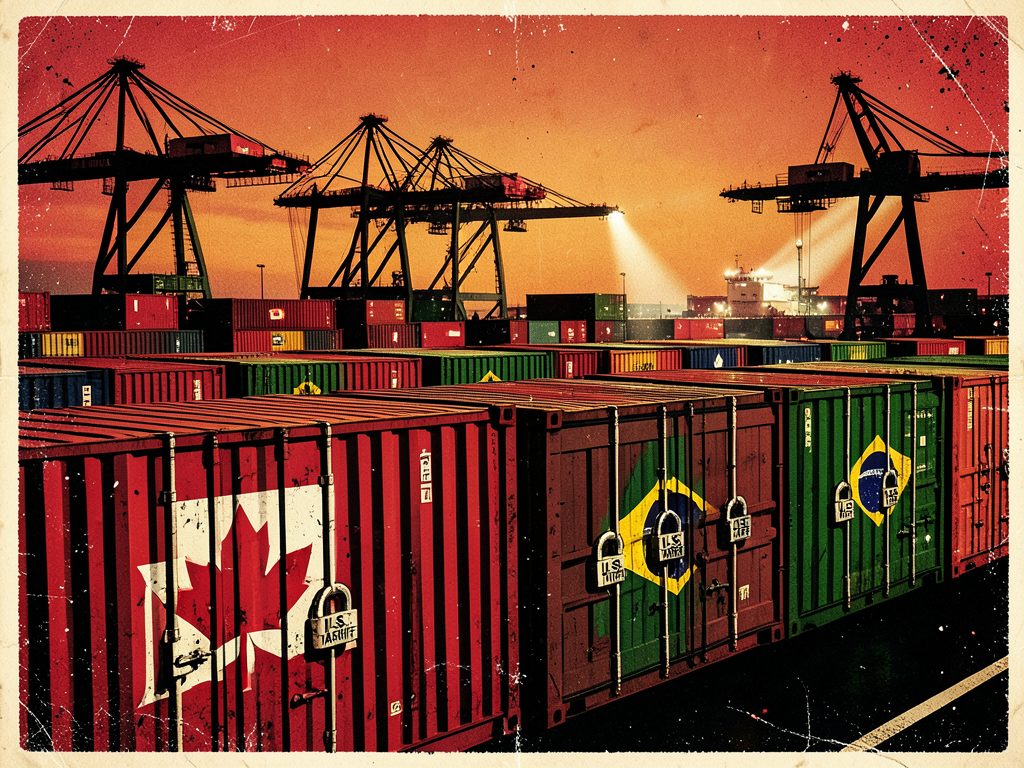
New US tariffs on Canada and Brazil are being framed as necessary and justified responses to trade disputes
On July 21–22, 2026, a spike in near-simultaneous reporting occurred across multiple outlets—CNBC, Al Jazeera, and NBC News—framing U.S. tariffs against Cana...
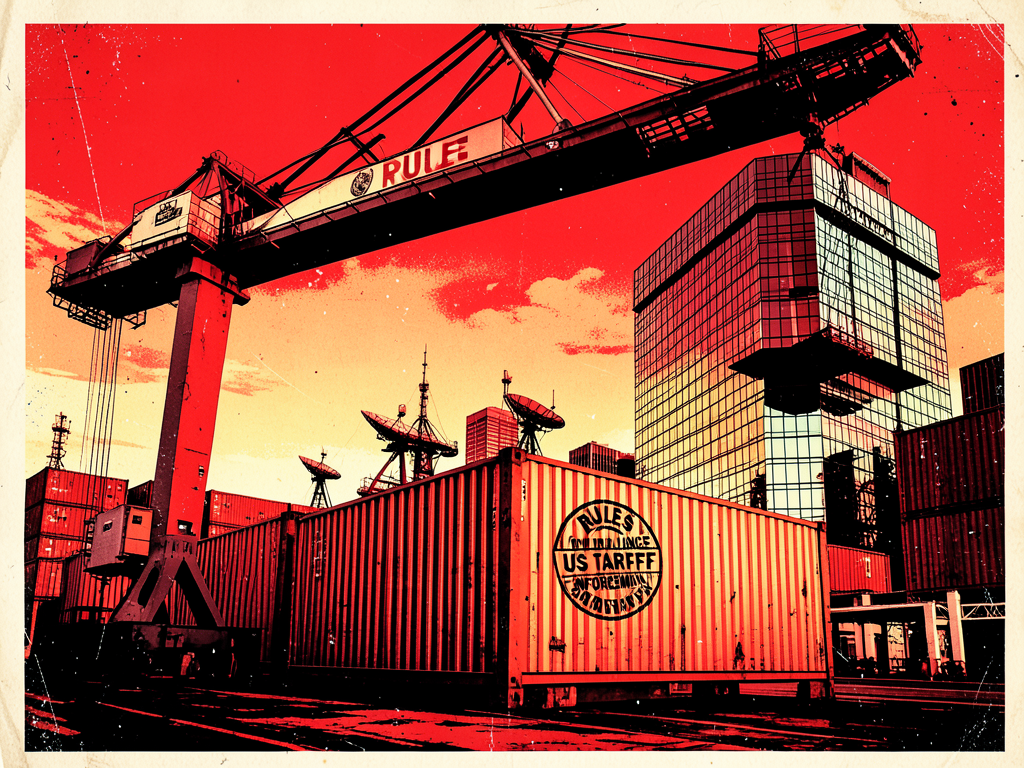
New US tariffs are being framed as rules-based responses to trade abuses
A coordinated narrative emerged on July 22, 2026, across three major outlets, normalizing U.S. tariff escalations against Canada and Brazil as legally justif...
Sources & Articles
2026-07-24T03:15:46.000Z
2026-07-23T21:05:15.000Z
2026-07-21T13:06:36.000Z
2026-07-20T21:00:39.000Z
2026-07-24T09:00:00.000Z
2026-07-21T10:31:34.000Z
2026-07-21T13:25:37.000Z
2026-07-21T15:54:13.000Z
2026-07-23T21:31:00.000Z
2026-07-20T21:42:42.658Z
Showing 10 of 14 articles